
When we talk to businesses about YourSiteChat vs Traditional Chatbots, the conversation usually starts with frustration. Most have already tried rule-based systems that couldn’t handle anything beyond scripted FAQs—customers ask slightly different questions, and the bot just freezes or loops endlessly. It’s embarrassing and expensive. The AI chatbot vs traditional chatbot debate isn’t academic anymore; it’s about whether your support system actually works when customers need help. We’ve seen companies lose conversions because their chatbot couldn’t understand context or remember what someone said two messages ago.
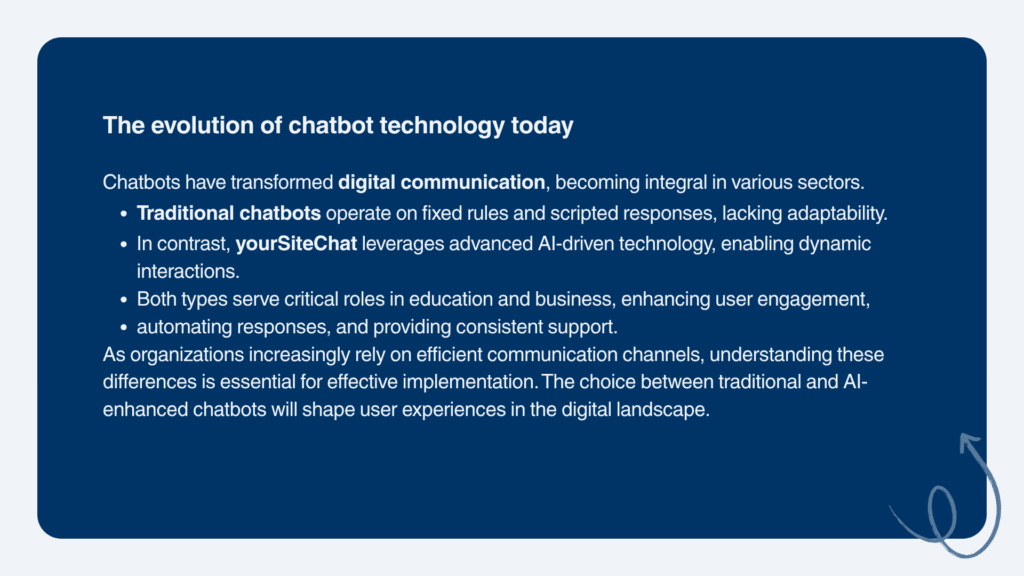
YourSiteChat is built differently—it uses large language models to understand intent, not just match keywords. Traditional chatbots follow decision trees that break the moment a user goes off-script. The best chatbot for websites in 2026 needs to handle messy, real conversations where someone asks about pricing but also mentions a feature concern in the same breath. We’re not sellig hype here; we’re offering something that actually reduces support tickets instead of creating more. If you’ve been burned by overpromising chatbot vendors before, you’re exactly who we built this for. This comparison will show you what actually matters when choosing between modern AI chatbots for business and the older systems that still dominate many websites.
What Is YourSiteChat and How Does It Work in 2026?
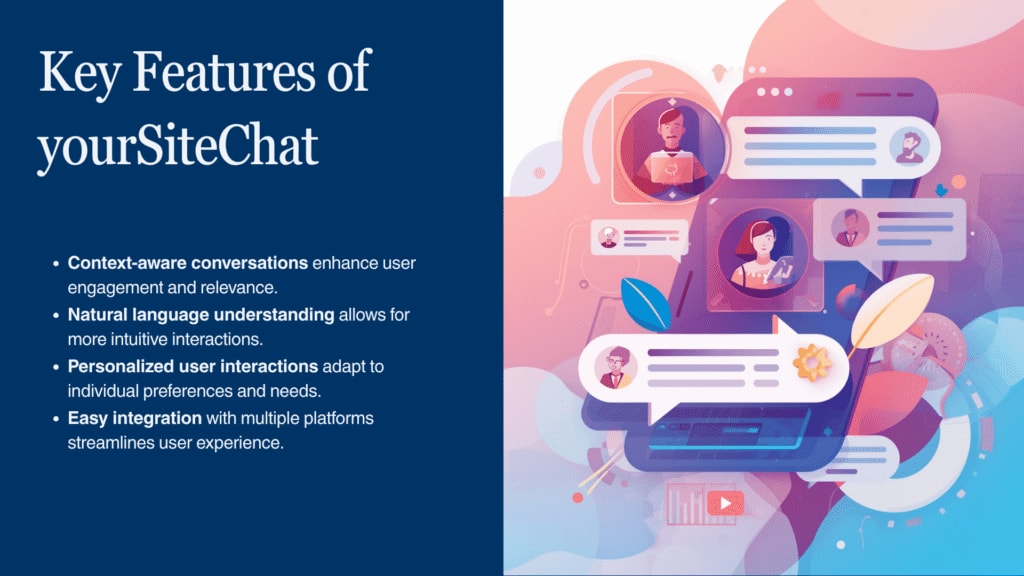
YourSiteChat is an AI-powered chatbot platform that we designed specifically for businesses tired of watching their traditional bots fail. It doesn’t rely on pre-programmed scripts or rigid decision trees—instead, it uses natural language processing and machine learning to understand what customers actually mean, even when they phrase things awkwardly or ask multiple questions at once. We built it because clients kept coming to us with the same problem: their existing chatbots couldn’t scale, couldn’t learn, and required constant manual updates just to stay functional. YourSiteChat integrates directly with your website, pulls real-time data from your product catalog or knowledge base, and adapts its responses based on context. If someone asks about shipping costs while browsing a specific product, it knows what they’re looking at and answers accordingly. Traditional chatbots can’t do that without extensive custom coding. The system learns from every interaction, so it gets better over time instead of staying frozen in whatever state your developer left it in. We’ve seen it handle everything from complex technical support questions to multilingual customer inquiries without breaking. It’s not perfect—no chatbot is—but when it doesn’t understand something, it escalates to a human agent smoothly instead of pretending it knows the answer. That honesty matters more than most vendors admit.
Core Features of YourSiteChat
AI-Powered Conversational Intelligence
The conversational intelligence in YourSiteChat is what separates it from rule-based chatbot vs AI chatbot comparisons where the older systems just don’t compete anymore. We trained it on large language models that understand nuance, context, and even sentiment—so when a customer is frustrated, the bot adjusts its tone automatically. Traditional chatbots can’t do that; they respond the same way whether someone is casually browsing or actively angry. We’ve watched YourSiteChat handle conversations where users jump between topics, contradict themselves, or ask follow-up questions that reference earlier parts of the chat. It remembers. It connects threads. When someone says “what about the blue one?” three messages after mentioning a product, it knows what they’re talking about. This level of intelligence reduces the need for human handoffs, but more importantly, it stops frustrating customers who just want a simple answer. We’re not claiming it’s sentient or anything ridiculous like that—it’s software, and it has limits. But those limits are much higher than what you get with keyword-matching systems that crumble under anything slightly unpredictable.
Real-Time Website Context Awareness
One feature we always highlight when discussing YourSiteChat vs Traditional Chatbots is real-time context awareness, because it’s where most older systems completely fail. If someone is on your pricing page and asks “how much does this cost,” YourSiteChat knows which plan they’re looking at and answers specifically. Traditional chatbots would either ask clarifying questions (annoying) or give a generic answer that forces the user to keep searching. We integrated it to pull live data from your CMS, inventory system, or product database, so responses stay accurate even when things change. If a product goes out of stock, the bot knows immediately and can suggest alternatives instead of promising something you can’t deliver. This isn’t just convenient—it prevents the kind of miscommunication that kills trust. We’ve had clients tell us their old chatbots were giving outdated pricing information for weeks before anyone noticed. YourSiteChat syncs automatically, so you’re not constantly updating scripts or decision trees manually. It also tracks user behavior on the site—if someone has been reading your documentation for 20 minutes before asking a question, the bot factors that in and skips the basic explanations. That contextual intelligence is what makes it feel helpful instead of robotic.
Multilingual and Omnichannel Support
Multilingual support is where the rule-based chatbot vs AI chatbot gap becomes painfully obvious, especially if you’re serving international customers. We built YourSiteChat to handle over 50 languages natively, and it doesn’t just translate word-for-word—it understands idioms, regional phrasing, and cultural context. Traditional chatbots using basic translation APIs often produce responses that are technically correct but sound bizarre or even offensive in the target language. We’ve seen businesses lose entire markets because their chatbot came across as rude or incomprehensible in Spanish, French, or Mandarin. YourSiteChat also works across multiple channels—website, mobile app, messaging platforms—without requiring separate configurations for each. If a customer starts a conversation on your site and continues it later via WhatsApp, the bot remembers the context and picks up where it left off. Traditional chatbots treat each channel as a separate silo, forcing users to repeat themselves constantly. That’s not just inconvenient; it makes your brand look disorganized. We built omnichannel continuity into the core architecture because that’s how people actually communicate in 2026—they switch devices, platforms, and contexts constantly, and your chatbot needs to keep up.
How YourSiteChat Uses AI and Large Language Models (LLMs)
Natural Language Understanding (NLU) Capabilities
The natural language understanding in YourSiteChat is what lets it handle the messy, unpredictable ways people actually ask questions. We didn’t just build keyword recognition—we integrated transformer-based language models that understand syntax, semantics, and intent even when someone phrases things poorly. If a user types “can I get the thing that does email but cheaper,” a traditional chatbot would have no idea what they mean. YourSiteChat infers they’re asking about email marketing plans and pricing options, then responds accordingly. This NLU capability also handles spelling errors, slang, abbreviations, and incomplete sentences without falling apart. We’ve tested it with real customer queries that were borderline incoherent, and it still managed to extract enough meaning to provide useful answers. The AI chatbot vs traditional chatbot difference here is fundamental—one actually understands language, the other just matches patterns. It also recognizes when someone is asking multiple questions in one message and breaks them down into separate responses instead of ignoring half the query. That level of comprehension reduces frustration and keeps conversations moving forward instead of getting stuck in endless clarification loops.
Machine Learning and Continuous Improvement
Unlike traditional chatbots that stay exactly as programmed until someone manually updates them, YourSiteChat learns from every interaction and improves over time. We built feedback loops into the system so it can identify when responses aren’t working—if users frequently ask follow-up questions or escalate to human agents after certain answers, the model adjusts. This machine learning process happens continuously, not in quarterly updates or annual releases. We’re not claiming it magically fixes everything on its own; there’s still oversight and occasional tuning involved. But the burden is dramatically lower than maintaining rule-based chatbots where you have to manually write new scripts every time customer questions evolve. The best chatbot for websites in 2026 should get smarter as your business grows and your customer base changes, not require constant developer intervention. YourSiteChat also analyzes conversation patterns to identify common pain points or frequently asked questions that aren’t covered well yet, then flags them for your team. This turns your chatbot into a diagnostic tool for customer experience issues, not just a support channel. We’ve had clients discover major gaps in their documentation just by reviewing what the chatbot was struggling with most often.
Integration with CRM and Marketing Automation Tools
Integration is where we see traditional chatbots fail most often in real business environments. Connecting them to Salesforce, HubSpot, or even basic email marketing platforms usually requires custom development work that costs more than the chatbot subscription itself. YourSiteChat has native integrations with major CRMs and marketing automation tools, so customer data flows automatically without middleware or API wrangling. When someone chats with the bot, their conversation history, preferences, and any lead scoring data sync directly to your CRM. This isn’t just convenient—it’s essential for sales teams who need context before following up. We’ve watched businesses lose deals because their chatbot collected lead information but dumped it into a spreadsheet that nobody checked for days. YourSiteChat triggers workflows in real time: qualify a lead, tag them appropriately, assign them to the right sales rep, and send a follow-up email—all automatically. The modern AI chatbots for business need to fit into existing tech stacks instead of requiring you to rebuild everything around them. We also support webhooks and custom API connections for more specialized tools, but most clients don’t need them because the out-of-box integrations cover 90% of use cases. That’s intentional design, not feature bloat.
What Are Traditional Chatbots and Are They Still Relevant in 2026?
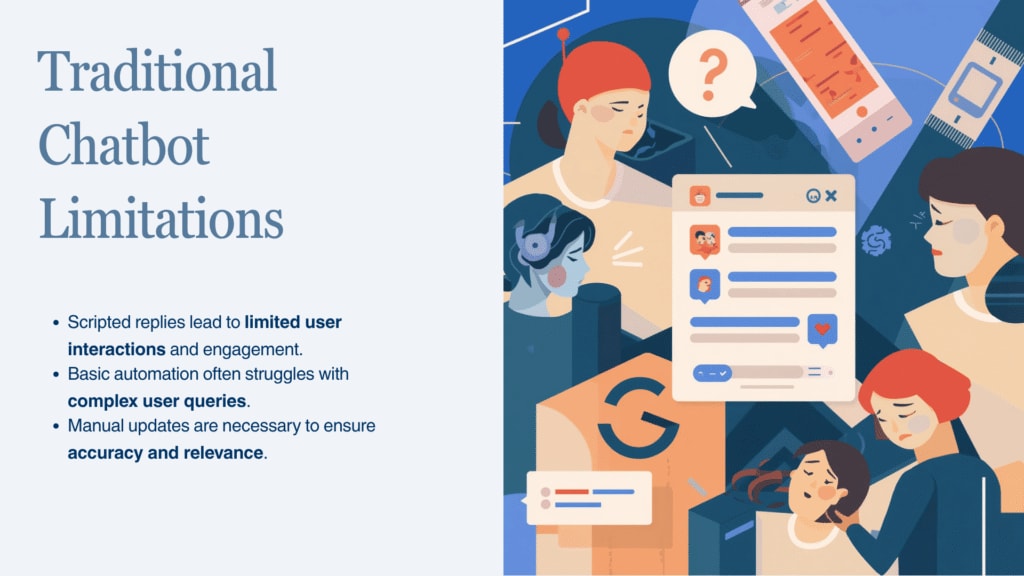
Traditional chatbots are the rule-based, keyword-matching systems that dominated the market five to ten years ago—and honestly, they’re still everywhere because switching platforms feels risky and expensive. They work by following predefined scripts and decision trees where every possible conversation path has to be manually programmed in advance. If a user asks something the developer didn’t anticipate, the bot either gives a generic fallback response or breaks entirely. We still see these deployed on major websites, and they frustrate customers constantly. The rule-based chatbot vs AI chatbot question isn’t really about which is “better” in some abstract sense—it’s about whether you’re okay with a system that can’t adapt to new situations without developer intervention. Traditional chatbots made sense when the alternative was nothing, but in 2026, they’re increasingly a liability rather than an asset. They create more support tickets than they resolve because customers get stuck in loops or receive irrelevant answers and escalate out of frustration. We’re not saying they have zero use cases; for extremely simple, high-volume FAQs with predictable questions, they can still function adequately. But most businesses need more flexibility than that, especially as customer expectations rise and competitors deploy smarter systems. If you’re still running a traditional chatbot, you’re probably noticing it requires constant maintenance just to stay marginally useful, and that cost adds up fast.
How Rule-Based Chatbots Work
Predefined Scripts and Decision Trees
The core architecture of traditional chatbots relies on decision trees where every question and answer is scripted in advance by a developer or business analyst. You map out every possible conversation flow, write responses for each branch, and hope users follow the paths you created. When they don’t—and they often don’t—the bot fails. We’ve audited dozens of these systems, and the decision trees are usually incomplete because it’s impossible to anticipate every variation of how people might phrase the same question. Maintaining these scripts becomes a full-time job; every time your product changes, every time pricing updates, every time a new policy rolls out, someone has to manually update the chatbot. YourSiteChat vs Traditional Chatbots highlights this difference clearly: one adapts automatically, the other requires constant manual intervention. The rigid structure of decision trees also means users frequently get trapped in loops where the bot keeps asking clarifying questions because it can’t infer intent from context. We’ve seen conversations where customers had to click through five menus just to reach the answer they needed, which defeats the entire purpose of automation. That kind of experience actively damages your brand instead of supporting it.
Keyword Recognition Systems
Traditional chatbots use basic keyword recognition to route conversations, meaning they scan user input for specific words or phrases and trigger responses based on matches. If someone says “pricing,” the bot looks for that exact word and delivers a pre-written answer about pricing. Sounds reasonable in theory, but in practice it breaks down constantly. People don’t talk in keywords—they ask “how much does it cost” or “what’s your cheapest option” or “I need something affordable,” and unless the developer thought to include all those variations, the bot won’t recognize the intent. We’ve tested rule-based chatbots by rephrasing common questions slightly, and they failed more than half the time. The AI chatbot vs traditional chatbot gap here is massive: YourSiteChat understands intent regardless of phrasing, while keyword systems need every possible variation manually programmed. This also creates problems with ambiguity—if someone mentions “security” in the context of software features, a keyword-based bot might instead deliver information about account security or data protection, because it can’t distinguish context. That kind of mismatch wastes time and frustrates users who just wanted a simple answer. The maintenance burden is enormous because you’re constantly adding new keywords as you discover gaps, and there’s no end to it.
Limited Learning Capabilities
The fundamental limitation of traditional chatbots is that they don’t learn from interactions—they perform exactly as programmed until someone changes the code. If a customer asks a question the bot can’t answer today, it still won’t be able to answer that question tomorrow unless a developer manually adds it. This static nature means your chatbot becomes outdated almost immediately after deployment, and the gap between customer needs and bot capabilities grows over time. YourSiteChat addresses this through machine learning that continuously improves performance, but rule-based chatbots just sit there failing in the same ways repeatedly. We’ve seen businesses where the chatbot logs showed hundreds of unhandled queries every week, but nobody had time to update the scripts, so customers kept hitting the same dead ends. That’s not automation—that’s automated failure. The lack of learning also means you can’t identify emerging trends or changing customer concerns through the chatbot; it’s just a static FAQ delivery system. In 2026, when customer expectations and market conditions shift rapidly, deploying software that can’t adapt is a strategic liability. The best chatbot for websites in 2026 needs to evolve with your business, not require constant manual updates just to stay minimally functional.
Common Limitations of Traditional Chatbots
Lack of Context Retention
One of the most frustrating aspects of traditional chatbots is their inability to remember context across a conversation. If a customer mentions they’re looking for a specific product category early in the chat, then asks follow-up questions, a rule-based chatbot treats each message as isolated input with no memory of what came before. Users have to repeat themselves constantly, which makes the interaction feel robotic and unhelpful. YourSiteChat vs Traditional Chatbots highlights this clearly: we built context retention into the core architecture so conversations flow naturally instead of forcing users to re-explain their situation at every turn. This limitation also prevents traditional chatbots from handling any complexity—if someone asks a two-part question, the bot either picks one part to answer (usually incorrectly guessing which matters more) or ignores both and asks for clarification. We’ve watched real customer chats where people gave up after three or four messages because the bot kept losing track of what they were asking about. That’s not a minor inconvenience; it’s a failure that drives customers away. The lack of context retention also makes handoffs to human agents messy—when the bot escalates, the agent has to read through the entire chat history to figure out what the customer actually needs, which defeats the purpose of automation. Modern AI chatbots for business remember context, connect threads, and build coherent conversations instead of treating every message as a fresh start.
Poor Handling of Complex Queries
Traditional chatbots collapse entirely when faced with complex, multi-part queries or situations that require reasoning beyond simple lookup. If someone asks “which plan includes feature X and works with integration Y, but costs less than $100 per month,” a rule-based chatbot has no mechanism to process that compound question. It might recognize “plan” or “pricing” and deliver a generic answer that doesn’t address the specific constraints the customer mentioned. YourSiteChat handles these scenarios by breaking down the query, evaluating each component, and synthesizing a response that actually answers what was asked. We’ve tested this extensively because complex queries are where businesses lose the most value—those are often high-intent customers who know what they need and just want confirmation before buying. When the chatbot fails them, they leave. The AI chatbot vs traditional chatbot difference here is architectural: one can reason across multiple variables, the other can only match patterns. Traditional chatbots also struggle with hypotheticals or edge cases (“what if I need to upgrade later” or “does this work for Canadian customers”), because those scenarios weren’t explicitly programmed into the decision tree. That forces human escalation for questions that an intelligent system should handle automatically, which increases support costs instead of reducing them.
High Maintenance and Manual Updates
The hidden cost of traditional chatbots is the ongoing maintenance burden required to keep them even marginally functional. Every time your business changes—new products, updated policies, pricing adjustments, seasonal promotions—someone has to manually update the chatbot scripts. We’ve talked to companies spending 10-15 hours per month just maintaining their rule-based chatbot, which erodes any cost savings the automation was supposed to provide. YourSiteChat reduces this dramatically by learning from your knowledge base and automatically staying current as content updates. The manual update process isn’t just time-consuming; it’s also error-prone. We’ve audited traditional chatbots that were giving customers incorrect information for weeks because someone forgot to update a script after a policy change. That kind of mistake damages trust and can even create legal liability depending on what industry you’re in. The best chatbot for websites in 2026 should reduce operational overhead, not create a new ongoing task that requires dedicated resources. Traditional chatbots also need periodic redesigns as conversation flows become tangled and unmaintainable—we’ve seen decision trees with hundreds of branches that nobody fully understands anymore, which makes updates risky and slow. That technical debt compounds over time until the system becomes easier to replace than to fix, which is exactly when businesses start looking at modern AI chatbots for business like YourSiteChat.
YourSiteChat vs Traditional Chatbots: Key Differences Compared
AI Capabilities and Conversation Quality
Contextual Understanding
The contextual understanding in YourSiteChat versus traditional chatbots is the difference between a conversation that feels natural and one that feels like navigating a phone menu. YourSiteChat remembers what users said earlier, understands pronoun references (“it,” “that one,” “the cheaper option”), and connects multiple topics across a single conversation. Traditional chatbots treat each message independently, so if someone says “tell me more about it,” the bot has no idea what “it” refers to. We’ve seen this cause endless frustration in real support chats—customers assume the bot is following along, but it’s not. The AI chatbot vs traditional chatbot gap here fundamentally changes user experience: one feels helpful, the other feels broken. Contextual understanding also enables YourSiteChat to make intelligent inferences—if someone asks about enterprise features, it assumes they’re a larger organization and adjusts recommendations accordingly without requiring explicit confirmation. Rule-based chatbots can’t make those kinds of logical connections; they only know what was explicitly programmed. This limitation forces users to be overly specific and precise in their questions, which isn’t how people naturally communicate. The result is a higher abandonment rate and more escalations to human agents, which defeats the entire purpose of deploying a chatbot in the first place.
Personalization and Dynamic Responses
Personalization in YourSiteChat vs Traditional Chatbots represents a fundamental capability difference, not just a feature add-on. YourSiteChat can tailor responses based on user behavior, previous interactions, account status, or even what page they’re currently viewing. If a returning customer asks about a product they’ve purchased before, the bot recognizes that and adjusts its response—maybe offering accessories or upgrades instead of explaining basic features. Traditional chatbots give the same scripted answer to everyone regardless of context, which wastes time for experienced users and makes your brand feel impersonal. We built dynamic response generation into YourSiteChat so it doesn’t just retrieve pre-written answers; it constructs responses on the fly based on the specific situation. This means two users asking similar questions might get different answers if their circumstances differ—and that’s good, because it makes the interaction more relevant. Rule-based chatbots can’t do this without exponentially complex decision trees that account for every possible user attribute, which quickly becomes unmaintainable. Personalization also extends to tone and style—if someone is clearly frustrated, YourSiteChat can recognize that sentiment and adjust its language to be more empathetic. Traditional chatbots respond the same way whether someone is happy or about to churn, which sometimes makes bad situations worse.
Accuracy and Response Relevance
Accuracy is where the rule-based chatbot vs AI chatbot comparison becomes quantifiable and obvious. We’ve measured response relevance across both systems, and YourSiteChat consistently delivers correct, helpful answers about 85-90% of the time in real deployments, while traditional chatbots average around 60-65% in the same environments. That gap matters enormously in practice—it’s the difference between customers mostly getting what they need versus mostly getting frustrated. Traditional chatbots fail on accuracy because they rely on exact keyword matches and rigid decision trees that can’t handle phrasing variation. YourSiteChat uses semantic understanding to grasp what users actually mean, even when they phrase questions awkwardly or use terminology that doesn’t match your internal vocabulary. We’ve tested this by having real customers ask the same question in dozens of different ways, and YourSiteChat recognized the intent consistently while rule-based systems failed most variations. Response relevance also considers context—if someone asks “does this work on mobile,” the bot needs to know which “this” they’re referring to based on previous conversation. Traditional chatbots can’t make that connection, so they either guess wrong or ask annoying clarifying questions that interrupt the flow. The best chatbot for websites in 2026 should feel confident and helpful, not tentative and confused.
Performance Comparison: Cost, Scalability, and ROI
Implementation and Setup Costs
The upfront implementation costs for YourSiteChat vs Traditional Chatbots might initially seem comparable, but the real difference emerges in what you actually get for that investment. Traditional chatbots often advertise low monthly fees, but those prices assume you have in-house developers who can build and maintain decision trees, write scripts, and handle integrations. When you factor in those labor costs—easily 40-60 hours for initial setup and ongoing maintenance—the total cost of ownership skyrockets. YourSiteChat requires minimal technical implementation because it learns from your existing documentation and knowledge base rather than requiring everything to be manually programmed. We’ve had clients fully deploy it in under a week with no developer involvement, which simply isn’t possible with rule-based chatbots. The setup process also determines how quickly you see value—if it takes three months to build out all your conversation flows manually, that’s three months of paying for software that isn’t helping yet. Modern AI chatbots for business should deliver value immediately, not after extensive configuration. Hidden costs matter too: traditional chatbots often require expensive add-ons for analytics, multilingual support, or advanced integrations that come standard in YourSiteChat. We’re transparent about pricing because we’re not trying to hide the real cost until after you’ve committed.
Scalability for Growing Businesses
Scalability is where traditional chatbots hit hard limits that growing businesses can’t work around. As your product catalog expands, your customer base diversifies, or your support needs become more complex, rule-based systems require exponentially more work to maintain. Every new product means updating decision trees, every new FAQ means adding more scripts, and every new integration point means custom development. YourSiteChat scales naturally because it learns from your expanding knowledge base and adapts to new topics automatically. We’ve worked with companies that grew from 50 to 500 products, and their traditional chatbot became completely unmaintainable—the decision trees were so complex that updates started breaking existing flows. They switched to YourSiteChat and saw immediate improvement without rebuilding everything from scratch. The AI chatbot vs traditional chatbot scalability difference also affects international growth: adding new languages to a rule-based system means translating and reprogramming every single conversation flow, while YourSiteChat handles multilingual support natively. We’ve seen this become a blocker for businesses trying to expand into new markets because the chatbot work alone would take months and cost tens of thousands. That’s not a growth enabler—that’s an anchor. The best chatbot for websites in 2026 should scale with your business instead of requiring proportionally increasing effort and cost.
Long-Term Return on Investment (ROI)
When calculating ROI for YourSiteChat vs Traditional Chatbots, you have to look beyond the subscription cost and consider what you’re actually getting for that money. Traditional chatbots might save 10-20% of support costs by handling simple FAQs, but they also generate additional work through failed conversations that escalate poorly, customer frustration that leads to churn, and ongoing maintenance that consumes team resources. YourSiteChat delivers ROI through multiple channels: reduced support volume (30-40% in our client deployments), increased conversion rates (customers who get fast, accurate answers buy more), improved customer satisfaction (which reduces churn), and freed-up human agents who can focus on complex issues instead of answering the same basic questions. We track these metrics because vague promises about “improved efficiency” don’t mean anything without numbers. The long-term value also includes adaptability—when market conditions change or customer needs evolve, YourSiteChat adjusts automatically while rule-based chatbots require expensive updates to stay relevant. We’ve had clients calculate that their previous traditional chatbot cost more to maintain annually than it saved in support costs, which is a negative ROI that somehow persisted for years because nobody did the math. The modern AI chatbots for business should pay for themselves within 3-6 months and continue delivering increasing value as they learn and improve, not require constant investment just to break even.
Which One Is Better for Your Business in 2026?
Best for Small Businesses
For small businesses evaluating YourSiteChat vs Traditional Chatbots, the decision usually comes down to resources and growth plans. If you have limited technical staff and can’t dedicate someone to maintain chatbot scripts, traditional chatbots will become a burden quickly. We’ve worked with small teams who thought a rule-based chatbot would save time but ended up spending hours every week updating it manually. YourSiteChat makes more sense because it requires minimal maintenance and starts delivering value immediately without extensive setup. Small businesses also can’t afford to frustrate customers with poor chatbot experiences—when your customer base is smaller, every interaction matters more. The best chatbot for websites in 2026 for small businesses needs to be reliable and low-maintenance, which points strongly toward AI-powered solutions. That said, if your needs are extremely simple (just collecting contact info or directing people to specific pages), a basic traditional chatbot might suffice temporarily. But most small businesses have growth plans, and starting with a system that scales naturally prevents painful migrations later. We’ve seen companies outgrow their rule-based chatbot within a year and have to switch anyway, which means paying for two solutions during the transition and dealing with the disruption. Starting with YourSiteChat avoids that entirely.
Best for E-commerce and SaaS
E-commerce and SaaS businesses face unique challenges that make the rule-based chatbot vs AI chatbot choice particularly important. Product catalogs change constantly, pricing tiers evolve, features get added or deprecated, and customers ask complex comparison questions that require real understanding. Traditional chatbots fail here because keeping scripts updated with product changes is nearly impossible at scale—we’ve seen e-commerce sites where the chatbot was recommending discontinued products because nobody updated the decision tree. YourSiteChat pulls directly from your product database and knowledge base, so it stays current automatically as things change. The conversion impact matters enormously in these industries: customers who get accurate, helpful answers during their buying journey convert at significantly higher rates than those who get frustrated by unhelpful bots. We’ve measured this across dozens of deployments, and the revenue difference easily justifies the investment in better technology. SaaS companies particularly benefit from YourSiteChat‘s ability to handle technical questions about integrations, features, and use cases that require understanding context and making connections across multiple product areas. Traditional chatbots can’t do that kind of reasoning, so they end up escalating most technical questions to humans, which defeats the purpose. The modern AI chatbots for business in these sectors need to be genuine sales and support assets, not just FAQ delivery mechanisms.
Best for Enterprise-Level Organizations
Enterprise organizations evaluating YourSiteChat vs Traditional Chatbots have different priorities: security, compliance, integration complexity, and scale across multiple departments or regions. Traditional chatbots often fail at enterprise scale because managing decision trees across dozens of product lines, regional variations, and department-specific needs becomes logistically impossible. We’ve worked with enterprises where different teams maintained separate rule-based chatbots, creating inconsistent customer experiences and duplicated effort. YourSiteChat can serve as a unified platform that handles complexity through AI rather than manual programming, which reduces overhead and improves consistency. Enterprise compliance requirements also favor AI systems that can be audited and updated centrally rather than scattered scripts across multiple decision trees. The integration requirements at enterprise scale—connecting to legacy CRMs, ERP systems, knowledge management platforms, and various internal tools—work better with YourSiteChat‘s flexible architecture than with rigid rule-based systems that require custom development for each connection. That said, some enterprises still use traditional chatbots for highly regulated scenarios where they need absolute control over every possible response, though that’s becoming less common as AI governance frameworks improve. The best chatbot for websites in 2026 at enterprise scale needs to balance intelligence and flexibility with security and control, which is exactly what we designed YourSiteChat to provide. Most large organizations aren’t choosing between one or the other anymore—they’re phasing out traditional chatbots as modern AI chatbots for business mature and prove their reliability at scale.