
Businesses are investing in artificial intelligence to improve customer support, reduce operational costs, and provide faster service across multiple channels. One of the most common questions decision-makers ask is whether Voice AI or AI chatbots are the better investment. While both technologies fall under the broader category of conversational AI, they solve different business challenges and deliver unique customer experiences.
The debate around Voice AI vs Chatbots is no longer about choosing the latest technology. Instead, it focuses on selecting the solution that matches customer expectations, business goals, and operational requirements. Some organisations benefit from intelligent voice conversations, while others achieve better results with text-based automation. Many successful companies even combine both approaches to create seamless customer journeys.
As customer expectations continue to evolve, businesses are looking for smarter ways to automate conversations without sacrificing quality. AI-powered solutions now handle appointment scheduling, product recommendations, technical support, lead qualification, order tracking, and frequently asked questions with remarkable accuracy.
Businesses searching for scalable AI customer support solutions can explore platforms like https://www.yoursitechat.com/ to automate customer conversations across websites while improving response times and customer satisfaction.
This guide explains the complete comparison between Voice AI vs Chatbots, including their differences, advantages, limitations, business applications, implementation strategies, and recommendations for organisations of different sizes.
What Is the Difference Between Voice AI and AI Chatbots?
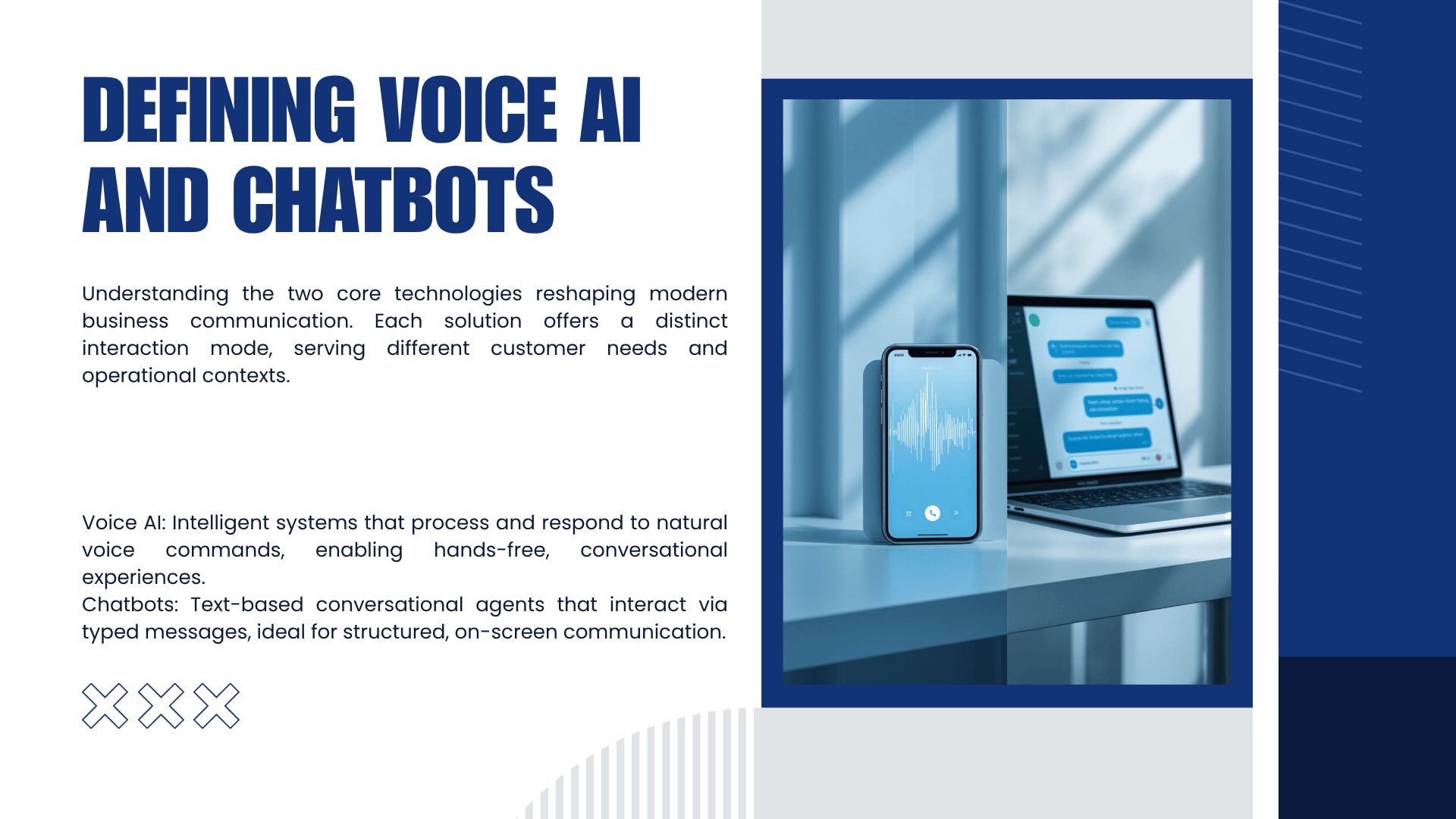
Voice AI vs Chatbots differs primarily in how customers communicate with artificial intelligence. Voice AI understands and responds through spoken conversations, while AI chatbots communicate using text messages. Both automate customer interactions, but each serves different business goals, customer preferences, and communication channels.
Although people often use these terms interchangeably, they represent different technologies built for different experiences.
A chatbot typically interacts through text on websites, mobile applications, messaging platforms, or social media. Customers type their questions, and the chatbot provides instant responses using artificial intelligence, natural language processing (NLP), and predefined business knowledge.
Voice AI, on the other hand, allows customers to speak naturally instead of typing. It converts speech into text, understands intent using AI models, processes the request, and responds with a human-like voice.
Both technologies belong to the broader category of Conversational AI, but their communication methods create very different customer experiences.
How AI Chatbots Work
AI chatbots use natural language processing to understand written messages, identify customer intent, and deliver accurate responses. They automate repetitive conversations while remaining available around the clock.
Unlike traditional rule-based chatbots, modern AI chatbots learn from business knowledge bases, FAQs, documentation, and websites.
A typical chatbot process includes:
Customer types a question.
AI analyses the message.
Intent is identified.
Business knowledge is searched.
Response is generated instantly.
Conversation continues until resolution.
This process helps businesses reduce support workloads while maintaining consistent customer service.
Common chatbot capabilities include:
Answering FAQs
Lead qualification
Product recommendations
Order tracking
Appointment booking
Customer onboarding
Technical support
Sales assistance
How Voice AI Works
Voice AI listens to spoken language, understands customer intent, generates intelligent responses, and replies using natural speech. This creates conversations that feel closer to speaking with a human representative.
Voice AI combines several advanced technologies:
Speech recognition
Natural language understanding
Large Language Models (LLMs)
Context awareness
Text-to-speech synthesis
Machine learning
Instead of typing:
Customer:
"I'd like to reschedule my appointment for tomorrow afternoon."
Voice AI understands:
Customer identity
Appointment details
Available schedule
Preferred time
It then confirms the booking automatically without human intervention.
This makes Voice AI especially valuable for businesses handling high call volumes.
Where Conversational AI Fits In
Conversational AI is the umbrella technology that powers both Voice AI and AI chatbots. It enables computers to understand, process, and respond to human language naturally across voice and text channels.
Rather than treating Voice AI and chatbots as competing technologies, businesses should recognise that both are components of a comprehensive conversational AI strategy.
A mature conversational AI ecosystem may include:
Website chatbot
Voice assistant
WhatsApp chatbot
Facebook Messenger bot
Instagram automation
Live agent handoff
CRM integration
Knowledge base search
Together, these tools create consistent customer experiences regardless of the communication channel.
Voice AI vs Chatbots: Key Differences Explained
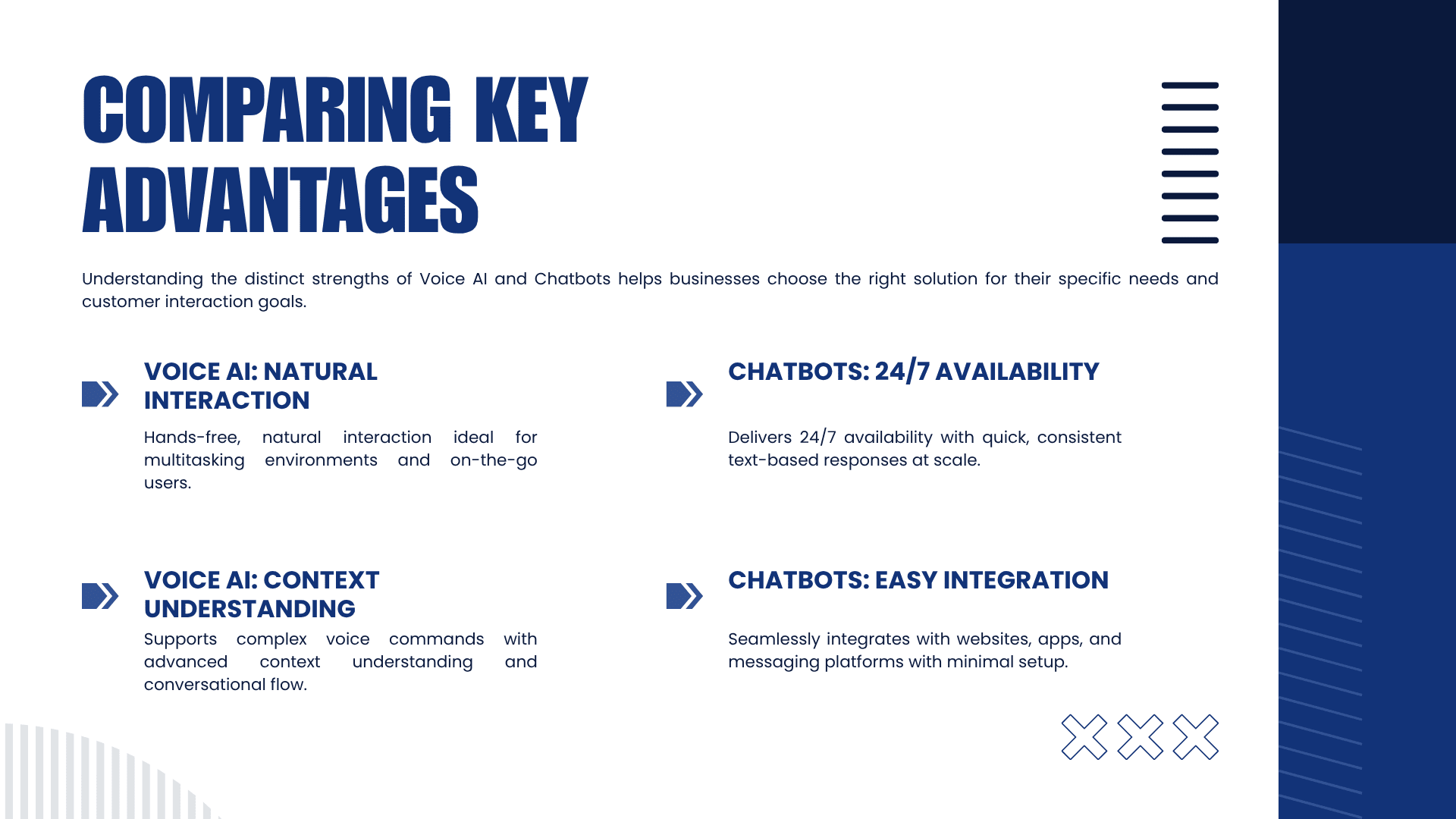
Understanding Voice AI vs Chatbots requires comparing communication methods, customer experience, implementation costs, scalability, and business objectives. While both improve customer service automation, they deliver value in different situations and customer journeys.
Selecting the wrong technology often leads to unnecessary expenses or poor customer satisfaction. Instead of focusing on which solution is more advanced, businesses should evaluate which one aligns better with customer behaviour.
The following comparison highlights the major differences.
FeatureVoice AIAI ChatbotsCommunication MethodSpoken conversationsText-based conversationsCustomer ExperienceHuman-like and naturalFast and convenientResponse SpeedReal-time voice interactionInstant text repliesCostHigher implementation costMore affordableBest Use CasesPhone support, bookings, healthcare, salesWebsite support, FAQs, lead generation, eCommercePersonalisationHigh contextual conversationsStrong contextual responses through textScalabilityHandles thousands of calls simultaneouslyHandles unlimited website conversations efficiently
Both solutions can integrate with CRMs, ticketing systems, payment gateways, and business software.
The decision depends less on technical capability and more on customer expectations.
Customer Communication Experience
Voice AI creates natural spoken conversations, while AI chatbots provide quick written interactions. Businesses should choose based on how customers prefer to communicate throughout their buying journey.
For example:
A hospital appointment line benefits greatly from Voice AI because patients naturally prefer speaking.
An online clothing store usually benefits more from an AI chatbot since shoppers are already browsing the website.
Different industries naturally favour different communication styles.
Cost and Implementation
Voice AI generally requires greater investment because it combines speech recognition, voice synthesis, telephony integration, and AI processing. AI chatbots usually require lower setup costs and faster deployment.
Implementation costs vary depending on:
Business size
Customer volume
Number of integrations
AI model complexity
Languages supported
Security requirements
Small businesses often begin with AI chatbots before expanding into Voice AI as operations grow.
Customer Expectations
Customer expectations should drive the Voice AI vs Chatbots decision more than technology trends. Businesses succeed when they match communication channels with customer preferences.
For example:
Customers calling an insurance company usually expect to speak.
Customers shopping online often expect instant text assistance.
Businesses that ignore these behavioural differences frequently experience lower customer satisfaction despite investing heavily in AI.
Why Businesses Are Adopting Voice AI and AI Chatbots
The growing adoption of Voice AI vs Chatbots reflects the increasing demand for faster customer service, lower operating costs, and scalable business automation. Organisations across industries use conversational AI to improve efficiency while delivering better customer experiences.
Customers no longer expect to wait several hours for email responses or spend long periods on hold during phone calls. They expect immediate assistance, accurate information, and personalised support at any time of day.
Artificial intelligence makes this possible.
Instead of replacing customer service teams, AI increasingly handles repetitive tasks so human agents can focus on more complex conversations.
Businesses adopting AI customer support often report improvements in response speed, customer satisfaction, and operational efficiency.
Some of the primary reasons organisations invest in conversational AI include:
24/7 customer availability
Reduced support costs
Faster response times
Consistent customer experiences
Higher lead conversion
Better customer retention
Improved employee productivity
Scalable support during peak demand
These advantages explain why AI-powered automation continues to expand across industries such as healthcare, banking, retail, education, travel, logistics, and SaaS.
Improving Customer Support Efficiency
Businesses use Voice AI and AI chatbots to automate repetitive customer inquiries, allowing support teams to focus on high-value conversations that require empathy, expertise, or complex problem-solving.
Support teams often spend a significant portion of their day answering identical questions:
Where is my order?
What are your business hours?
How can I reset my password?
What are your pricing plans?
How do I book an appointment?
Automating these requests dramatically reduces ticket volume while improving response times.
This creates a better experience for both customers and support agents.
Supporting Business Growth Without Expanding Teams
Conversational AI enables businesses to manage increasing customer interactions without hiring large support teams. This makes AI business automation particularly valuable for growing companies with limited operational resources.
A rapidly growing eCommerce store, for example, may receive thousands of customer inquiries during seasonal sales. Hiring enough agents to handle temporary spikes can be expensive and inefficient.
AI chatbots and Voice AI systems can absorb these surges by answering routine questions, processing common requests, and directing only complex issues to human representatives.
As a result, businesses maintain service quality while controlling operational costs.
When Should Businesses Choose Voice AI?
The best choice in the Voice AI vs Chatbots debate depends on business communication needs. Voice AI is ideal for organisations that handle high volumes of phone calls, require natural conversations, or need to automate voice-based customer interactions without sacrificing customer experience.
Voice AI is becoming an essential technology for businesses where customers naturally prefer speaking over typing. Industries such as healthcare, banking, insurance, hospitality, logistics, and real estate often receive thousands of phone enquiries every day. AI Voice Agents can answer these calls instantly, understand customer intent, and complete tasks without waiting for a human representative.
Unlike traditional IVR systems that force callers through confusing menu options, modern Voice AI allows customers to speak naturally.
For example, instead of pressing multiple numbers to reach the right department, a customer can simply say:
"I'd like to change my delivery address."
The AI understands the request, verifies the customer, updates the information, and confirms the change within seconds.
This creates a smoother customer journey while significantly reducing call centre workloads.
Businesses That Benefit Most from Voice AI
Voice AI delivers the greatest value for organisations that rely heavily on phone conversations. Businesses with appointment scheduling, customer verification, or high inbound call volumes often see the fastest return on investment.
Industries where Voice AI performs exceptionally well include:
Healthcare clinics and hospitals
Banks and financial institutions
Insurance providers
Travel and hospitality businesses
Logistics and courier companies
Utility service providers
Automotive dealerships
Government service centres
These organisations typically receive repetitive phone enquiries that can be automated without reducing service quality.
Advantages of AI Voice Agents
AI Voice Agents improve customer service by providing fast, natural conversations while remaining available around the clock. They reduce waiting times and increase operational efficiency across multiple departments.
Some of the biggest advantages include:
24/7 voice support
Human-like conversations
Reduced call waiting times
Automatic appointment scheduling
Call routing based on customer intent
Multilingual communication
CRM integration
Increased first-call resolution
Better customer satisfaction
Lower operational costs
Because Voice AI continuously improves through machine learning, businesses often notice better performance as more customer interactions are processed.
Common Mistakes When Deploying Voice AI
Many businesses expect Voice AI to replace every customer interaction immediately. Successful implementations focus on automating repetitive conversations first before expanding into more complex customer journeys.
Some common deployment mistakes include:
Automating highly emotional customer conversations
Ignoring call quality monitoring
Poor CRM integration
Lack of human agent escalation
Using outdated business knowledge
Not testing different customer accents
Launching without staff training
Companies that avoid these mistakes usually achieve faster adoption and higher customer satisfaction.
When Are AI Chatbots the Better Choice?
In the Voice AI vs Chatbots comparison, AI chatbots are often the better solution for businesses that primarily interact with customers through websites, mobile apps, social media, or messaging platforms. They provide instant responses while remaining affordable and highly scalable.
Most customers visiting a website prefer getting quick answers without making a phone call.
A well-trained AI chatbot can answer product questions, recommend services, qualify leads, book demonstrations, and assist customers throughout the buying journey.
Unlike live chat agents, AI chatbots remain available at any hour without increasing staffing costs.
For many small and medium-sized businesses, chatbot automation provides one of the fastest ways to improve customer service while increasing lead generation.
Businesses looking for an advanced AI chatbot platform can explore https://www.yoursitechat.com/ to automate website conversations, answer customer questions, capture leads, and improve customer engagement using conversational AI.
Best Business Use Cases for AI Chatbots
AI chatbots perform best when customers already communicate through digital channels. They deliver immediate support while reducing repetitive workloads for customer service teams.
Popular chatbot use cases include:
Website customer support
Product recommendations
Lead qualification
FAQ automation
Appointment booking
Order tracking
Customer onboarding
Technical troubleshooting
Pricing enquiries
Sales assistance
These applications improve both customer satisfaction and operational efficiency.
Benefits of AI Chatbots
AI chatbots combine affordability, scalability, and intelligent automation, making them one of the most accessible AI business solutions for organisations of every size.
Key benefits include:
Instant responses
Lower implementation costs
Easy deployment
Consistent customer experiences
Multi-language support
Seamless website integration
CRM connectivity
Improved lead generation
Better customer engagement
Reduced support workload
As AI models become more advanced, chatbots now understand conversational context far better than earlier rule-based systems.
Industry Observation
Businesses that deploy AI chatbots effectively rarely use them only for customer support. They also integrate chatbots into marketing, sales, onboarding, and post-purchase engagement to maximise return on investment.
For example:
An eCommerce business may use a chatbot to:
Welcome new visitors.
Recommend products.
Offer discount codes.
Answer shipping questions.
Recover abandoned carts.
Collect customer feedback.
This creates value across the entire customer journey rather than limiting automation to support alone.
Can Voice AI and AI Chatbots Work Together?
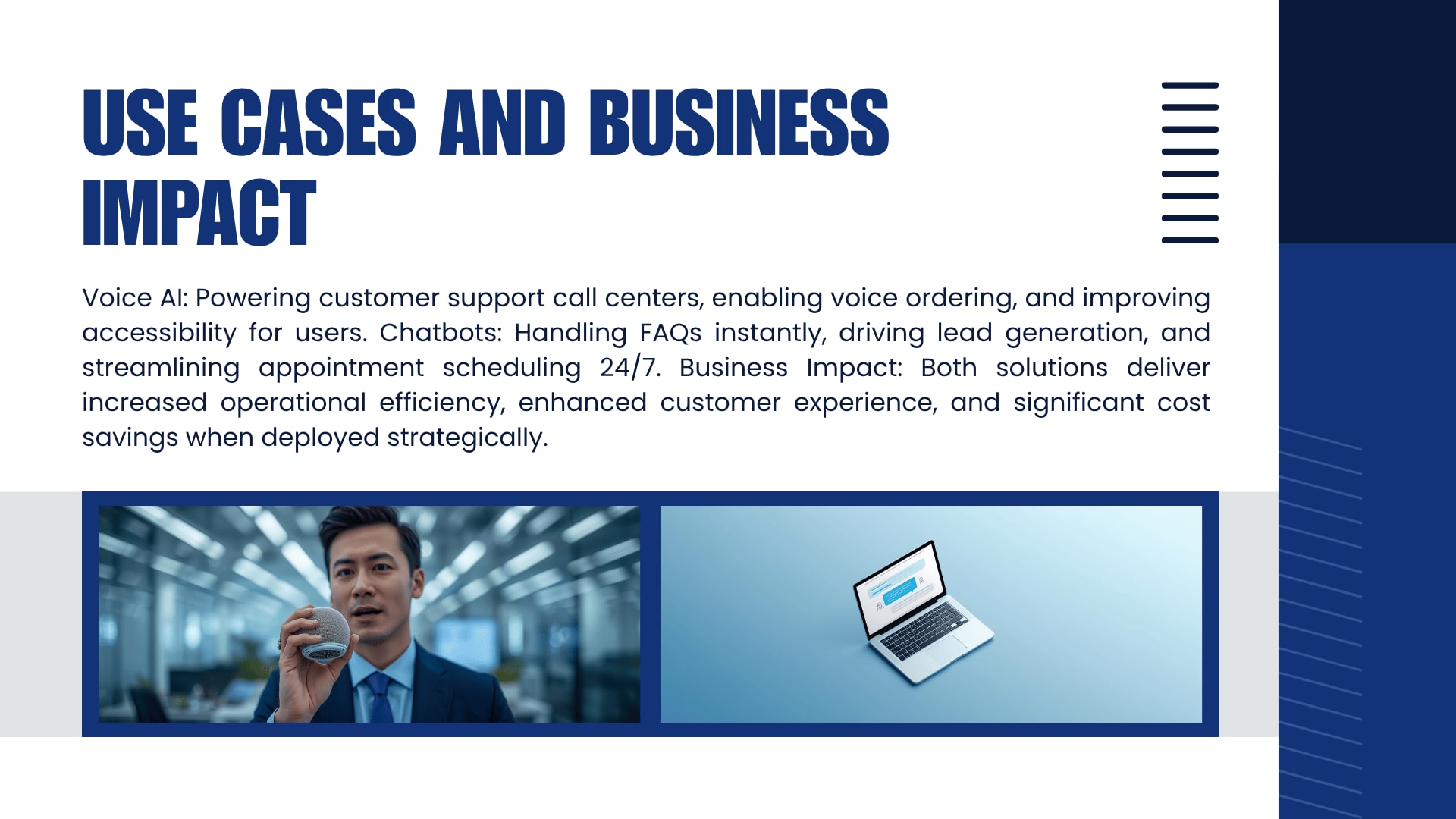
Yes. The most effective Voice AI vs Chatbots strategy is often a combination of both technologies. Businesses that integrate voice and text automation create consistent customer experiences across multiple communication channels while improving efficiency and reducing support costs.
Rather than viewing Voice AI and chatbots as competing tools, successful organisations use them together as part of a unified conversational AI strategy.
A customer may first interact with a chatbot on the company website. If the issue becomes more complex, the conversation can seamlessly transfer to an AI Voice Agent or a live support representative without requiring the customer to repeat information.
This omnichannel approach creates a smoother experience and improves customer satisfaction.
A Practical Customer Journey
Combining Voice AI with AI chatbots allows businesses to support customers across different touchpoints without disrupting the conversation.
Consider a real-world example:
A visitor lands on a company's website.
The chatbot answers product-related questions.
The visitor requests a personalised consultation.
The chatbot schedules a callback.
An AI Voice Agent contacts the customer.
The Voice AI qualifies the lead.
Complex questions are transferred to a human sales consultant.
The CRM stores the complete interaction history.
The customer experiences one connected journey instead of multiple disconnected conversations.
Benefits of Combining Both Technologies
Businesses that integrate Voice AI and chatbots gain greater flexibility, higher customer satisfaction, and more efficient customer service automation.
Key advantages include:
Consistent customer experiences
Omnichannel support
Better lead qualification
Faster issue resolution
Lower operational costs
Reduced support queues
Higher conversion rates
Improved data collection
Increased customer retention
Better resource allocation
This hybrid approach is becoming increasingly common among enterprises looking to modernise customer engagement.
Factors to Consider Before Choosing a Solution
Choosing between Voice AI vs Chatbots requires evaluating customer behaviour, business goals, budget, communication channels, and long-term automation plans. The right decision depends on solving real business problems rather than simply adopting the latest technology.
Every organisation has unique operational requirements. A startup with limited resources may prioritise affordable chatbot automation, while a healthcare provider managing thousands of daily phone calls may benefit more from Voice AI.
Decision-makers should evaluate several practical factors before investing.
1. Customer Communication Preferences
Businesses should first understand how customers prefer to communicate. Selecting technology that aligns with existing customer behaviour typically produces higher adoption and satisfaction rates.
Questions worth asking include:
Do customers usually call?
Do they prefer website chat?
Are most enquiries received through social media?
Do customers need immediate answers?
Are conversations usually simple or complex?
Understanding these patterns makes technology selection far easier.
2. Business Objectives
Automation should support measurable business goals rather than simply replacing manual work.
Examples include:
Reducing support costs
Increasing lead generation
Improving customer satisfaction
Shortening response times
Growing sales
Supporting business expansion
Handling seasonal demand
Clear objectives help determine whether Voice AI, AI chatbots, or both provide the greatest value.
3. Integration Requirements
Businesses should ensure that any AI solution integrates with existing systems before deployment. Poor integration often limits automation and reduces overall effectiveness.
Important integrations may include:
CRM platforms
Help desk software
Payment gateways
Appointment booking systems
ERP software
Knowledge bases
Email marketing platforms
Smooth integration allows AI to access relevant customer information and deliver more personalised experiences.
4. Future Scalability
An AI solution should support future growth without requiring a complete technology replacement. Scalable platforms allow businesses to expand automation as customer demand increases.
Organisations planning long-term digital transformation often begin with chatbot automation and gradually introduce Voice AI for telephone interactions.
This phased approach minimises disruption while delivering measurable improvements over time.