
Let me be blunt: if you’re still relying solely on traditional customer service methods in 2026, you’re leaving money on the table.I’m not saying this to be dramatic. I’m saying it because I’ve watched businesses transform their operations—and their bottom lines—by implementing intelligent chatbot solutions. We’re talking about companies that went from frustrated customers waiting hours for email responses to instant, accurate support that never sleeps.
The best part? This isn’t just for tech giants with massive budgets anymore.
When I started consulting with small businesses about AI chatbots three years ago, most owners thought this technology was out of their reach. Today, I’m helping bakeries, law firms, e-commerce stores, and local service providers implement chatbot solutions that pay for themselves within months.
In this comprehensive guide, I’ll walk you through everything you need to know to transform your business with AI chatbots. You’ll learn what these tools actually do (beyond the marketing hype), how to integrate them without disrupting your current operations, and why the businesses that embrace this technology now will dominate their markets tomorrow.
No fluff. No technical jargon you don’t need. Just practical, actionable insights from someone who’s been in the trenches.
Show Image Alt text: Transform Your Business with AI Chatbots
What Are AI Chatbots and How Do They Actually Work?
Let’s cut through the confusion first.
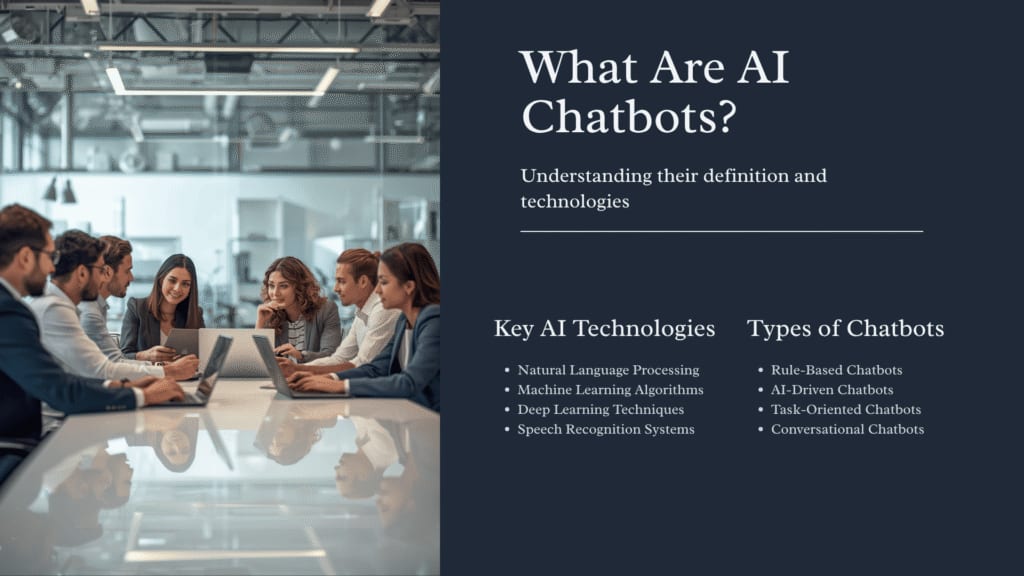
An AI chatbot is essentially a software application that uses artificial intelligence to simulate human conversation. But here’s where it gets interesting: modern chatbots aren’t just following scripted responses anymore. They’re using machine learning chatbots technology to understand context, remember previous interactions, and actually improve over time.
Think of it this way: old-school chatbots were like those automated phone systems we all hate—”Press 1 for sales, press 2 for support.” Frustrating and rigid.
Today’s conversational AI is more like having a knowledgeable team member who never takes a break, never has a bad day, and gets smarter with every customer interaction.
The Technology Behind Modern AI Chatbots
Without getting too technical, here’s what powers these intelligent virtual assistants:
Natural Language Processing (NLP): This allows chatbots to understand what people mean, not just what they type. If someone asks “Where’s my order?” or “When will my package arrive?” the bot recognizes these as the same question.
Machine Learning: The chatbot analyzes thousands of conversations to identify patterns and improve its responses. It learns which answers satisfy customers and which ones lead to escalations.
Intent Recognition: Advanced systems can detect not just what someone is asking, but why they’re asking. Are they frustrated? Just browsing? Ready to buy? This context shapes the response.
Integration Capabilities: Modern chatbots connect with your CRM, inventory systems, payment processors, and other tools. They don’t just talk—they take action.
The technology has reached a point where many customers can’t tell whether they’re chatting with a bot or a human. And honestly? When the bot solves their problem in 30 seconds, they don’t particularly care.
How to Transform Your Business with AI Chatbots: The Real Benefits
Everyone knows chatbots can answer questions. But when you truly transform your business with AI chatbots, the benefits go much deeper than most business owners realize.
Immediate ROI You Can Measure
I worked with a mid-sized e-commerce company that was spending $45,000 monthly on customer support staff. After implementing AI-powered automation, they reduced that cost by 60% while actually improving customer satisfaction scores.
How? The chatbot handled the repetitive stuff—order tracking, return policies, product specifications. This freed their human agents to focus on complex issues and high-value customers.
The math is simple: if you’re paying support staff $20 per hour and a chatbot can handle 70% of inquiries, that’s direct cost savings. But it gets better.
Sales Opportunities You’re Currently Missing
Here’s something most people overlook: chatbots don’t just save money on support. They make you money through sales.
A chatbot on your website engages visitors within seconds. It asks qualifying questions, recommends products, and guides people toward purchase—all while your sales team is asleep or focused on other leads.
One of my clients, a B2B software company, saw a 34% increase in qualified leads simply because their chatbot was capturing and qualifying visitors who would have otherwise bounced.
The Data Goldmine
Every conversation your chatbot has generates valuable data. You learn:
- What questions customers ask most frequently
- Which products confuse people
- Where people drop off in the buying process
- What features or services customers want
- Common objections and concerns
This intelligence helps you improve your products, marketing, and overall customer experience. It’s like having thousands of focus groups running 24/7.
Consistency That Humans Can’t Match
Your best customer service rep might give brilliant answers 90% of the time. But we all have bad days, moments of distraction, or gaps in knowledge.
A properly trained chatbot delivers the same high-quality response to the 1st customer and the 10,000th customer. Every. Single. Time.
This consistency builds trust and professionalism in your brand.
AI Chatbots for Small Businesses: Finally Within Reach
I need to address the elephant in the room: for years, small business owners thought AI chatbots were only for companies with six-figure IT budgets.
That’s no longer true.
Why Small Businesses Actually Benefit More
Larger companies have resources to throw at problems. Small businesses need to be smarter with every dollar and every hour.
AI chatbots for small businesses level the playing field in ways that weren’t possible five years ago:
You compete with bigger brands on customer service. Your chatbot can provide the same instant, professional support that Fortune 500 companies offer.
You maximize your limited team. If you have three employees wearing multiple hats, a chatbot becomes your 24/7 fourth team member who never needs training or time off.
You capture leads outside business hours. How many potential customers visit your website at 9 PM when your office is closed? Your chatbot is there, qualifying leads and booking appointments.
Real-World Small Business Applications
I’ve seen bakeries use chatbots to take custom cake orders and answer questions about allergens. Law firms use them to schedule consultations and provide basic legal information. Fitness studios use them to handle class bookings and membership inquiries.
The key is choosing the right platform and implementation strategy for your specific needs and budget.
Affordable Platforms That Don’t Compromise Quality
The chatbot market has exploded with options for businesses of all sizes. Platforms like YourSiteChat (https://www.yoursitechat.com/) have specifically designed solutions for small to medium businesses that want enterprise-level functionality without enterprise-level costs.
You can typically get started for $50-$300 per month, depending on your needs. Compare that to hiring even a part-time customer service person, and the ROI becomes obvious.
AI Chatbot Integration Strategies: The Blueprint to Transform Your Business with AI Chatbots
Here’s where many businesses stumble: they get excited about chatbot technology, rush into implementation, and create more problems than they solve.
I’ve watched this happen enough times to know the pattern. Let me save you from those mistakes.
Start Small and Specific
Don’t try to deploy a chatbot that does everything on day one. That’s a recipe for frustration.
Instead, identify your biggest pain point:
- Are you drowning in “Where’s my order?” emails?
- Do you lose leads because no one’s available to respond after hours?
- Are your support staff spending 80% of their time answering the same five questions?
Build your chatbot to solve that one problem first. Nail it. Then expand.
The Integration Roadmap That Works
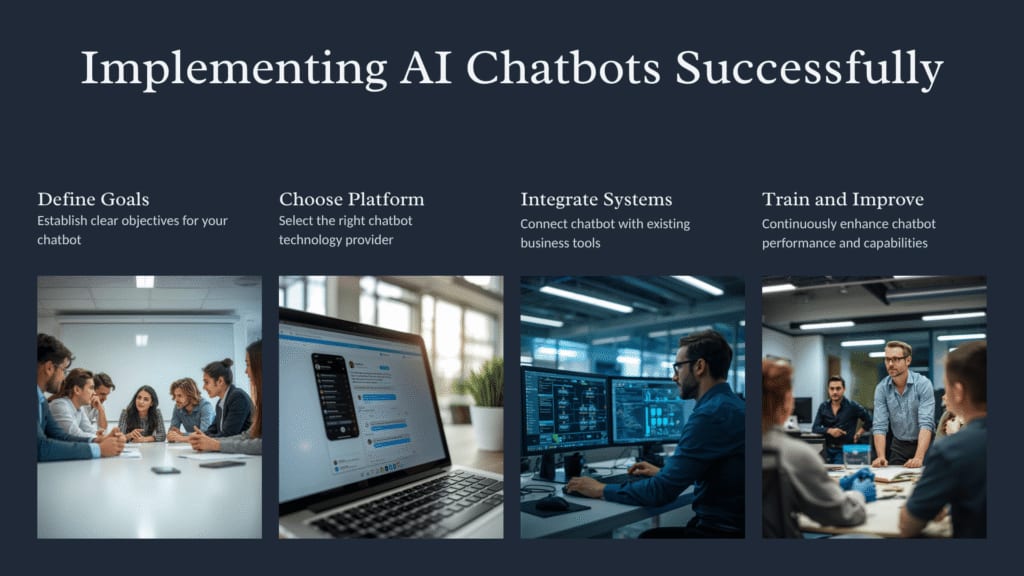
Phase 1: Foundation (Weeks 1-2)
- Map out your most common customer questions
- Document your ideal responses
- Identify which systems need to connect (CRM, inventory, etc.)
- Choose your platform
Phase 2: Build and Test (Weeks 3-4)
- Configure your chatbot with initial responses
- Test internally with your team
- Refine based on feedback
- Create escalation paths to human agents
Phase 3: Soft Launch (Week 5)
- Deploy to a small percentage of visitors
- Monitor conversations closely
- Identify gaps and confusion points
- Adjust and improve
Phase 4: Full Deployment (Week 6+)
- Launch to all visitors
- Continuously analyze performance
- Add new capabilities based on data
- Train your team on working alongside the bot
Critical Integration Points
Your chatbot shouldn’t exist in isolation. The real power comes from connecting it to your existing business systems:
CRM Integration: When someone chats with your bot, that conversation and contact information flows directly into your CRM. No manual data entry.
Calendar Systems: Let customers book appointments, consultations, or service calls directly through the chat interface.
Payment Processing: For simple transactions, allow customers to complete purchases without leaving the chat.
Knowledge Bases: Connect your chatbot to your help center, documentation, or FAQ resources for comprehensive answers.
Email and SMS: Enable the chatbot to send confirmation emails, appointment reminders, or follow-up messages.
The businesses that win with AI chatbot integration strategies are those that think holistically about their customer journey, not just about adding a chat widget.
24/7 Customer Support Chatbots: The Competitive Advantage You Can’t Ignore
Let me tell you about a turning point I witnessed firsthand.
A regional medical supply company was losing business to national competitors. Not because of product quality or pricing—they were competitive on both fronts. They were losing because when healthcare facilities needed supplies urgently at 2 AM, the national companies had 24/7 support lines. My client didn’t.
Hiring round-the-clock staff wasn’t financially viable for a 25-person company. So they implemented 24/7 customer support chatbots.
Within six months, they’d recaptured lost business and expanded into new markets. The chatbot handled order placement, inventory checks, and delivery tracking at any hour. Complex issues got routed to the appropriate specialist when the office opened.
Why 24/7 Support Isn’t Optional Anymore
Your customers don’t work on your schedule. They research products at midnight. They have questions on Sunday mornings. They need support when it’s convenient for them, not when you’re staffed.
Every hour your business is “closed” is an hour your competitors can steal your customers.
What 24/7 Chatbots Handle Best
Not everything requires human intervention at 3 AM. Here’s what chatbots excel at around the clock:
- Order status and tracking
- Basic product information
- FAQs and policy questions
- Appointment scheduling
- Lead qualification and collection
- Password resets and account issues
- Store hours and location information
- Return and exchange processes
For everything else, your chatbot should collect detailed information and create a ticket for your human team to address during business hours. The customer feels heard immediately, even if resolution comes later.
The Psychology of Instant Response
There’s research backing this up: customers who receive instant acknowledgment—even if it’s not a complete solution—are significantly more satisfied than those who wait hours for a “complete” response.
A chatbot that says “I’ve logged your issue and our specialist will email you by 9 AM with a solution” beats radio silence every time.
Digital Transformation with AI: How Chatbots Fit the Bigger Picture
If you’re thinking about chatbots in isolation, you’re missing the strategic opportunity.
Digital transformation with AI isn’t about implementing individual tools. It’s about fundamentally changing how your business operates, serves customers, and makes decisions.
Chatbots as Your Digital Foundation
Think of your chatbot as the front door to your digital ecosystem. It’s often the first touchpoint customers have with your business, and it connects to everything else:
Your chatbot converses with a customer, identifies their needs, pulls data from your CRM to personalize the interaction, checks your inventory system for availability, processes a payment, updates your fulfillment system, and schedules a follow-up—all in one seamless conversation.
That’s digital transformation. That’s what separates companies that survive from those that thrive.
Data-Driven Decision Making
Traditional businesses make decisions based on quarterly reports and gut feeling. Digitally transformed businesses make decisions based on real-time data from every customer interaction.
Your chatbot tells you:
- Which products generate the most questions (potential issues or opportunities)
- What price objections come up most frequently
- Which marketing messages resonate
- Where customers get confused in your sales process
This intelligence drives everything from product development to marketing strategy.
Operational Efficiency That Scales
Here’s the beautiful thing about AI-driven customer experience: it scales without proportional cost increases.
Doubling your customer base doesn’t mean doubling your support staff. Your chatbot handles the increased volume while your human team focuses on high-value interactions.
This operational leverage is how small companies compete with giants and how medium companies become giants.
AI Chatbot Trends: What’s Happening Right Now in 2026
The chatbot landscape is evolving fast. Here’s what you need to know about current AI chatbot trends that will impact your business decisions.

Voice Integration Is Going Mainstream
Text-based chat is no longer the only game. Customers increasingly want to speak to AI assistants, just like they would to Siri or Alexa.
Forward-thinking businesses are deploying chatbots that seamlessly handle both text and voice interactions. This is particularly powerful for:
- Hands-free customer support (think automotive or manufacturing settings)
- Accessibility for users with visual impairments
- Mobile-first customer experiences
Hyper-Personalization Through AI
Generic responses are dying. Modern chatbots leverage customer data to provide personalized experiences:
“Welcome back, Sarah! I see you ordered our organic coffee blend last month. We just released a limited-edition roast I think you’d love.”
This level of personalization, which was previously only possible with dedicated account managers, is now automated at scale.
Emotional Intelligence and Sentiment Analysis
The newest generation of conversational AI can detect frustration, excitement, confusion, or urgency in customer messages. This allows them to:
- Adjust their tone appropriately
- Escalate frustrated customers to human agents proactively
- Offer additional help when they sense confusion
- Capitalize on buying signals when they detect interest
I’ve seen this reduce customer churn significantly because issues get addressed before they escalate.
Multilingual Capabilities Without Extra Cost
Want to expand internationally but worried about language barriers? Modern AI chatbots can converse fluently in dozens of languages, translating in real-time.
A small business in Texas can serve customers in Spain, Japan, and Brazil without hiring multilingual staff. That’s genuinely transformative for growth potential.
Predictive Customer Service
This is where it gets really interesting. Advanced chatbot solutions now use historical data to predict what customers need before they ask.
Example: A customer who bought a printer three months ago logs into your website. The chatbot proactively asks, “Running low on ink? I can have replacement cartridges delivered by tomorrow.”
This shift from reactive to predictive service is a game-changer for customer retention.
The Future of AI Chatbots in Business: What’s Coming Next
I’m not going to pretend I can predict the future with certainty, but based on current development trajectories and conversations with technology leaders, here’s where things are heading.
Autonomous Problem-Solving
Today’s chatbots follow sophisticated decision trees and use AI to understand intent. Tomorrow’s chatbots will solve complex, multi-step problems autonomously.
Imagine a customer with a billing dispute that involves checking payment history, reviewing contracts, calculating prorations, and issuing a refund. Currently, that requires human intervention. Within two years, advanced chatbots will handle this end-to-end.
Deeper Business Integration
The future of AI chatbots in business isn’t just customer-facing. Internal chatbots will become core to operations:
- HR chatbots handling employee onboarding and benefits questions
- IT chatbots troubleshooting technical issues for staff
- Finance chatbots processing expense reports and answering policy questions
- Sales chatbots helping reps find information and prepare proposals
Every department will have AI assistance.
Augmented Reality and Virtual Shopping Assistants
We’re already seeing early versions of this: chatbots that help you visualize furniture in your room or try on clothes virtually. This will become standard for e-commerce.
Your chatbot won’t just recommend products; it’ll show you exactly how they’ll look in your specific context.
Blockchain-Verified Interactions
For industries where transaction verification is critical (finance, healthcare, legal), blockchain integration will create immutable records of chatbot interactions. This addresses compliance, disputes, and accountability.
The Human-AI Collaboration Model
Here’s what I’m most excited about: we’re moving away from “chatbot vs. human” toward sophisticated collaboration.
The best model isn’t replacing humans—it’s using AI to make humans superhuman. Your support agent gets real-time suggestions from AI during live conversations. Your sales rep gets instant access to product specs and pricing while talking to customers. Your manager gets AI-generated insights about team performance and customer trends.
This augmentation approach will define winning businesses.
Transform Your Business with AI Chatbots: Overcoming Challenges and Limitations
I’d be doing you a disservice if I only painted a rosy picture. Let’s talk about the real challenges you’ll face when you transform your business with AI chatbots and how to navigate them.
When Chatbots Fail (And They Do)
No technology is perfect. I’ve seen chatbots misunderstand questions, provide incorrect information, and frustrate customers.
The key is acknowledging this upfront and building safety nets:
Always provide an easy escalation path to humans. If a customer asks three times for something beyond the bot’s capability, route them to a person automatically.
Be transparent that it’s a bot. Don’t try to trick people. Research shows customers are more forgiving of AI limitations when they know they’re talking to a bot.
Monitor and improve continuously. Review conversations where customers seemed frustrated or where the bot failed to help. Use those insights to improve.
The Privacy and Data Security Minefield
Your chatbot collects sensitive customer information. That comes with serious responsibility.
Best practices include:
- End-to-end encryption for all conversations
- Clear privacy policies explaining how data is used
- Compliance with GDPR, CCPA, and relevant regulations
- Regular security audits
- Limited data retention (don’t keep information longer than necessary)
A data breach involving customer conversations can destroy your reputation overnight. Take security seriously.
The Ethical Questions We Can’t Ignore
Should chatbots disclose they’re not human? Always.
Should they collect data without explicit consent? Never.
Should they manipulate customers into purchases using psychological tactics? That’s a gray area worth thinking deeply about.
I’ve watched businesses use chatbots to prey on customer vulnerabilities—creating false urgency, exploiting cognitive biases, or misleading about product capabilities. This might boost short-term sales, but it’s ethically questionable and unsustainable.
Build chatbots that serve customers genuinely, not just extract value from them.
The Job Displacement Concern
Let’s address the elephant in the room: yes, chatbots can replace certain jobs.
But here’s the nuance: in every business I’ve consulted with, chatbot implementation led to job transformation, not elimination. Support staff became customer success managers. Order processors became strategic account handlers.
The jobs that disappear are the repetitive, soul-crushing ones. The jobs that emerge are more engaging and valuable.
If you’re a business owner, invest in training your team for higher-value roles. If you’re an employee, develop skills that complement AI rather than compete with it.
Best Practices to Successfully Transform Your Business with AI Chatbots
After helping dozens of businesses deploy chatbots, I’ve identified the patterns that separate successful implementations from disappointing ones.
Design for Conversation, Not Interrogation
Bad chatbot: “What is your name? What is your email? What is your phone number? How can I help?”
Good chatbot: “Hey! I’m here to help you find what you need. What brings you in today?”
The best chatbots feel like talking to a helpful human, not filling out a form.
Give Your Bot a Personality (But Keep It Professional)
Your chatbot should reflect your brand voice. A legal firm’s bot will sound different from a trendy fashion retailer’s bot.
But remember: personality is great, but competence comes first. A funny chatbot that can’t answer questions is just annoying.
Set Clear Expectations
Tell users what your chatbot can and can’t do. “I can help you track orders, find products, and answer questions about our return policy. For custom requests or complex issues, I’ll connect you with our team.”
This prevents frustration from unmet expectations.
Optimize for Mobile
Over 60% of chatbot interactions happen on mobile devices. Make sure your chat interface is thumb-friendly, loads fast, and doesn’t require excessive typing.
Create Smart Fallback Options
When your bot doesn’t understand something, it should:
- Ask for clarification in a different way
- Offer related topics or common questions
- Provide an easy path to human support
Never let customers hit a dead end.
Measure What Matters
Track metrics that indicate real success:
- Resolution rate: What percentage of conversations are resolved without human intervention?
- Customer satisfaction: Are users happy with the chatbot experience?
- Response time: How quickly are inquiries addressed?
- Conversion rate: For sales-focused bots, how many conversations lead to purchases?
- Cost per interaction: How much are you saving compared to human-only support?
Vanity metrics like “total conversations” don’t tell you much. Focus on outcomes.
Keep Improving Based on Real Data
Your chatbot on day 100 should be dramatically better than on day one. Review conversations weekly. Identify gaps. Add new capabilities. Refine responses.
The businesses with the best chatbots treat them as living products, not set-it-and-forget-it tools.
Why YourSiteChat Deserves Your Attention
I’m not in the habit of specifically promoting platforms unless they solve real problems in ways that matter.
YourSiteChat (https://www.yoursitechat.com/) has caught my attention because they’ve focused on the implementation challenges that trip up most businesses.
What They Get Right
Easy Integration: You don’t need a developer to get started. Their platform connects with popular CMS and e-commerce systems with minimal technical expertise required.
Customization Without Complexity: You can tailor the chatbot to your specific business needs without writing code or navigating overwhelming interfaces.
Scalable Pricing: They offer solutions for small businesses just getting started and enterprise features for larger organizations. You pay for what you need.
Training Support: Unlike platforms that sell you software and disappear, YourSiteChat provides guidance on actually making the chatbot work for your specific industry and use case.
Analytics That Matter: Their dashboard focuses on actionable insights rather than overwhelming you with data points you don’t understand.
I’m highlighting them not as a sales pitch, but because they represent the kind of accessible, practical approach that makes chatbot technology viable for businesses that don’t have dedicated IT departments.
Real-World Examples: Businesses That Successfully Transformed with AI Chatbots
Let me share some specific scenarios I’ve witnessed (names changed for confidentiality).
Case Study 1: E-commerce Apparel Store
Challenge: High cart abandonment rate and overwhelmed customer service during peak seasons.
Solution: Deployed a chatbot that proactively engaged shoppers browsing for more than 60 seconds, answered sizing questions, and offered personalized recommendations.
Results:
- 23% reduction in cart abandonment
- 41% of customer inquiries resolved without human intervention
- 15% increase in average order value (chatbot upselling worked)
- Customer support team could focus on complex issues and VIP customers
Case Study 2: Local HVAC Service Company
Challenge: Missing calls from potential customers because technicians were in the field and office staff was limited.
Solution: Implemented a chatbot that scheduled service appointments, provided pricing estimates for common services, and answered FAQs about maintenance.
Results:
- Booked 34 additional service appointments per month from after-hours inquiries
- Reduced phone call volume by 40%, freeing office staff for other tasks
- Improved response time from hours to seconds
- Collected customer information for follow-up even when immediate booking wasn’t needed
Case Study 3: SaaS Company
Challenge: High volume of repetitive technical support questions slowing down the team.
Solution: Created a chatbot integrated with their knowledge base that could walk users through common troubleshooting steps and account setup.
Results:
- 67% of tier-1 support tickets resolved by chatbot
- Customer satisfaction scores increased (faster resolution)
- Support team retention improved (less burnout from repetitive work)
- Significant cost savings allowed investment in product development
The pattern across these examples: chatbots didn’t replace human value—they amplified it by handling repetitive tasks and freeing people for work that actually requires human judgment and creativity.
Frequently Asked Questions About How to Transform Your Business with AI Chatbots
How much does it cost to implement an AI chatbot?
Costs vary widely based on complexity and scale. Basic chatbots for small businesses start around $50-$100 per month for subscription-based platforms. Custom enterprise solutions can run $10,000-$100,000+ for development plus monthly fees. Most small to medium businesses find success with platforms in the $100-$500 monthly range.
Will a chatbot replace my customer service team?
Not entirely, and it shouldn’t. Chatbots excel at handling repetitive questions and simple tasks. Complex issues, emotional situations, and high-value customer relationships still benefit from human touch. Think of chatbots as your team’s assistant, not their replacement.
How long does implementation take?
For platform-based solutions, you can have a basic chatbot running in days. For it to be truly effective and well-integrated with your systems, plan on 4-8 weeks from decision to full deployment. Custom solutions take longer, typically 3-6 months.
What if my customers don’t like chatbots?
Some won’t—and that’s okay. Always provide easy access to human support for those who prefer it. However, research consistently shows that most customers prefer instant chatbot assistance over waiting hours for email responses or minutes in phone queues, as long as the chatbot is competent.
Do I need technical skills to manage a chatbot?
Not with modern platforms. Most are designed for non-technical users. You should be comfortable with basic computer skills and willing to learn the platform, but you don’t need coding knowledge for standard implementations.
How do I measure if my chatbot is successful?
Focus on: customer satisfaction scores, resolution rate (percentage of issues solved without human intervention), response time improvements, cost savings, and revenue impact (for sales-focused bots). Most platforms provide analytics dashboards tracking these metrics.
Can chatbots handle multiple languages?
Yes, many modern AI chatbots support multilingual conversations. This capability varies by platform, so verify language support for your target markets.
What industries benefit most from chatbots?
E-commerce, SaaS, healthcare, financial services, real estate, hospitality, education, and professional services all see significant value. Honestly, any business that fields customer questions or leads can benefit—it’s about implementation, not industry.
Are chatbots secure enough for sensitive information?
Reputable platforms use encryption and follow security best practices, but you should vet this carefully, especially in regulated industries. For highly sensitive data (medical records, financial details), ensure your chatbot solution is compliant with relevant regulations (HIPAA, PCI DSS, etc.).
What happens when the chatbot doesn’t know an answer?
Well-designed chatbots acknowledge limitations and offer alternatives: escalating to a human agent, suggesting related resources, or collecting detailed information for follow-up. Poor chatbots get stuck in frustrating loops—which is why quality implementation matters.
Conclusion: Transform Your Business with AI Chatbots Starting Today
We’ve covered a lot of ground, so let me distill this into what actually matters for your business.
AI chatbots aren’t a futuristic luxury anymore. They’re a practical business tool that delivers measurable results: lower costs, happier customers, more captured leads, and better data for decision-making.
But here’s the critical point: implementing a chatbot successfully isn’t about the technology itself. It’s about understanding your customers’ needs, your team’s pain points, and your business goals—then using the technology strategically to address those specific challenges.
Your Action Plan to Transform Your Business with AI Chatbots
Step 1: Identify your primary use case. What’s the one problem a chatbot could solve that would have the biggest impact on your business? Start there.
Step 2: Do your homework. Explore platforms like YourSiteChat and compare features, pricing, and integration capabilities. Request demos. Ask tough questions.
Step 3: Start small and iterate. Don’t try to build the perfect chatbot on day one. Launch with basic functionality, gather data, and improve continuously.
Step 4: Prepare your team. Your staff should understand how the chatbot works, when it escalates to them, and how to leverage the data it generates.
Step 5: Commit to ongoing optimization. Set up a monthly review process to analyze performance and make improvements.
The Competitive Reality
Your competitors are either already implementing chatbot solutions or actively exploring them. The businesses that move thoughtfully but decisively will capture the advantages: better customer experiences, operational efficiencies, and market differentiation.
The businesses that wait will find themselves explaining to frustrated customers why they can’t get instant answers like they can from competitors.
Final Thought
I started this article promising practical, no-fluff guidance. Here’s the most practical advice I can give: stop thinking about whether to transform your business with AI chatbots and start thinking about how.
The question isn’t if this technology will transform your industry—it already is. The question is whether you’ll be leading that transformation or scrambling to catch up.
Choose wisely. Choose soon. And remember that the goal isn’t to replace the human elements that make your business special—it’s to free yourself and your team to focus on those elements while AI handles the rest.
Transform your business with AI chatbots, and you transform your ability to serve customers, compete effectively, and build the future you want.