
Machine Learning Frameworks are shaping the future of artificial intelligence, automation, robotics, cloud computing, and enterprise software in 2026. From generative AI systems to real-time analytics platforms, developers now rely heavily on AI development frameworks to build scalable and production-ready applications faster than ever before.
The rapid growth of large language models, AI assistants, edge computing, and intelligent automation has increased demand for developers who understand modern machine learning frameworks such as TensorFlow, PyTorch, Scikit-learn, XGBoost, and Hugging Face Transformers. Companies across healthcare, finance, cybersecurity, eCommerce, and manufacturing are actively hiring engineers with expertise in neural network frameworks and open-source machine learning tools.
This guide explores the best frameworks for machine learning in 2026, including practical use cases, industry trends, comparisons, career opportunities, and future predictions. It is optimized for Google Search, AI Overviews, voice search, and GEO-based search intent to help readers find actionable answers quickly.
Which Machine Learning Frameworks Are Dominating AI Development in 2026?
Machine Learning Frameworks dominating AI development in 2026 include TensorFlow, PyTorch, Scikit-learn, XGBoost, Hugging Face Transformers, ONNX, TensorFlow Lite, and cloud-native AI programming frameworks like AWS SageMaker and Azure ML. These tools enable faster model development, deployment automation, and scalable AI solutions across industries.
Modern AI systems require flexibility, scalability, and real-time performance. Developers no longer choose frameworks only for research purposes. Instead, they evaluate machine learning frameworks based on deployment speed, community support, hardware optimization, and integration with cloud ecosystems.
The rise of generative AI has also transformed the framework landscape. Organizations need AI development frameworks capable of handling:
Large language models (LLMs)
Multimodal AI systems
Edge AI deployment
Distributed model training
Real-time inference pipelines
MLOps integration
Today’s leading frameworks focus heavily on production efficiency and developer productivity.
What makes machine learning frameworks essential for AI engineers in 2026?
Machine learning frameworks simplify the complex process of building, training, testing, and deploying AI models. Without these AI programming frameworks, developers would need to manually handle tensor operations, optimization algorithms, GPU acceleration, and neural network architecture creation.
AI engineers rely on machine learning frameworks because they provide:
Pre-built algorithms and libraries
GPU and TPU acceleration
Distributed training support
Integration with cloud infrastructure
Faster experimentation cycles
Easier deployment pipelines
In practical environments, companies prioritize developers who can build AI products quickly while maintaining scalability and accuracy. This is why ML tools for developers have become foundational in modern software engineering.
For example:
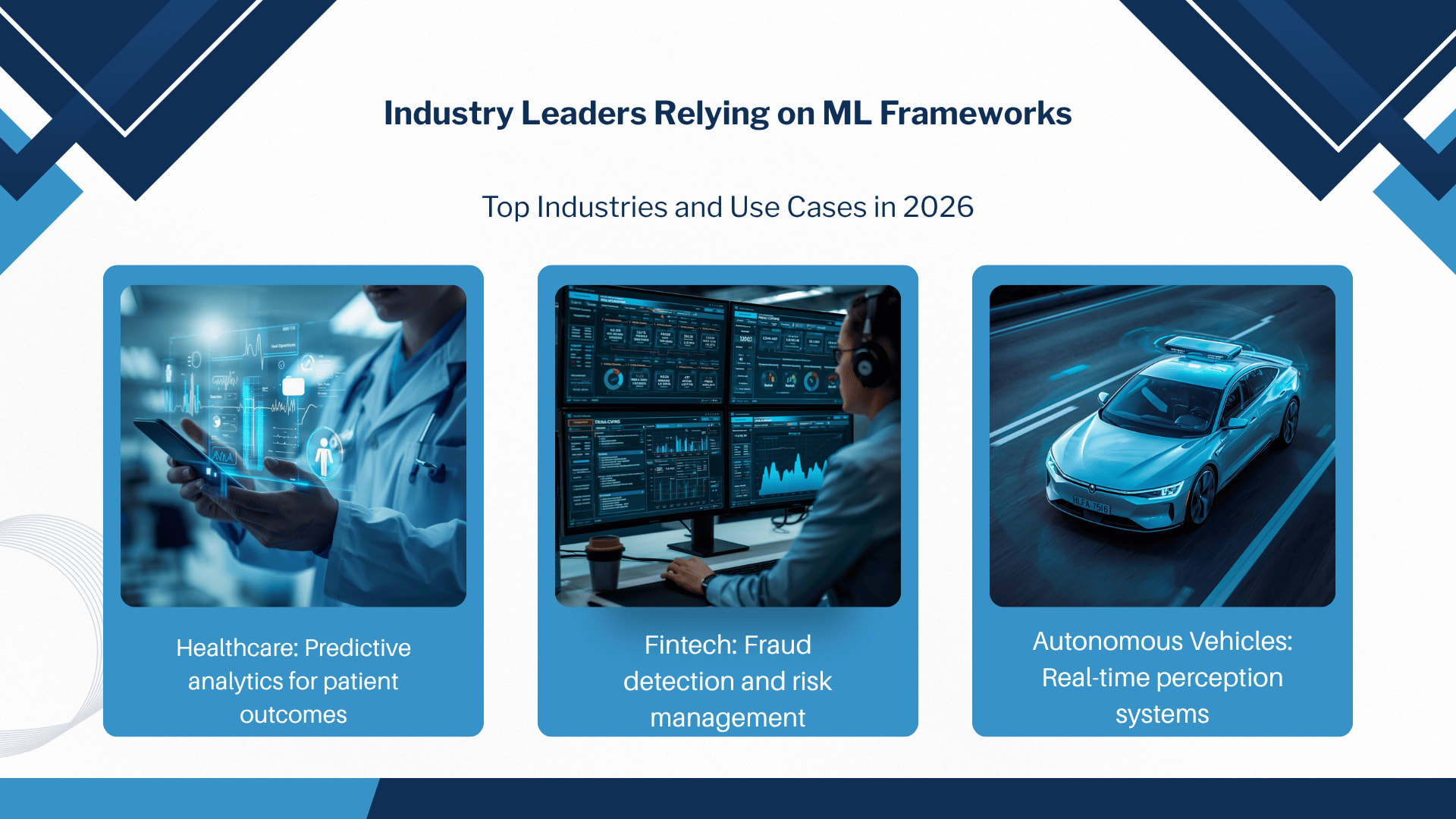
Healthcare companies use neural network frameworks for disease prediction.
Retail platforms use AI frameworks in 2026 for recommendation engines.
Fintech companies use deep learning libraries for fraud detection.
Logistics firms use machine learning frameworks for route optimization.
The ability to move from experimentation to deployment efficiently is now a major competitive advantage.
How have machine learning frameworks evolved with generative AI and automation?
Machine Learning Frameworks have evolved dramatically due to generative AI, automation, and multimodal computing. Earlier frameworks focused mainly on supervised learning and predictive analytics. Modern frameworks now support LLMs, diffusion models, AI agents, and autonomous systems.
Several important shifts have occurred:
1. Frameworks now support massive-scale training
Large AI models require distributed infrastructure. Frameworks such as PyTorch and TensorFlow now include advanced distributed training capabilities.
2. Automation has become central
Modern AI development frameworks automate:
Hyperparameter tuning
Model deployment
Data preprocessing
Monitoring
Experiment tracking
3. Frameworks are becoming cloud-native
AI frameworks in 2026 integrate deeply with:
Kubernetes
Docker
Cloud GPUs
Serverless AI pipelines
4. Edge AI support has improved
Lightweight frameworks such as TensorFlow Lite and ONNX Runtime now enable AI deployment on:
Smartphones
IoT devices
Smart cameras
Embedded systems
This evolution has significantly reduced the time required to launch AI-powered products.
Which industries rely most heavily on machine learning frameworks today?
Nearly every major industry now depends on machine learning frameworks for automation, analytics, personalization, and decision-making. However, some sectors are investing more aggressively in AI development frameworks than others.
Industries heavily using machine learning frameworks include:
Healthcare
Finance
Retail
Manufacturing
Cybersecurity
Autonomous vehicles
Telecommunications
Media and entertainment
How are healthcare companies using machine learning frameworks for predictive analytics?
Healthcare organizations use machine learning frameworks for:
Early disease detection
Medical imaging analysis
Drug discovery
Personalized treatment recommendations
Hospital workflow optimization
TensorFlow and PyTorch are commonly used for deep learning applications involving MRI scans, X-rays, and pathology reports.
AI engineers working in healthcare often prioritize explainable AI and model accuracy due to regulatory requirements.
Why are fintech startups investing in scalable machine learning frameworks?
Fintech companies process enormous amounts of real-time transactional data. Machine learning frameworks help these businesses:
Detect fraud instantly
Analyze credit risk
Automate trading
Predict customer behavior
Improve cybersecurity
XGBoost remains particularly popular for structured financial data because of its strong predictive performance.
Scalable AI programming frameworks also help startups reduce operational costs while improving customer experiences.
Which machine learning frameworks power autonomous vehicles and robotics?
Autonomous systems rely heavily on:
PyTorch
TensorFlow
ROS-compatible AI frameworks
ONNX Runtime
NVIDIA TensorRT
These frameworks support:
Computer vision
Real-time object detection
Sensor fusion
Reinforcement learning
Robotics engineers often combine multiple deep learning libraries to optimize both speed and accuracy.
What should beginners look for when choosing machine learning frameworks?
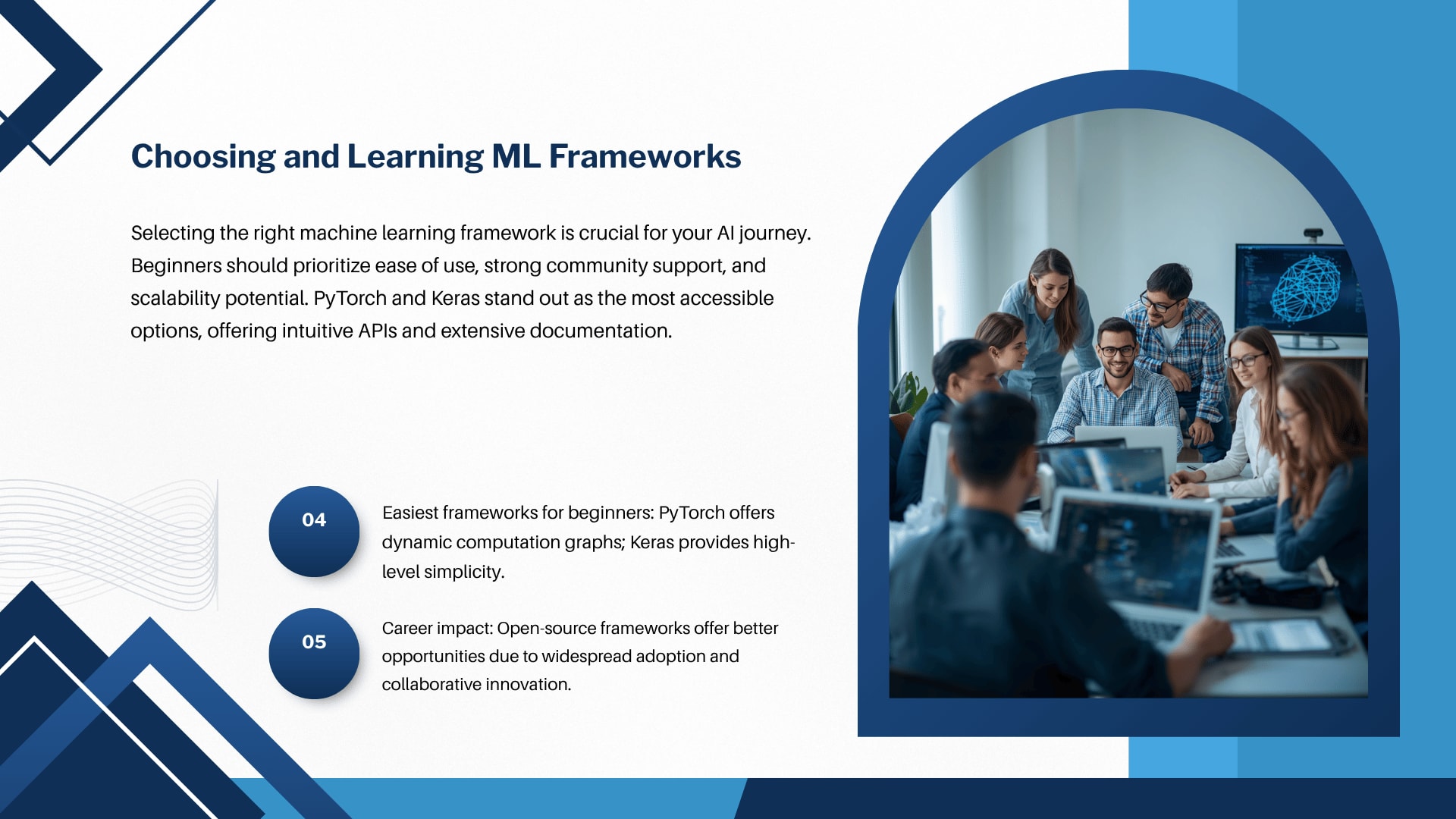
Beginners should prioritize machine learning frameworks that offer strong documentation, active communities, simple APIs, and beginner-friendly learning resources. Framework complexity matters less than usability during the early learning phase.
Important factors include:
Ease of learning
Community support
Available tutorials
Real-world industry demand
Open-source ecosystem
Deployment capabilities
Many beginners make the mistake of chasing advanced frameworks before understanding core ML concepts.
Which machine learning frameworks are easiest for beginners to learn?
The easiest machine learning frameworks for beginners include:
Scikit-learn
TensorFlow with Keras
PyTorch
FastAI
Scikit-learn is ideal for learning traditional machine learning algorithms because of its simple syntax and excellent documentation.
PyTorch is beginner-friendly for deep learning because of its intuitive design and Pythonic structure.
How important is community support when selecting machine learning frameworks?
Community support is extremely important because it impacts:
Learning speed
Problem-solving
Debugging assistance
Availability of tutorials
Open-source contributions
Frameworks with large communities evolve faster and offer better long-term stability.
TensorFlow and PyTorch dominate this area due to their global developer ecosystems.
Do open-source machine learning frameworks offer better career opportunities?
Yes. Open-source machine learning tools often create stronger career opportunities because they are widely adopted by startups, enterprises, and research organizations.
Employers prefer developers experienced with:
TensorFlow
PyTorch
Scikit-learn
Hugging Face
XGBoost
Open-source contributions also strengthen developer portfolios significantly.
Which Machine Learning Frameworks Should Developers Learn in 2026?
The most valuable Machine Learning Frameworks to learn in 2026 are TensorFlow, PyTorch, Scikit-learn, XGBoost, Hugging Face Transformers, TensorFlow Lite, ONNX, and cloud-native AI frameworks. These tools dominate enterprise AI, generative AI, MLOps, and production-scale deployment.
Choosing the right framework depends on career goals, project requirements, and deployment environments. Some frameworks excel in research, while others are optimized for enterprise scalability or mobile AI.
Below is a simple comparison table of the top machine learning frameworks in 2026.
FrameworkBest Use CaseDifficulty LevelIndustry DemandTensorFlowEnterprise AI deploymentModerateVery HighPyTorchDeep learning researchModerateExtremely HighScikit-learnTraditional ML modelsBeginner-FriendlyHighXGBoostStructured data predictionModerateHighHugging Face TransformersNLP and LLMsModerateVery HighTensorFlow LiteMobile AI appsIntermediateGrowingONNXCross-platform deploymentIntermediateGrowing
Why is TensorFlow still one of the top machine learning frameworks in 2026?
TensorFlow remains one of the most powerful machine learning frameworks because it offers enterprise-grade scalability, cloud integration, production deployment tools, and support for advanced deep learning applications.
Large enterprises continue adopting TensorFlow due to its mature ecosystem and production-ready infrastructure.
What are TensorFlow’s biggest advantages for enterprise AI projects?
TensorFlow provides several enterprise advantages:
Distributed training support
Strong cloud integration
TensorFlow Serving for deployment
TensorBoard for visualization
TPU optimization
Mobile AI support
Large organizations value reliability and scalability more than experimentation speed.
How does TensorFlow support deep learning and neural network deployment?
TensorFlow supports neural networks through:
Keras APIs
GPU acceleration
Model optimization tools
TensorFlow Serving
TensorFlow Extended (TFX)
These tools simplify large-scale deployment across cloud environments.
Which companies use TensorFlow for production-grade AI applications?
Major companies using TensorFlow include:
Google
Airbnb
Intel
Coca-Cola
Twitter/X
NVIDIA
These organizations use TensorFlow for recommendation systems, image recognition, predictive analytics, and AI automation.
Why are developers increasingly choosing PyTorch over other machine learning frameworks?
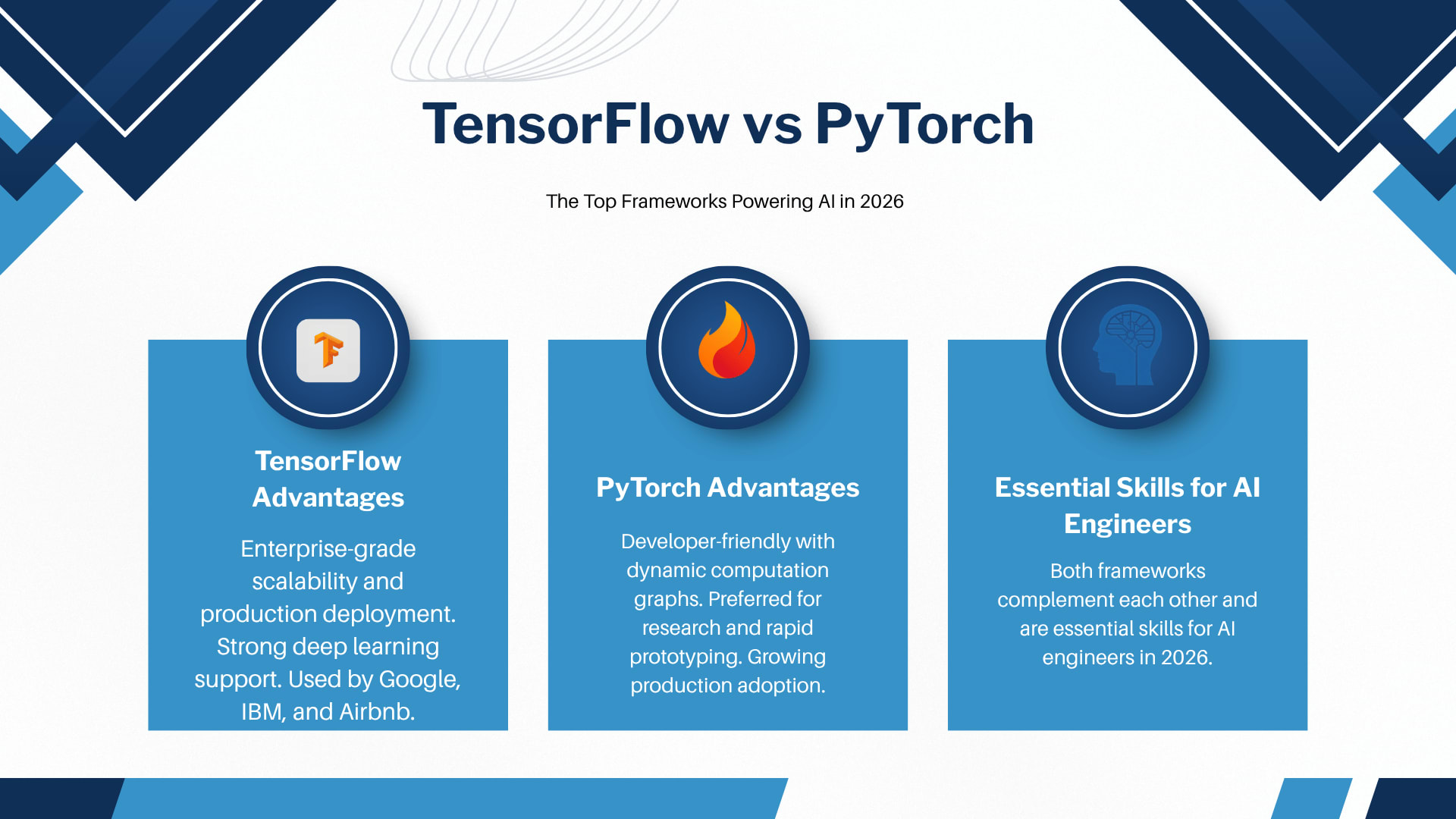
PyTorch has become a preferred machine learning framework because it simplifies experimentation, debugging, and neural network development. Its flexibility makes it especially popular for generative AI and research-focused projects.
The rise of LLMs significantly accelerated PyTorch adoption.
How does PyTorch simplify deep learning model experimentation?
PyTorch enables dynamic computation graphs, allowing developers to modify models during runtime.
Benefits include:
Faster debugging
Easier experimentation
Cleaner Python syntax
Better research flexibility
This approach feels more intuitive for developers building advanced AI systems.
Why is PyTorch preferred in AI research and academia?
Academic institutions favor PyTorch because researchers can prototype models quickly.
Many cutting-edge AI breakthroughs involving:
LLMs
Diffusion models
Reinforcement learning
Vision transformers
were developed using PyTorch.
What are the best PyTorch libraries and tools for developers?
Popular PyTorch ecosystem tools include:
TorchVision
TorchText
PyTorch Lightning
Hugging Face Transformers
Detectron2
These deep learning libraries improve productivity significantly.
Is Scikit-learn still relevant among modern machine learning frameworks?
Yes. Scikit-learn remains highly relevant because most business problems still rely on structured data rather than massive deep learning models.
It is one of the best frameworks for machine learning beginners and data analysts.
Which machine learning tasks are best suited for Scikit-learn?
Scikit-learn works best for:
Classification
Regression
Clustering
Recommendation systems
Predictive analytics
It performs exceptionally well on smaller datasets.
How does Scikit-learn help beginners build machine learning models quickly?
Scikit-learn offers:
Simple APIs
Extensive documentation
Pre-built algorithms
Easy model evaluation tools
Beginners can build real projects quickly without understanding advanced neural networks.
What are the limitations of Scikit-learn compared to deep learning frameworks?
Scikit-learn struggles with:
Large neural networks
Image processing
NLP at scale
GPU acceleration
Deep learning frameworks outperform it for large-scale AI tasks.
Why is XGBoost considered one of the most powerful machine learning frameworks for structured data?
XGBoost dominates structured data tasks because it delivers exceptional prediction accuracy and handles tabular datasets extremely efficiently.
Many Kaggle competition winners still rely heavily on XGBoost.
How does XGBoost improve prediction accuracy?
XGBoost uses gradient boosting techniques that reduce model errors iteratively.
Advantages include:
Regularization
Parallel processing
Missing value handling
Strong feature importance analysis
Which real-world use cases benefit most from XGBoost?
XGBoost performs exceptionally well in:
Fraud detection
Customer churn prediction
Sales forecasting
Credit scoring
Insurance risk modeling
How does XGBoost compare with LightGBM and CatBoost?
All three frameworks are powerful, but differences exist:
XGBoost offers strong stability
LightGBM prioritizes speed
CatBoost handles categorical data efficiently
The best choice depends on dataset structure and business requirements.
Which lightweight machine learning frameworks are ideal for mobile and edge AI?
TensorFlow Lite, ONNX Runtime, Core ML, and TinyML frameworks are leading lightweight AI frameworks in 2026. These tools allow machine learning models to run efficiently on smartphones, wearables, drones, and embedded devices.
How does TensorFlow Lite support mobile machine learning applications?
TensorFlow Lite optimizes AI models for:
Android devices
iOS apps
Embedded systems
It reduces latency and improves mobile inference speed.
Why are ONNX and Core ML gaining popularity in edge computing?
ONNX enables cross-platform model interoperability, while Core ML optimizes AI applications for Apple devices.
Both frameworks improve deployment flexibility significantly.
Which machine learning frameworks are best for IoT devices?
Popular frameworks for IoT include:
TensorFlow Lite
TinyML
Edge Impulse
ONNX Runtime
These frameworks support low-power AI processing.
What are the best machine learning frameworks for natural language processing in 2026?
The best NLP machine learning frameworks in 2026 include Hugging Face Transformers, PyTorch, TensorFlow, LangChain, and spaCy. These AI programming frameworks support LLM development, multilingual AI systems, and conversational AI applications.
Generative AI growth has dramatically increased NLP framework adoption.
How does Hugging Face Transformers simplify NLP development?
Hugging Face provides pre-trained transformer models that reduce development time significantly.
Developers can quickly implement:
Chatbots
Translation systems
Summarization tools
AI assistants
Which machine learning frameworks support large language models efficiently?
Frameworks supporting LLMs include:
PyTorch
TensorFlow
JAX
Hugging Face Transformers
These tools optimize distributed training and inference pipelines.
How are NLP frameworks improving multilingual AI systems?
Modern NLP frameworks now support:
Cross-lingual embeddings
Translation automation
Regional language processing
Speech recognition
This is especially important for global AI products.
Which machine learning frameworks are best for computer vision projects?
PyTorch, TensorFlow, OpenCV, Detectron2, and YOLO-based frameworks dominate computer vision development in 2026. These neural network frameworks support object detection, image classification, facial recognition, and video analytics.
How does OpenCV integrate with modern machine learning frameworks?
OpenCV handles image preprocessing and integrates with:
TensorFlow
PyTorch
YOLO
ONNX
This combination enables robust computer vision pipelines.
Why is Detectron2 popular for object detection tasks?
Detectron2 offers advanced object detection capabilities with high accuracy and modular architecture.
Researchers frequently use it for:
Instance segmentation
Object tracking
Autonomous systems
Which frameworks are best for real-time image recognition systems?
Top frameworks include:
TensorRT
YOLO
OpenCV
TensorFlow Lite
These frameworks prioritize speed and low latency.
Are cloud-native machine learning frameworks replacing traditional AI development tools?
Cloud-native machine learning frameworks are rapidly replacing traditional AI workflows because they simplify scalability, deployment, collaboration, and infrastructure management.
Companies increasingly prefer managed AI ecosystems over manual infrastructure setups.
How do AWS SageMaker and Azure ML accelerate AI deployment?
These platforms automate:
Model training
Hyperparameter tuning
Deployment pipelines
Monitoring
Infrastructure scaling
This reduces operational complexity dramatically.
What are the advantages of cloud-based machine learning frameworks?
Cloud-native AI frameworks provide:
Elastic scalability
Faster deployment
Global accessibility
Lower infrastructure maintenance
Easier collaboration
Which machine learning frameworks integrate best with MLOps pipelines?
Top MLOps-compatible frameworks include:
TensorFlow
PyTorch
MLflow
Kubeflow
SageMaker
These frameworks support production-grade AI lifecycle management.
Developers building enterprise AI products often combine multiple ML tools for developers into unified pipelines.
For practical AI deployment strategies and scalable AI automation insights, many engineering teams also explore platforms like YourSiteChat for AI-driven workflow optimization and conversational automation solutions.
How Can You Choose the Best Machine Learning Framework for Your Career Goals in 2026?
Choosing the right Machine Learning Frameworks in 2026 depends on career goals, industry demand, deployment requirements, and specialization areas such as NLP, computer vision, MLOps, or edge AI. Developers should focus on frameworks aligned with real-world hiring trends and long-term AI growth.
Many professionals waste time learning too many frameworks simultaneously. Instead, successful AI engineers usually master one primary framework before expanding into specialized ecosystems.
Which machine learning frameworks offer the highest-paying job opportunities?
PyTorch, TensorFlow, Hugging Face Transformers, and cloud-native AI frameworks currently offer the strongest salary potential in AI engineering roles.
Demand is particularly high for developers skilled in:
Generative AI
LLM deployment
Computer vision
AI infrastructure
MLOps
Which AI roles require TensorFlow expertise?
TensorFlow expertise is valuable for:
AI engineers
ML platform engineers
Enterprise AI developers
Edge AI specialists
Large enterprises continue relying heavily on TensorFlow ecosystems.
Why are PyTorch developers highly sought after in 2026?
PyTorch dominates generative AI and advanced research projects.
Companies building LLMs and AI assistants often prioritize PyTorch developers because of:
Faster experimentation
Flexible architecture
Strong research ecosystem
How valuable is experience with NLP and LLM frameworks?
LLM expertise has become one of the highest-paying AI skills worldwide.
Knowledge of:
Hugging Face
LangChain
Vector databases
RAG pipelines
is increasingly valuable.
How do machine learning frameworks compare in performance and scalability?
Machine learning frameworks differ significantly in speed, scalability, deployment flexibility, and hardware optimization. Choosing the wrong framework can increase operational costs and reduce deployment efficiency.
Which machine learning frameworks are fastest for training large AI models?
Top-performing frameworks include:
PyTorch
JAX
TensorFlow
DeepSpeed-enhanced systems
Distributed GPU training plays a major role in performance optimization.
How do GPU and TPU optimizations impact framework performance?
Hardware optimization improves:
Training speed
Inference latency
Scalability
Energy efficiency
TensorFlow performs especially well on TPUs, while PyTorch dominates GPU-based research environments.
Which frameworks provide the best deployment flexibility?
ONNX and TensorFlow are strong choices for deployment flexibility because they support multiple environments.
Developers can deploy models across:
Cloud servers
Mobile apps
Browsers
Embedded devices
What are the biggest challenges developers face when learning machine learning frameworks?
Developers often struggle with complexity, deployment workflows, GPU configuration, model optimization, and rapidly evolving AI ecosystems.
The learning curve becomes steeper with advanced deep learning libraries.
How steep is the learning curve for advanced machine learning frameworks?
Framework complexity varies:
Scikit-learn → Beginner-friendly
TensorFlow → Moderate
PyTorch → Moderate
Distributed AI systems → Advanced
Many beginners underestimate deployment complexity.
What are the most common mistakes beginners make with AI frameworks?
Common mistakes include:
Learning frameworks before ML fundamentals
Ignoring deployment skills
Overfocusing on tutorials
Avoiding real-world projects
Neglecting data engineering basics
How can developers build production-ready machine learning skills faster?
The fastest learning approach includes:
Building real applications
Contributing to open-source projects
Learning cloud deployment
Studying MLOps workflows
Participating in Kaggle competitions
Hands-on experience matters far more than certifications alone.
Which machine learning frameworks are expected to grow the fastest after 2026?
Frameworks focused on generative AI, edge AI, multimodal learning, and distributed computing are expected to experience the fastest growth after 2026.
Emerging trends are reshaping the AI development landscape rapidly.
Will open-source AI frameworks dominate the future of machine learning?
Yes. Open-source machine learning tools continue gaining momentum because they encourage innovation, collaboration, and transparency.
Companies increasingly prefer customizable frameworks over proprietary systems.
How will generative AI influence machine learning framework development?
Generative AI is driving demand for frameworks that support:
Massive model training
Vector databases
AI agents
Retrieval-augmented generation
Multimodal AI systems
Framework ecosystems are evolving around these requirements.
Which emerging machine learning frameworks should developers watch closely?
Emerging frameworks and ecosystems include:
JAX
DeepSpeed
LangChain
Haystack
Ollama ecosystems
These tools are becoming increasingly important in AI infrastructure development.
How can beginners create a roadmap for mastering machine learning frameworks?
Beginners should learn Machine Learning Frameworks progressively rather than attempting to master everything at once. A structured roadmap improves retention and practical understanding.
What is the best order for learning machine learning frameworks?
A practical learning sequence includes:
Scikit-learn
TensorFlow or PyTorch
Hugging Face Transformers
MLOps tools
Cloud deployment platforms
This progression aligns well with industry expectations.
Which online resources and certifications help developers learn faster?
Helpful learning resources include:
Official framework documentation
Kaggle
FastAI
Coursera
Real projects remain the best learning method.
How long does it take to become proficient in machine learning frameworks?
Most developers become reasonably proficient within:
3–6 months for beginner ML frameworks
1–2 years for advanced AI engineering
Consistent project-based learning accelerates growth significantly.
What are the final factors to consider before selecting a machine learning framework?
The final framework decision should depend on deployment goals, scalability needs, industry relevance, and long-term career opportunities.
Many developers prioritize popularity alone, which is not always ideal.
Should developers prioritize popularity or specialization?
The best strategy combines both:
Learn one popular framework first
Specialize later based on career goals
Specialization often leads to higher-paying niche opportunities.
How important are scalability and deployment features?
Scalability is now one of the most important framework considerations.
Production AI systems require:
Monitoring
CI/CD integration
Low-latency inference
Cloud scalability
Which machine learning frameworks provide the best long-term career growth?
The strongest long-term opportunities currently exist in:
PyTorch
TensorFlow
Hugging Face ecosystems
Cloud-native AI frameworks
Developers combining AI engineering with deployment and MLOps skills are especially valuable.
Expert Insights on Machine Learning Frameworks in 2026
Industry experts increasingly believe that AI engineers will no longer succeed by learning only algorithms. Instead, success depends on understanding full AI ecosystems.
Real-world hiring trends show that employers now value:
Deployment experience
Cloud integration skills
AI infrastructure knowledge
MLOps familiarity
Generative AI expertise
Framework flexibility is becoming more important than framework loyalty.
Many senior AI engineers now use:
PyTorch for experimentation
TensorFlow for production deployment
ONNX for interoperability
Hugging Face for NLP pipelines
This hybrid approach is becoming common across enterprise environments.
FAQs About Machine Learning Frameworks
Which machine learning framework is best in 2026?
PyTorch and TensorFlow remain the top machine learning frameworks in 2026 due to strong community support, enterprise adoption, and generative AI capabilities.
Is PyTorch better than TensorFlow?
PyTorch is generally preferred for research and experimentation, while TensorFlow remains stronger for enterprise-scale deployment and production systems.
Which machine learning framework is easiest for beginners?
Scikit-learn is often considered the easiest framework for beginners because of its simple syntax and beginner-friendly documentation.
Are open-source machine learning frameworks better?
Open-source frameworks usually offer stronger community support, better flexibility, and wider industry adoption compared to proprietary AI tools.
Which machine learning framework is best for NLP?
Hugging Face Transformers combined with PyTorch currently dominates NLP and large language model development.
Which framework should developers learn first?
Most beginners should start with Scikit-learn before moving into TensorFlow or PyTorch.
Final Thoughts
Machine Learning Frameworks are evolving faster than ever in 2026. The rise of generative AI, autonomous systems, edge computing, and cloud-native AI infrastructure has transformed how developers build intelligent applications.
TensorFlow, PyTorch, Scikit-learn, XGBoost, Hugging Face Transformers, and ONNX continue dominating the AI ecosystem because they solve real-world engineering challenges efficiently.
For beginners, the smartest approach is to build strong ML fundamentals first and then gradually specialize in high-demand AI development frameworks. For experienced developers, mastering deployment pipelines, cloud infrastructure, and generative AI ecosystems will likely provide the biggest long-term career advantages.
The future of AI frameworks in 2026 is not about choosing one tool forever. It is about understanding how multiple Machine Learning Frameworks work together to build scalable, production-ready AI systems that solve real business problems.