The launch of Next-Generation Quantum Processors in 2026 is expected to redefine the future of computing across industries worldwide. Researchers, technology companies, and governments are investing billions into quantum computing technology because these advanced systems promise to solve problems that traditional computers cannot handle efficiently.
From healthcare discoveries to financial forecasting and cybersecurity improvements, advanced quantum chips are moving from experimental laboratories into real-world applications. launch of Next-Generation Quantum Processors The growing interest in scalable quantum systems signals a major shift in how businesses approach data processing, artificial intelligence, and scientific simulations.
Quantum computing in 2026 is no longer viewed as a distant dream. Instead, it is becoming one of the most important technological transitions of the decade. Major corporations are already building quantum-ready strategies to stay competitive in a rapidly evolving digital economy.
Businesses exploring future-focused technologies often follow innovation updates from platforms like https://www.yoursitechat.com/ to stay informed about emerging computing trends, AI developments, and enterprise technology solutions.
What Are Next-Generation Quantum Processors and Why Are They Important in 2026?
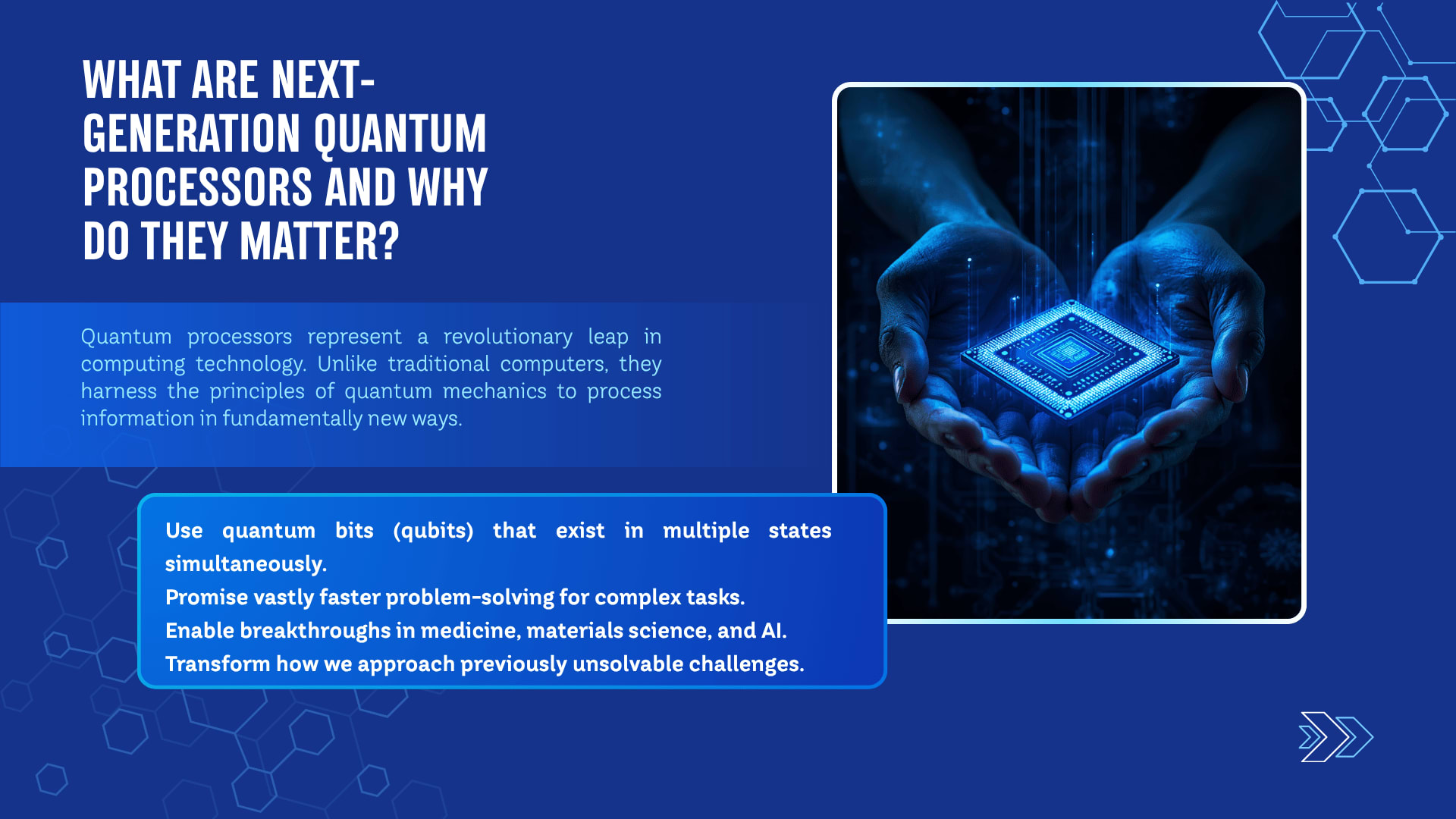
Next-Generation Quantum Processors are highly advanced computing systems designed to process information using qubits instead of traditional binary bits. These processors are important in 2026 because they offer dramatically faster problem-solving capabilities for complex simulations, optimization tasks, cryptography, and artificial intelligence applications that classical computers struggle to handle efficiently.
Quantum computing technology relies on the principles of quantum mechanics, including superposition and entanglement. Unlike traditional computers that process information sequentially using zeros and ones, quantum processors can evaluate multiple possibilities simultaneously.
This breakthrough creates enormous opportunities in areas such as:
Drug discovery
Climate modeling
Machine learning
Cybersecurity
Logistics optimization
Financial risk analysis
Technology analysts believe the launch of advanced quantum chips in 2026 will represent a turning point similar to the rise of cloud computing or artificial intelligence during previous decades.
How do next-generation quantum processors differ from traditional processors?
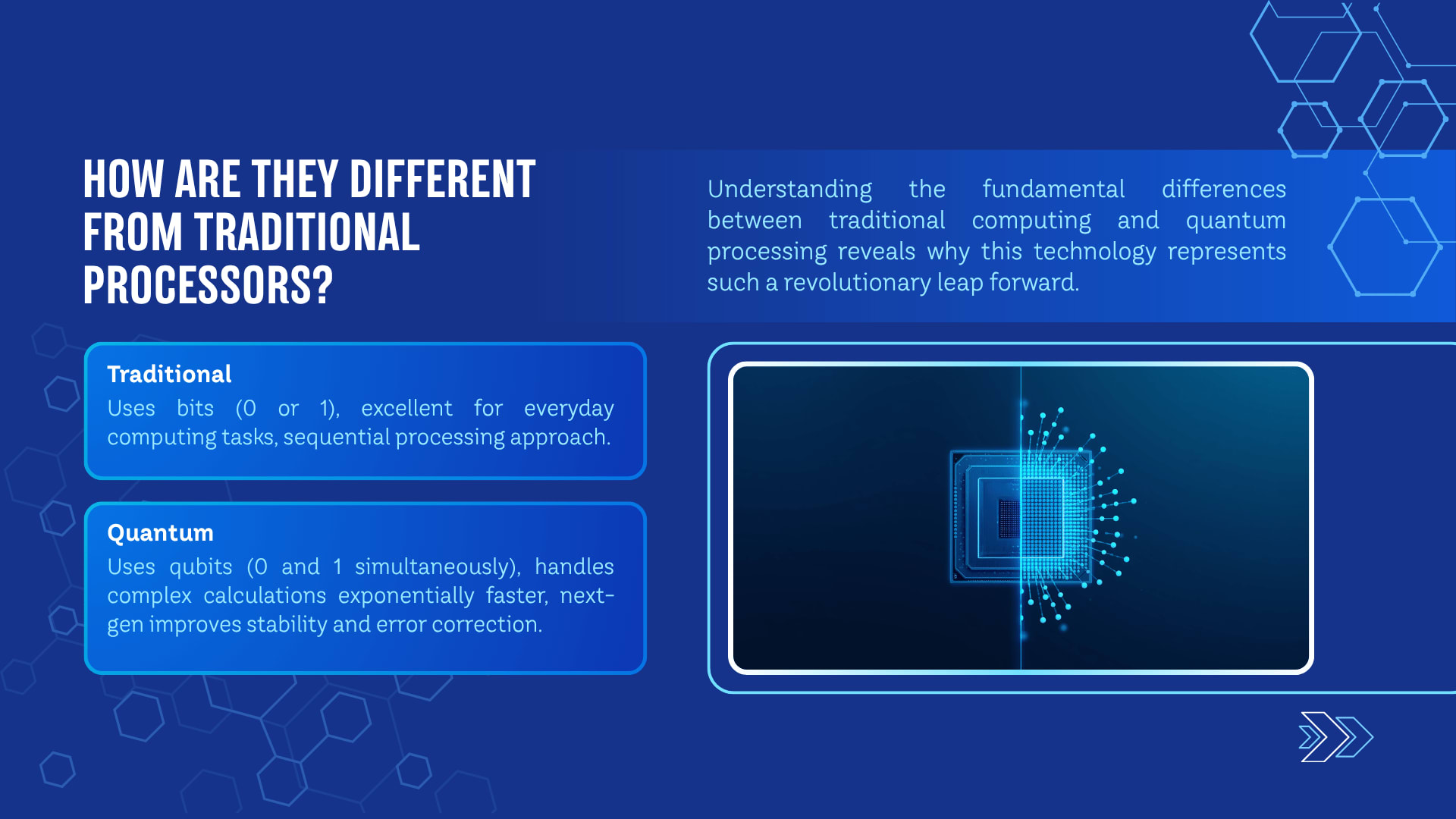
Next-Generation Quantum Processors differ from traditional processors because they use qubits capable of existing in multiple states simultaneously. This allows quantum systems to solve highly complex calculations much faster than classical computers, making them ideal for scientific research, optimization, and advanced AI workloads.
Traditional processors operate through linear computation. They process information step by step using binary logic. Quantum processors, however, leverage quantum physics to process enormous data combinations at the same time.
Key Differences Between Classical and Quantum Computing
Traditional ProcessorsNext-Generation Quantum ProcessorsUse binary bits (0 or 1)Use qubitsSequential calculationsParallel probability-based calculationsLimited optimization speedExtremely fast optimization potentialBest for everyday computingBest for advanced simulationsLower hardware complexityHighly specialized quantum hardware
What makes quantum computing fundamentally different from classical computing?
Quantum computing is fundamentally different because it relies on quantum mechanical behavior rather than electrical transistor switching. Quantum systems can perform simultaneous calculations through superposition, allowing advanced quantum chips to explore multiple computational pathways instantly.
Classical computers remain excellent for standard tasks such as:
Browsing the internet
Running applications
Office productivity
Gaming
Data storage
Quantum processors focus on problems involving:
Massive datasets
Complex simulations
Predictive modeling
Molecular interactions
Optimization scenarios
This difference explains why the future of quantum processors is centered around enterprise and scientific applications rather than replacing consumer laptops immediately.
Why are qubits more powerful than binary bits in advanced quantum chips?
Qubits are more powerful because they can exist as both 0 and 1 simultaneously through quantum superposition. This capability enables Next-Generation Quantum Processors to analyze multiple outcomes at once, dramatically improving computational efficiency for complex tasks.
Another major advantage comes from quantum entanglement. When qubits become entangled, changes to one qubit instantly influence another, even across distances. This creates computational relationships impossible in traditional systems.
Benefits of qubits include:
Faster optimization
Enhanced simulation accuracy
Better AI training capabilities
Improved cryptographic analysis
Advanced scientific modeling
Researchers continue developing stable superconducting qubits to improve reliability and scalability in commercial quantum systems.
Why is 2026 considered a breakthrough year for quantum computing technology?
The year 2026 is considered a breakthrough moment because multiple technology companies are expected to launch commercially viable Next-Generation Quantum Processors with improved qubit stability, reduced error rates, and scalable architectures suitable for enterprise adoption.
Several factors contribute to this acceleration:
Increased private investment
Government-backed quantum programs
Improvements in superconducting qubits
AI-assisted quantum research
Better cryogenic systems
Global competition among tech giants
Industry experts believe quantum computing breakthroughs achieved in recent years are finally reaching commercial readiness.
What technological advancements are accelerating quantum hardware innovation?
Quantum hardware innovations are accelerating because researchers have improved qubit coherence, error correction techniques, and processor scalability. These advancements make quantum computing technology more stable and commercially practical for large-scale deployment.
Some of the most important innovations include:
Improved superconducting materials
Better cryogenic cooling systems
AI-assisted quantum error correction
Modular quantum architectures
Cloud-accessible quantum computing platforms
Many companies are now integrating artificial intelligence with quantum systems to accelerate research and improve computational efficiency.
How are governments and tech companies investing in scalable quantum systems?
Governments and major technology companies are investing heavily in scalable quantum systems to secure leadership in future computing infrastructure, cybersecurity, and AI innovation.
Countries leading quantum investments include:
United States
China
Germany
Canada
Japan
United Kingdom
Tech companies are spending billions on:
Quantum research laboratories
Quantum cloud services
University partnerships
AI-quantum integration
Talent development programs
The race to dominate quantum computing in 2026 is increasingly viewed as both an economic and geopolitical competition.
Which industries are expected to benefit most from next-generation quantum processors?
Industries expected to benefit most from Next-Generation Quantum Processors include healthcare, finance, cybersecurity, logistics, manufacturing, and artificial intelligence because these sectors rely heavily on data analysis, predictive modeling, and complex simulations.
Quantum systems can solve optimization problems that traditional computing systems may require years to process.
How could quantum processors transform healthcare and pharmaceutical research?
Quantum processors could revolutionize healthcare by dramatically accelerating drug discovery, protein modeling, and personalized medicine research.
Current pharmaceutical development often takes years because researchers must analyze enormous molecular combinations. Quantum computing technology can significantly reduce simulation times.
Potential healthcare benefits include:
Faster vaccine development
Precision medicine
Improved cancer research
Advanced DNA analysis
Better molecular simulations
Researchers believe advanced quantum chips could shorten pharmaceutical research timelines from years to months.
Why are financial institutions exploring quantum AI processors for risk analysis?
Financial institutions are exploring quantum AI processors because these systems can analyze massive financial datasets and market variables faster than traditional computing platforms.
Applications in finance include:
Fraud detection
Portfolio optimization
Risk assessment
Predictive analytics
Real-time trading strategies
Banks and investment firms are already building experimental quantum finance divisions to prepare for future deployment opportunities.
How can cybersecurity evolve with advanced quantum computing systems?
Advanced quantum computing systems could both strengthen and disrupt cybersecurity frameworks. While quantum processors can improve encryption methods, they may also break certain traditional cryptographic standards.
Cybersecurity experts are currently developing:
Post-quantum encryption
Quantum-safe authentication
Quantum-resistant communication systems
Secure quantum networking protocols
This transition is becoming increasingly urgent as quantum computing breakthroughs continue accelerating worldwide.
What are the biggest challenges facing quantum processor development in 2026?
The biggest challenges facing Next-Generation Quantum Processors include quantum error correction, qubit instability, high infrastructure costs, and scalability limitations. These obstacles continue slowing widespread commercial adoption despite rapid technological progress.
Quantum systems remain extremely sensitive to environmental interference such as heat, vibration, and electromagnetic disturbances.
Why is quantum error correction still a major obstacle?
Quantum error correction remains difficult because qubits are highly fragile and prone to computational inaccuracies caused by environmental noise.
Unlike traditional systems where errors are easier to detect, quantum states collapse when improperly observed. This creates major engineering challenges.
Current solutions involve:
Redundant qubit systems
AI-assisted correction algorithms
Improved processor isolation
Advanced calibration techniques
Reducing error rates is considered essential for building commercially reliable scalable quantum systems.
How does maintaining qubit stability affect processor performance?
Maintaining qubit stability directly affects processor accuracy, computational speed, and reliability. Unstable qubits reduce the effectiveness of advanced quantum chips and increase processing errors.
To improve stability, researchers use:
Ultra-cold temperatures
Specialized superconducting materials
Vacuum-sealed quantum chambers
Precision electromagnetic controls
These requirements explain why quantum hardware innovations remain expensive and technically demanding.
What infrastructure limitations are slowing large-scale quantum adoption?
Large-scale quantum adoption is slowed by infrastructure limitations such as expensive cooling systems, specialized facilities, limited quantum expertise, and insufficient quantum software ecosystems.
Organizations adopting quantum technologies often face challenges including:
High deployment costs
Limited skilled professionals
Integration complexity
Security concerns
Hardware maintenance demands
Despite these challenges, experts believe commercial quantum computing will continue expanding rapidly after 2026.