The End of Traditional Customer Support
Customer Support is entering a major transition. For years, businesses relied on phone calls, email tickets, FAQs, and human agents to answer customer questions. That model still has an important place, but it is increasingly difficult to match modern expectations with human-only processes. Customers often want immediate answers, businesses need to handle growing support volumes, and repetitive requests consume valuable agent time.
The change is not simply about replacing people with software. It is about redesigning how support works. AI customer support can answer routine questions, retrieve information, classify issues, and provide first-line assistance around the clock. Human agents can then focus on situations that require judgment, empathy, negotiation, or deeper investigation.
The result is a shift from human-only Customer Support toward a hybrid model in which automation provides speed while people provide understanding.
Why is traditional customer support reaching its limits?
Traditional Customer Support is reaching its limits because customer expectations, communication channels, and support volumes have changed faster than many human-only processes. Phone and email remain useful, but they can create queues, delays, repetitive workloads, and limited availability. AI-powered support provides another layer that can handle routine conversations immediately.
The traditional model was designed around a relatively simple sequence: a customer has a problem, the customer contacts the company, an agent receives the request, the agent searches for information, and a response is sent.
That process can work well when request volumes are manageable.
Problems appear when hundreds or thousands of customers ask similar questions at the same time.
A software company may receive a large number of questions after releasing a product update. An online retailer may see support requests increase during a major promotion. A travel company may receive repeated booking questions during a holiday period. A financial service may experience a surge in inquiries after changing a product or policy.
The underlying questions may be simple, but the human effort required to answer them can be substantial.
What has changed about customer expectations?
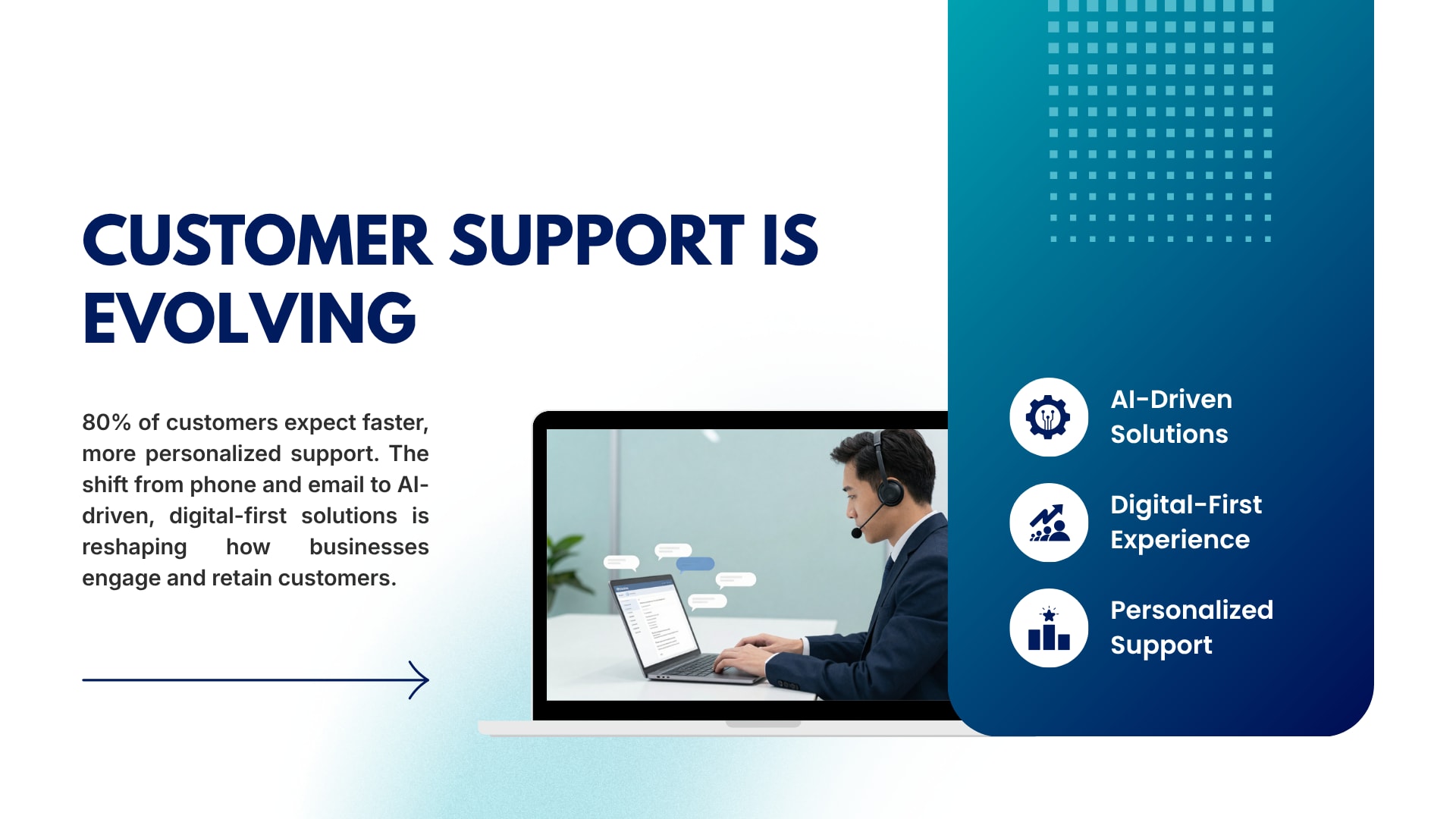
Customer expectations have moved toward faster, more convenient, and more conversational support. Digital services have trained customers to search for information immediately, communicate through chat and messaging applications, and expect businesses to respond outside traditional office hours.
A customer who has already found instant answers through search engines, mobile applications, and online services may find it frustrating to send an email and wait several hours for a basic response.
That does not mean customers reject human support.
Instead, customers increasingly expect the right type of support for the situation.
A simple question such as “What is the return period?” does not necessarily require a human agent. A complicated billing dispute probably does.
This distinction is central to the future of customer service.
Why do customers expect answers within seconds?
Digital experiences have changed the meaning of convenience. When information is available instantly in many parts of everyday life, waiting for basic customer service can feel unnecessary.
For example, a customer checking an order status may only need one piece of information. If the answer already exists in a business database, asking an agent to manually retrieve it creates an avoidable delay.
Instant support is particularly valuable for:
Product and service questions
Order-status requests
Business hours
Pricing information
Appointment information
Basic troubleshooting
Account instructions
Frequently asked questions
The goal is not to make every conversation instantaneous. The goal is to remove unnecessary waiting from straightforward interactions.
How do phone and email-only support models create friction?
Phone and email support depend heavily on human availability. Phone systems can create queues, while email creates an asynchronous conversation that may take hours or days to complete.
Neither channel is inherently outdated. Both remain valuable for specific situations.
The problem occurs when they become the only available support mechanisms.
A customer with a basic question may prefer a quick chat instead of calling a support number. Another customer may need an immediate answer at night when a human team is offline.
Modern digital customer support therefore tends to add channels rather than simply eliminate traditional ones.
Why are repetitive support requests becoming an operational problem?
Repetitive requests consume agent capacity even when the questions themselves are simple. When skilled support employees spend large portions of their day answering identical FAQs, the organization loses an opportunity to use human expertise on complex problems that genuinely need human attention.
A support team might repeatedly answer:
How can an order be tracked?
What payment methods are accepted?
How can an account password be changed?
What documents are required?
How long does delivery take?
How can a subscription be cancelled?
What are the product specifications?
These questions are legitimate. Customers deserve accurate answers.
The issue is who should provide those answers and how.
If a question can be answered consistently from an approved knowledge base, an automated support system may be able to provide the first response. Human agents can then spend more time investigating unusual cases.
How much time do agents spend answering the same questions?
The exact amount varies by company, industry, product complexity, and support process. There is no universal percentage that accurately represents every business.
What is consistent is the nature of the workload.
Repeated questions often require repeated actions:
Read the customer's message.
Identify the intent.
Search documentation.
Confirm the relevant information.
Write a response.
Record the interaction.
Move to the next similar request.
Automation can compress several of those steps into a conversational interaction.
The value is not simply fewer messages. The larger benefit can be better allocation of human attention.
What happens when support volume suddenly increases?
A human-only team has a physical capacity limit. More tickets generally mean longer queues unless additional agents become available.
That creates a difficult operational problem.
Hiring more people may help, but recruitment, training, scheduling, and management take time. A temporary spike may not justify permanent staffing increases.
Support automation provides another option. An AI support agent can handle many simultaneous routine conversations without requiring a separate human response to every question.
The system still needs appropriate safeguards and escalation paths, but the basic model is more scalable.
Why is 24/7 availability becoming part of the customer experience?
24/7 customer support matters because businesses increasingly serve customers across time zones, schedules, and digital channels. A customer may visit a website at midnight, need product information before a purchase, or encounter a problem outside normal business hours. Automated support can provide immediate first-line assistance when human teams are unavailable.
The demand for round-the-clock support does not necessarily mean every company needs a human call center operating continuously.
AI support agents can cover the first layer.
A customer might ask a question at 2 a.m. and receive an answer based on the company's approved information. If the issue is complex, the system can collect relevant details and route the conversation for human review.
This creates continuity instead of forcing the customer to start again later.
Why does customer support no longer stop at business hours?
Digital businesses operate continuously. Websites, online stores, SaaS applications, mobile apps, and social channels remain accessible whether an office is open or closed.
A customer can encounter a problem at any hour.
An automated support layer does not eliminate the need for a human team. It simply gives customers a way to receive immediate assistance while waiting for human intervention when necessary.
That distinction is important.
A useful AI support system should not pretend that every issue can be solved automatically. It should know when to provide information, when to collect details, and when to escalate.
What is the real cost of traditional customer support?
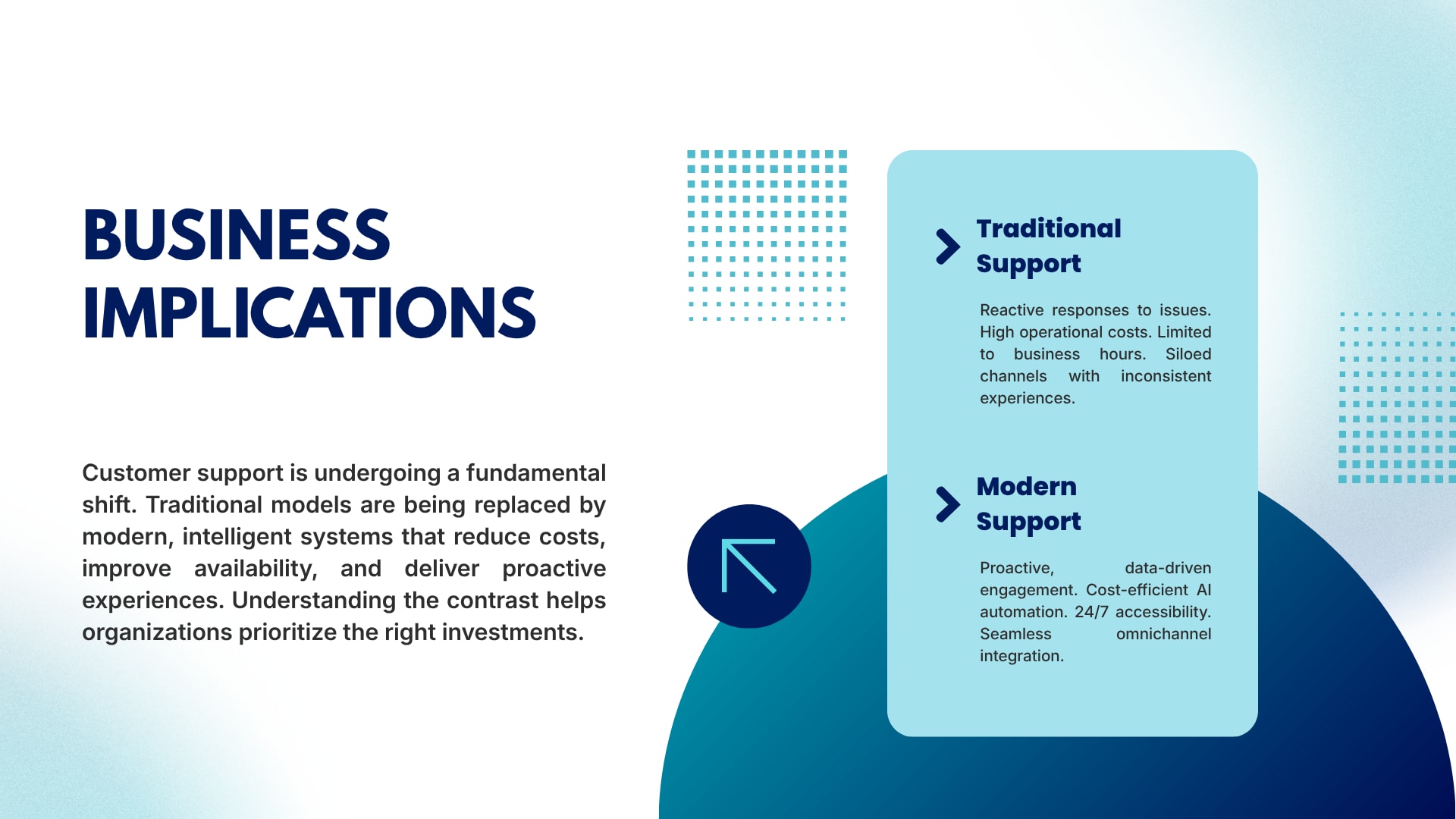
The cost of traditional Customer Support extends beyond employee salaries. Businesses also absorb the operational impact of queues, repetitive work, training, inconsistent responses, limited coverage, and the difficulty of scaling support during demand spikes. Automation can address some of these pressures, although implementation and ongoing oversight also create costs.
A useful evaluation should consider the complete support workflow.
Costs may include:
Agent staffing
Training
Support software
Phone infrastructure
Ticket management
Management time
After-hours coverage
Employee turnover
Repetitive administrative work
Lost opportunities caused by slow responses
AI does not make all of these costs disappear.
It changes where resources are used.
Where do response delays affect customer satisfaction?
Response delays are particularly damaging when customers need simple information to continue a task.
For example, a customer may be ready to complete a purchase but needs confirmation about delivery timing. If the answer requires submitting a ticket and waiting until the next working day, the customer may abandon the process.
A delayed response can also increase the number of follow-up messages.
One unanswered question can become:
“Has anyone seen this?”
“Can someone please respond?”
“Is there an update?”
The support workload grows while the customer experience deteriorates.
Why does scalability become difficult with human-only teams?
Human teams scale through additional people, better processes, improved tools, and better training. Each method has limits.
A sudden increase in demand can therefore expose weaknesses that were invisible during normal periods.
AI support automation provides elastic capacity for certain categories of work. It can manage many routine conversations simultaneously, while human teams handle the cases that need deeper attention.
That is why the strongest argument for automation is not simply cost reduction.
It is capacity management.
How is AI changing the way customer support works?
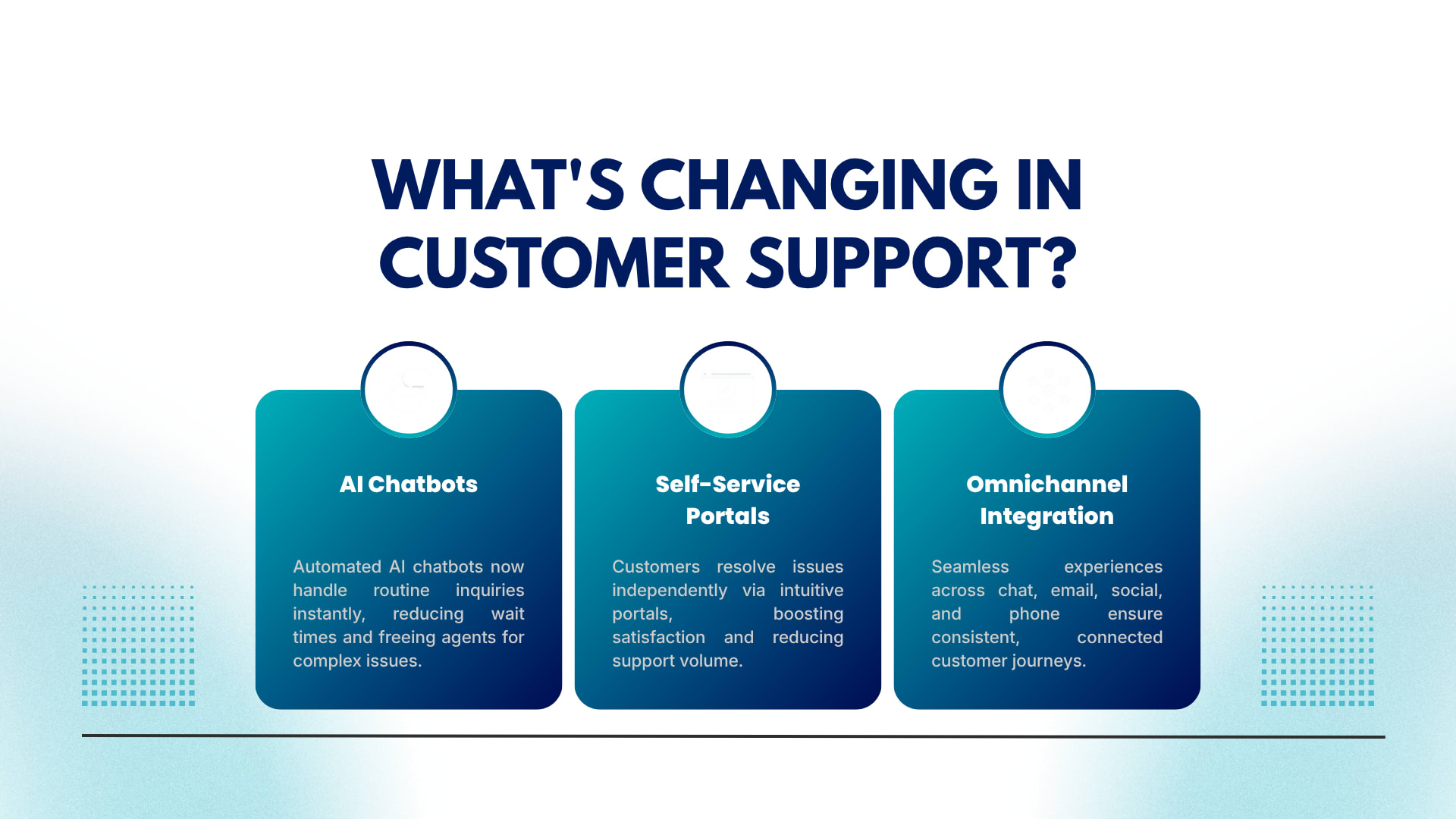
AI is changing Customer Support by moving routine conversations from a human-first process to an automated first-response model. AI-powered customer service can understand natural-language questions, retrieve approved information, guide customers through simple processes, and escalate complex situations. This creates a support system that combines automation, conversational AI, knowledge retrieval, and human oversight.
AI customer support is broader than the traditional chatbot found on many websites.
Older chatbots often depended on predefined buttons and keyword matches.
Modern conversational AI can interpret natural language and use context to produce more flexible responses. The quality still depends on the underlying system, information, controls, and implementation.
What is AI customer support?
AI customer support is the use of artificial intelligence to assist with customer questions, service requests, troubleshooting, information retrieval, and support workflows.
An AI support system may operate through:
Website chat
Mobile applications
Messaging platforms
Social channels
Help centers
Internal support interfaces
The system can be trained or connected to approved business information so responses are based on relevant knowledge.
For example, a software company could provide product documentation, onboarding information, troubleshooting instructions, and frequently asked questions.
The AI then becomes a conversational interface to that information.
How does an AI support agent understand customer questions?
An AI support agent interprets the language and intent behind a customer's message.
Consider three different messages:
“Where is my package?”
“Has my order shipped?”
“When will the delivery arrive?”
The wording is different, but the intent may be similar.
An AI system can identify that intent and retrieve the appropriate information when the necessary data is available.
More advanced systems can also maintain conversational context.
A customer might first ask about a product and then ask, “Does it come with a warranty?”
A conversational system can understand that “it” refers to the product discussed earlier.
That makes the interaction feel more natural than a sequence of disconnected keyword responses.
What role does conversational AI play in customer service?
Conversational AI provides the language layer between customers and automated support systems. Instead of forcing customers to select rigid menu options, it allows them to describe problems in ordinary language.
This can reduce friction.
However, conversational ability should not be confused with unlimited understanding.
AI systems can misinterpret questions, lack necessary information, or produce incorrect answers. Effective support therefore requires clear knowledge sources, boundaries, testing, monitoring, and escalation.
The National Institute of Standards and Technology recommends considering trustworthiness throughout the design, development, deployment, use, testing, and evaluation of AI systems.
Which customer support tasks can be automated?
The best candidates for automation are usually repetitive, predictable, information-based tasks with clear rules and reliable source data. AI can provide first-line assistance for FAQs, basic troubleshooting, order information, knowledge retrieval, initial issue classification, and other routine requests.
Common candidates include:
Frequently asked questions
Product information
Order-status requests
Basic troubleshooting
Appointment information
Return-policy questions
Account instructions
Knowledge-base searches
Initial issue classification
Lead qualification
Basic onboarding guidance
The suitability of automation depends on risk.
A simple product question may be highly suitable.
A sensitive financial complaint may require human review.
The best support strategy therefore starts with task classification rather than trying to automate everything.
Can AI handle FAQs, order-status requests, and basic troubleshooting?
Yes, these are among the more practical areas for AI support when the business has accurate information and the necessary integrations.
For FAQs, the AI can retrieve approved answers.
For order status, the system may need access to order information.
For troubleshooting, the AI can guide customers through documented steps.
The important point is that AI should not invent information when the source data is unavailable.
A good system needs a clear boundary between what it knows and what requires human intervention.
How does AI help with issue classification and knowledge retrieval?
Issue classification helps determine what a customer needs before deciding what should happen next.
For example:
A customer explains a problem.
AI identifies the likely issue category.
The system checks relevant knowledge.
A suitable response is provided.
If the issue is outside the automated scope, the conversation is escalated.
The human agent receives the relevant context.
This can reduce the amount of initial sorting performed manually by support staff.
The agent does not necessarily begin with an empty ticket.
Instead, the agent can receive a conversation that has already been organized.
What is the difference between an AI chatbot and a traditional chatbot?
A traditional chatbot typically follows predefined rules, buttons, keywords, or decision trees, while an AI chatbot can use natural-language processing and conversational models to interpret a wider range of customer questions. The distinction is not absolute, but AI systems generally provide more flexible conversational interaction than purely rule-based bots.
A traditional chatbot might respond:
“Choose one of the following:
Billing
Delivery
Returns”
An AI-powered chatbot may interpret:
“I received the wrong item and need to know how to exchange it.”
The second interaction can potentially identify both the issue and the customer's goal.
How do rule-based chatbots differ from conversational AI?
Rule-based systems are predictable because their behavior is explicitly defined.
That can be useful for structured processes.
Conversational AI is more flexible but introduces additional risks because generated responses may vary and require stronger controls.
The choice depends on the task.
A simple appointment workflow might benefit from clearly defined automation. A broad knowledge-support environment may benefit from conversational AI.
In some cases, both approaches can work together.
Can AI provide genuine 24/7 customer support?
AI can provide continuous first-line Customer Support for suitable tasks, making 24/7 assistance practical without requiring human agents to be available every minute. The important limitation is that round-the-clock AI availability does not mean every issue will be resolved immediately. Complex cases may still require human intervention.
A 24/7 AI support layer can:
Answer routine questions
Provide basic guidance
Collect customer details
Identify issue types
Retrieve approved information
Create or prepare support requests
Route complex cases
Human teams can then handle escalations during their working hours or through dedicated coverage.
What happens when customers need help outside business hours?
The AI can provide immediate assistance and gather information needed for later human review.
For example, a customer reports a billing problem at 11:30 p.m.
Instead of seeing a message that says, “Support is closed,” the customer can explain the issue, receive relevant information, and provide account details.
If the case requires human action, the conversation can be routed to the appropriate team.
The customer still receives a useful interaction even though the human team is unavailable.
How does customer support automation affect response time and scalability?
Customer support automation can reduce response time for routine requests because software can respond without waiting for an available human agent. It can also increase capacity by handling multiple conversations simultaneously. The greatest benefit usually appears when automation is applied to high-volume, repetitive requests rather than complex cases requiring judgment.
Response time is only one metric.
Businesses should also examine:
Resolution rate
Escalation rate
Customer satisfaction
Repeat contacts
First-contact resolution
Agent workload
Accuracy
Abandonment rate
Time to human intervention
A fast incorrect answer is not good Customer Support.
The goal is useful speed.
Why can automation absorb sudden increases in support volume?
Automation is not constrained by shift schedules in the same way human teams are.
If a product launch generates a sudden wave of basic questions, an AI support layer can respond to many of those conversations simultaneously.
The human team can then concentrate on unexpected problems.
That creates a buffer between demand and human capacity.
How can businesses measure the impact of support automation?
A sensible measurement framework compares the support operation before and after automation.
Key measures can include:
Average response time
Average resolution time
Percentage of routine requests automated
Human escalation rate
Customer satisfaction
Repeat-contact rate
Agent workload
Accuracy of automated responses
After-hours interactions
Cost per resolved interaction
The purpose is not to prove that AI is better.
The purpose is to determine whether the new workflow performs better for customers and employees.
What does traditional customer support look like compared with AI-powered support?
FactorTraditional Customer SupportAI-Powered Customer SupportAvailabilityUsually based on staff schedulesCan provide continuous first-line assistanceResponse timeDepends on queue and agent availabilityOften immediate for supported requestsScalabilityRequires additional human capacityCan handle many routine conversations simultaneouslyOperating costPrimarily driven by human labor and support infrastructureIncludes AI technology, integration, monitoring, and human oversightRepetitive queriesUsually handled manuallySuitable for automation when information is reliablePersonalizationStrong human understandingCan use conversation context, customer data, and configured knowledgeHuman involvementCentral to most interactionsFocused more heavily on complex or sensitive casesCustomer experiencePersonal but potentially slowerFast and convenient, with human escalation when needed
The comparison does not establish that one model is universally superior.
A customer with a sensitive complaint may prefer a person.
A customer checking delivery status may prefer instant automation.
The most effective model depends on the nature of the interaction.
Will AI replace human customer support agents?
AI is unlikely to eliminate the need for human Customer Support across most complex service environments. Instead, AI is more likely to change the role of support agents by handling repetitive work while humans focus on judgment, empathy, exceptions, complex troubleshooting, and sensitive customer situations.
This is already reflected in the design philosophy of platforms such as YourSiteChat, whose website describes AI as working alongside human teams and supporting escalation for complex questions.
The more realistic progression is:
Human-only support → Automated support → AI-assisted support → Hybrid human + AI support
That is an evolution rather than a complete replacement.
Which customer support tasks still require human judgment?
Human agents remain especially valuable when a case involves emotion, ambiguity, negotiation, risk, exceptions, or decisions that cannot be safely reduced to a predefined process.
Human-led support is particularly important for:
Sensitive complaints
Complex technical failures
Refund disputes
High-value customers
Emotional situations
Policy exceptions
Escalations
Account-security concerns
Cases involving unclear information
Situations where empathy matters
A customer who has experienced a serious service failure may not want a generic automated response.
That customer may need someone who can listen, understand the circumstances, and take responsibility for resolving the issue.
Why do sensitive complaints need empathy?
Empathy is more than using polite language.
It involves understanding why a situation matters to the customer.
A customer whose business was disrupted by a service outage may need reassurance and accountability. A family dealing with a travel problem may need flexibility. A long-term customer facing a billing issue may expect context rather than a generic policy statement.
AI can help collect information and organize the case.
A human may still need to decide what should happen next.
When should complex issues be escalated to a human?
Escalation should happen when the system lacks confidence, lacks information, reaches a defined risk boundary, or recognizes that human judgment is necessary.
Useful escalation triggers include:
The customer explicitly asks for a human
The issue involves a complaint
The requested action requires authorization
The knowledge base does not contain an answer
The AI cannot confidently interpret the request
The customer has repeated unsuccessful interactions
Sensitive information is involved
A technical problem requires investigation
Good automation does not hide the human team.
It makes reaching the human team more efficient.
Why is the hybrid human + AI model becoming more practical?
The hybrid model combines the speed of automation with the judgment of human agents. AI handles routine interactions, gathers context, and supports the first response, while human employees take over when a situation becomes complex, sensitive, or outside the automated system's authority.
Consider a software support team.
AI handles:
“Where can the invoice be downloaded?”
“Which browsers are supported?”
“How can a password be reset?”
A human handles:
“The billing system charged the company twice and the accounting records are now incorrect.”
The distinction allows each resource to do what it does best.
How does human handoff improve customer experience?
A poor handoff forces customers to repeat everything.
A strong handoff carries the conversation context forward.
For example, an AI assistant may collect:
Customer name
Product
Problem description
Previous troubleshooting steps
Relevant account information
Customer's requested outcome
The human agent can then begin with the actual problem rather than asking the customer to start from the beginning.
This is one of the most important design principles in AI-assisted support.
Automation should remove friction from escalation rather than create another layer of friction.
What are the risks and limitations of AI customer support?
AI customer support can introduce risks involving inaccurate answers, privacy, security, poor escalation, outdated knowledge, inconsistent behavior, and excessive automation. These risks do not make AI unsuitable for support, but they make governance, testing, monitoring, data controls, and human oversight essential.
AI systems are not automatically trustworthy because they are sophisticated.
NIST's AI Risk Management Framework emphasizes characteristics including validity and reliability, safety, security, resilience, accountability, transparency, explainability, privacy enhancement, and fairness.
How can businesses reduce inaccurate or misleading AI responses?
Businesses should create clear boundaries around the information an AI system is allowed to provide.
Practical safeguards include:
Use approved knowledge sources
Keep documentation updated
Test common and unusual questions
Monitor failed conversations
Create escalation rules
Avoid unsupported assumptions
Review high-risk workflows
Track customer feedback
Give agents access to conversation history
A knowledge base that was last updated several years ago can produce poor support even if the AI itself is technically advanced.
The quality of the information remains fundamental.
Why do privacy and data protection matter?
Customer support conversations can contain personal information, account details, payment-related information, business information, and other sensitive data.
AI introduces additional questions about how that information is collected, stored, processed, accessed, and retained.
NIST's Generative AI Profile specifically identifies privacy risks associated with personal information, including the possibility of sensitive information being exposed, inferred, or mishandled.
The Federal Trade Commission has also highlighted the importance of companies honoring privacy and confidentiality commitments when AI systems involve customer data.
Businesses should therefore evaluate:
What data enters the system?
Where is it stored?
Who can access it?
How long is it retained?
What third parties process it?
What security controls exist?
What information should never be disclosed by the AI?
Privacy cannot be treated as a feature added after deployment.
How should businesses manage customer trust?
Customers should know when they are interacting with an automated system when that distinction matters.
Trust improves when the AI is transparent about its role, provides useful answers, avoids pretending to have performed actions it cannot perform, and offers a clear path to human assistance.
A customer is more likely to accept automation when it works as a helpful service rather than an obstacle placed between the customer and the company.
What mistakes do businesses make when implementing support automation?
The most common implementation mistakes involve automating unsuitable tasks, using outdated information, ignoring human escalation, measuring only cost savings, and launching AI without adequate testing. Successful support automation requires process design first and technology second.
Technology cannot repair a poorly designed support process by itself.
If customers currently struggle to find accurate information, the first task is to understand why.
If agents provide inconsistent answers, the organization may need clearer policies and documentation.
If escalation is slow, the handoff process needs improvement.
AI should strengthen a sound process rather than hide a broken one.
Why is automating a broken support process a mistake?
Automation can make a bad process faster without making it better.
Suppose a company has six different versions of its refund policy stored across internal documents.
An AI assistant trained on conflicting information may create inconsistent answers at scale.
The problem is not simply the AI.
The underlying knowledge system is disorganized.
Before automation, businesses should identify:
Which questions are most common.
Which answers are officially approved.
Which processes are predictable.
Which issues require human approval.
Which data sources are reliable.
Which cases are too sensitive for automation.
Why does outdated knowledge create poor AI responses?
Customer support depends on current information.
Prices change.
Products change.
Policies change.
Shipping providers change.
Features change.
An AI system can only provide dependable information when the knowledge it relies on is maintained.
Knowledge management therefore becomes a core part of AI customer service.
How can businesses transition from traditional customer support to AI-assisted support?
Businesses can transition more safely by starting with high-volume, low-risk requests, preparing reliable knowledge sources, defining escalation rules, testing the system, and measuring results before expanding automation. A gradual transition reduces operational risk and gives support teams time to adapt to the new workflow.
A practical transition can follow these steps.
What should be automated first?
The first automation targets should usually be repetitive and predictable.
Examples include:
FAQs
Product information
Delivery questions
Basic account guidance
Simple troubleshooting
Business hours
Appointment information
The initial goal should be learning.
Businesses can observe which questions AI handles successfully and which conversations require human assistance.
Automation can then expand based on evidence.
How should human escalation rules be designed?
Escalation rules should be explicit rather than improvised.
The system should know when it needs human assistance.
A practical framework can include:
Low risk + known answer: AI handles the request.
Low risk + unclear answer: AI asks for clarification or escalates.
High sensitivity: Human review.
Policy exception: Human review.
Customer requests human: Human handoff.
Repeated unsuccessful attempts: Human handoff.
This creates predictable boundaries.
How should AI support performance be monitored?
Performance should be monitored continuously.
Useful metrics include accuracy, customer satisfaction, escalation frequency, unresolved conversations, repeat contacts, response time, and agent workload.
Businesses should also review actual conversations.
A dashboard may show that response time improved.
Conversation reviews may reveal that answers became less accurate.
Both signals matter.
The goal is not simply to optimize a metric.
The goal is to improve the complete support experience.
Where can a platform such as YourSiteChat fit into a modern support strategy?
YourSiteChat can fit into a modern support strategy as an AI-powered conversational layer for website and messaging interactions. Its published capabilities include AI website chat, knowledge-based training using URLs or documents, human handoff, conversation analytics, multilingual support, and integrations with channels such as WhatsApp, Instagram, Facebook, and web chat.
That positioning is relevant to businesses that want to move beyond a simple FAQ page or traditional live-chat model.
According to its website, YourSiteChat supports training an AI chatbot using website URLs or documents, provides human handoff for complex questions, and offers analytics related to conversations, agent performance, and resolution times.
The appropriate use case still depends on the business.
A company with simple FAQs may need only a small automated layer.
A company operating across several channels may need broader conversation management.
The key is to evaluate the workflow rather than adopting AI simply because AI is available.
A modern support strategy should ask:
Which questions arrive most often?
Which questions can be answered safely?
Which channels matter most?
How quickly should humans intervene?
What customer information is required?
Which conversations should never be automated?
How will performance be evaluated?
What does the future of customer support look like?
The future of Customer Support is likely to combine AI speed, automation, conversational interfaces, and human judgment rather than remove people entirely. AI will increasingly handle routine interactions and information retrieval, while human agents focus on complex, emotional, sensitive, and high-value situations. The strongest support model will be designed around the customer problem, not the technology itself.
The future is therefore less about choosing between humans and AI.
It is about deciding where each belongs.
How will AI-assisted customer service evolve?
AI-assisted customer service will likely become more contextual and connected to business systems. Instead of simply answering questions, support systems may increasingly understand customer history, recognize intent, retrieve relevant information, and coordinate the next step in a service workflow.
That could change the role of the support interface.
Today, a customer may ask:
“How do I change my appointment?”
A future support system may be able to understand the request, identify the appointment, explain available options, and guide the customer through the approved process.
The technology may become less visible.
The experience becomes the focus.
Will customers still want to speak with human agents?
Yes.
Human support remains valuable because not every customer problem is informational.
Some situations involve frustration, uncertainty, financial consequences, technical complexity, or emotional stress.
A human agent can interpret nuance and make judgments that automated systems should not make independently.
The future therefore does not require human support to disappear.
It requires human support to become more valuable.
When AI handles simple requests, human agents have more capacity for conversations where their expertise matters.
How could support become more proactive?
Support may increasingly shift from reacting to customer questions toward identifying problems before customers need to ask.
For example, a system could potentially recognize that a customer is repeatedly encountering the same setup problem and offer relevant guidance.
A SaaS product might identify a common onboarding issue and surface instructions.
An ecommerce system might provide relevant delivery information during a period of disruption.
The principle is simple:
Good support does not always wait for a complaint.
However, proactive support must remain useful rather than intrusive. Too many automated messages can create a different form of customer frustration.
What will the next generation of digital customer support look like?
The next generation of digital customer support will likely be conversational, connected, multilingual, available across multiple channels, and closely integrated with business knowledge and workflows. Customers may not care which underlying AI model is being used; they will care whether the problem is understood and resolved efficiently.
This changes how businesses should think about support technology.
A chatbot sitting alone on a website is not necessarily a complete support strategy.
The stronger model connects:
Customer → Conversation → Knowledge → Business Data → Automation → Human Escalation
Each part contributes something different.
How could conversational AI connect different support channels?
Customers may begin a conversation on a website and continue it through another channel.
For businesses, this creates a need for consistent context.
A customer should not have to explain the same issue repeatedly simply because the communication channel changed.
Omnichannel support therefore becomes more than having multiple channels.
It means coordinating information across those channels.
Platforms such as YourSiteChat describe support for web chat alongside WhatsApp, Instagram, and Facebook conversations through a unified interface.
The value of such an approach depends on implementation, data quality, permissions, and the actual customer journey.
How should businesses prepare for the future of customer service?
Businesses should prepare by auditing current support requests, identifying repetitive work, improving their knowledge base, selecting suitable automation opportunities, establishing human escalation rules, and measuring customer outcomes. Preparation should focus on operational needs first and technology second.
A practical preparation framework can begin with five questions:
What are the top customer questions?
Which questions are repetitive?
Which answers are already documented?
Which issues require human judgment?
Which support metrics need improvement?
Once these answers are clear, technology selection becomes easier.
What should businesses evaluate before adopting AI support?
A serious evaluation should cover more than price.
Businesses should examine:
Accuracy
Knowledge management
Integration requirements
Data privacy
Security
Human handoff
Analytics
Channel availability
Customization
Scalability
Administration
Support workflow compatibility
The cheapest tool may not be the least expensive choice if it creates inaccurate answers or requires substantial manual correction.
Likewise, the most advanced AI may not be appropriate for a business with a small number of simple customer questions.
Fit matters.
How can organizations balance automation with human empathy?
The balance starts by separating interactions according to their nature.
Automation is strong where consistency and speed matter.
Humans are strong where judgment and empathy matter.
That means a business can deliberately design boundaries.
For example:
AI-first
FAQs
Product information
Order status
Basic troubleshooting
Routine guidance
Human-first
Sensitive complaints
Complex disputes
Exceptions
High-value relationships
Emotional situations
AI-assisted human support
Conversation summaries
Knowledge retrieval
Initial classification
Suggested responses
Customer history
This division can make the support organization more efficient without making it less human.
Why is customer support becoming an AI-assisted rather than AI-only function?
Customer support is becoming AI-assisted because automation is particularly effective at repetitive information-based work, while humans remain stronger at judgment, empathy, exceptions, and complex problem-solving. The most practical future therefore combines AI assistance with human ownership instead of treating automation as a complete replacement for support teams.
The shift can be viewed as a redistribution of work.
Previously, a support agent might spend part of the day searching for information and answering simple questions.
With AI assistance, some of that work can be automated.
The agent can spend more time solving unusual cases.
This can change the skills expected from support professionals.
The future support agent may need stronger abilities in:
Complex problem-solving
Customer communication
Escalation management
Product knowledge
AI-assisted workflows
Quality control
Relationship management
Critical thinking
The human role does not necessarily become smaller.
In many situations, it becomes more specialized.
What will the ideal human and AI division of work look like?
The ideal division will vary by business, but a useful model is:
AI handles volume.
Humans handle complexity.
AI retrieves information.
Humans apply judgment.
AI provides speed.
Humans provide empathy.
AI identifies patterns.
Humans decide when exceptions matter.
This model avoids two common extremes.
The first is refusing automation and forcing people to perform every repetitive task manually.
The second is automating everything and leaving customers trapped inside systems that cannot understand unusual situations.
Neither extreme is necessary.
The strongest model uses automation where it is reliable and people where they add meaningful value.
What does the future of customer support ultimately depend on?
The future of Customer Support depends less on whether a business adopts AI and more on how thoughtfully it designs the relationship between automation, information, technology, and people. AI can make support faster and more scalable, but lasting customer trust still depends on accurate information, responsible data practices, clear escalation, and meaningful human involvement.
Traditional support is not simply disappearing.
It is changing shape.
Phone support will remain useful.
Email will remain useful.
Human agents will remain valuable.
But businesses are increasingly adding AI-powered customer service, automated support, conversational interfaces, and 24/7 assistance around those existing systems.
The most important transformation is therefore not human versus AI.
It is human plus AI.
A customer with a simple question should not have to wait hours for an answer that could have been provided immediately.
A support agent should not spend valuable time repeating information that an automated system can provide accurately.
And a customer facing a serious or sensitive problem should not be forced to argue with a machine when human judgment is needed.
The future of customer service sits between those three realities.
AI provides speed.
Automation provides scale.
Conversational systems provide accessibility.
Human agents provide judgment.
Empathy provides trust.
When these elements are designed together, Customer Support becomes more than a department that responds to complaints. It becomes a continuous part of the customer experience.
The end of traditional Customer Support, then, does not mean the end of human service.
It marks the end of a model in which every customer question must follow the same path.
The emerging model is more flexible: simple questions can receive immediate automated assistance, complex issues can move quickly to specialists, and businesses can use technology to make human support more focused and effective.
That is the more useful vision of AI-powered customer service—not a world without support agents, but a support system in which people spend more time doing the work only people can do well.