Social media marketing can become difficult to manage when content planning, research, creation, scheduling, engagement, and performance tracking all compete for the same limited time. AI Agent Mode offers a way to organize many of these repetitive activities into a more connected workflow, allowing marketing teams to spend less time on routine execution and more time on strategy, creativity, and decision-making.
AI social media automation does not mean handing an entire brand account to artificial intelligence and walking away. The strongest approach combines automation with clear goals, human judgment, editorial review, and ongoing performance analysis. When used thoughtfully, AI can help businesses create a more consistent and efficient social media process without removing the human thinking that makes a brand recognizable.
For businesses, agencies, creators, and marketing teams, the real opportunity is not simply generating more posts. It is building a system in which research can inform planning, planning can guide content creation, content can move into publishing workflows, and performance data can influence the next content cycle.
How can AI Agent Mode automate a social media strategy?
AI Agent Mode can support social media automation by connecting repetitive marketing activities into a more organized workflow. Instead of treating research, content creation, scheduling, engagement, and analysis as completely separate jobs, an AI-assisted approach can help coordinate these activities around defined goals and audience needs.
The exact level of automation depends on the AI solution being used, its integrations, the permissions provided, and the workflow designed by the marketing team. That distinction matters because "AI automation" can describe everything from simple content generation to more sophisticated workflows in which an AI system carries out several related tasks.
For social media teams, the most useful starting point is therefore not the question, "What can AI do?" It is:
Which repetitive parts of the social media process can be automated without weakening the brand's strategy or voice?
What is AI Agent Mode?
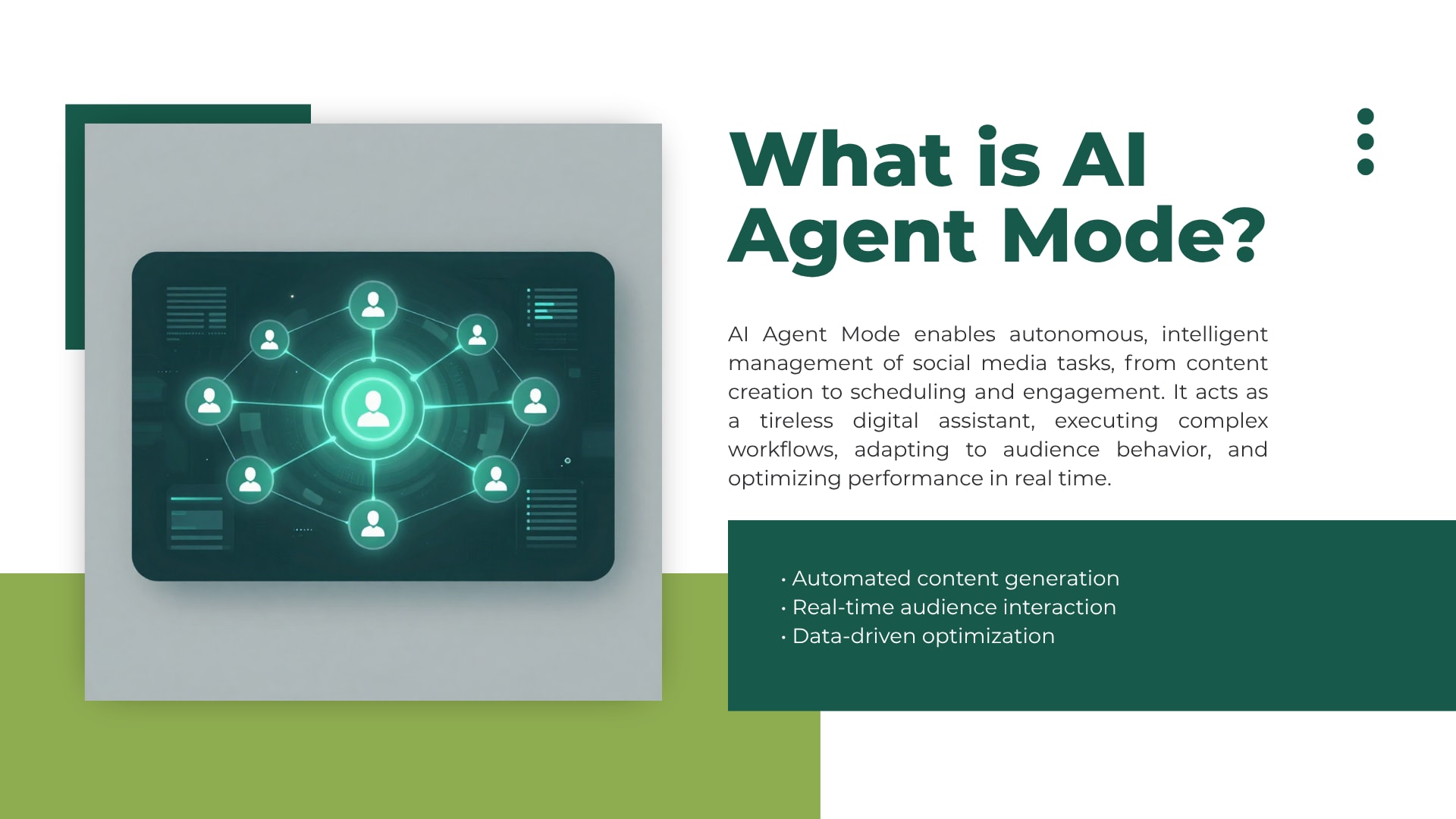
AI Agent Mode refers to an AI-assisted approach in which an AI system can work through a defined task or workflow rather than simply responding to one isolated prompt. In a social media context, that can mean supporting multiple connected activities, such as researching topics, organizing ideas, preparing content, or helping move information from one stage of a marketing workflow to another.
Traditional generative AI often works on a request-and-response basis. A marketer asks for ten post ideas, receives ten ideas, and then decides what to do next. An agent-oriented workflow can be designed around a broader objective, with multiple steps arranged around that objective.
For example, a social media workflow could begin with a marketing goal, move into audience research, generate content themes, prepare platform-specific drafts, send those drafts for review, and then support the publishing or measurement process.
That does not mean every AI Agent Mode product performs every one of these activities automatically. Capabilities vary between platforms, so businesses should verify current functionality before choosing a solution.
The Viral Marketing's AI Agent Mode can be explored as one option for businesses and marketers interested in AI-assisted marketing workflows. Explore AI Agent Mode from The Viral Marketing
How is AI social media automation different from ordinary content generation?
AI content generation creates an output from an instruction. AI social media automation focuses on the broader process surrounding that output.
For example, a basic content-generation task might look like this:
A marketer asks AI for five Instagram captions.
AI generates the captions.
The marketer copies them into another tool.
The marketer adds images.
The marketer schedules each post.
The marketer later checks engagement manually.
An automated workflow could potentially organize more of these steps into a connected process.
The distinction is important because content creation is only one part of social media management. A business can generate hundreds of captions and still have an ineffective social strategy if those captions are not connected to audience needs, business objectives, content themes, publishing schedules, or performance data.
AI marketing automation becomes more valuable when it reduces operational friction rather than simply increasing the volume of content.
Which social media tasks can AI automate?
AI can support many repetitive areas of social media management, although the precise capabilities depend on the tools and integrations involved.
Common areas include:
Topic and content research
Content idea generation
Content calendar planning
Caption drafting
Short-form copy creation
Content repurposing
Platform-specific content adaptation
Hashtag or keyword research
Scheduling support
Audience interaction assistance
Performance monitoring
Reporting
Content analysis
Workflow organization
Follow-up tasks
Repetitive administrative work
The best candidates for automation are usually tasks that happen frequently, follow recognizable patterns, and do not require sensitive judgment.
For example, turning a long educational article into several social media post concepts can be a strong automation opportunity. Deciding how a company should respond publicly to a serious customer complaint usually requires human review.
Can AI automate the entire social media strategy?
No. AI can automate substantial parts of social media execution, but a strong strategy still requires human direction.
A social media strategy involves decisions about positioning, audience, brand identity, business objectives, creative direction, messaging, reputation, and priorities. These decisions cannot be reduced to publishing as many posts as possible.
Automation works best when it handles operational work around a strategy that has already been defined.
A practical model is:
AI automation + human strategy + editorial oversight
The human team determines what the brand wants to achieve. AI helps organize and execute repeatable activities. Humans then review important outputs and use performance information to improve the next cycle.
This approach is more sustainable than treating AI as a complete replacement for marketing judgment.
Why does social media automation with AI matter for small businesses?
Small businesses often face a simple problem: there are many social media tasks but very few people available to perform them.
A business owner may need to manage Instagram, LinkedIn, Facebook, short-form video, website content, customer questions, promotions, and other marketing activities while also running the business.
AI social media automation can reduce some of the repetitive workload.
Consider a small fitness studio. Its marketing process might include:
Planning weekly topics
Creating educational posts
Promoting classes
Repurposing customer questions into content
Preparing captions
Scheduling posts
Reviewing engagement
Identifying popular topics
Without a system, these activities can become scattered across notes, spreadsheets, messaging apps, and different publishing tools.
An AI-assisted workflow can help organize the process so the team spends more time deciding what deserves attention and less time repeatedly formatting or recreating similar content.
How can AI agents support content planning?
Content planning is one of the areas where AI can provide useful operational support because it involves repeated research, categorization, organization, and adaptation.
A business can begin by defining several content pillars.
For example, a SaaS company might use:
Educational content
Product education
Industry insights
Customer problems
Company culture
Frequently asked questions
AI can then help generate topic ideas within those categories, identify variations of a topic, suggest formats, and organize ideas into a potential content calendar.
The marketing team still needs to decide which ideas fit the brand and audience.
A useful content planning workflow might look like this:
Business objective → audience → content pillars → topics → formats → platform adaptation → review → publishing → measurement
The benefit comes from connecting the stages rather than treating each stage as an isolated task.
Can AI create platform-specific social media content?
Yes, AI can help adapt the same underlying idea for different platforms, but the content should not simply be copied everywhere.
Each platform has its own audience expectations and communication patterns.
A LinkedIn post may need a professional and insight-driven structure. An Instagram caption may be more visual and conversational. An X post may require concise wording. A short-form video needs a strong opening and a structure that works visually.
AI content creation can help marketers adapt one central idea into multiple versions.
For example, a company publishes a detailed article about customer retention.
That single source can become:
A LinkedIn educational post
An Instagram carousel concept
A short video script
Several short social posts
A customer FAQ
A discussion prompt
A newsletter topic
This is where social media workflow automation can create meaningful productivity gains. Instead of repeatedly starting from zero, the team creates a central piece of knowledge and systematically repurposes it.
How can AI help with social media scheduling?
Scheduling is highly repetitive, which makes it a natural candidate for automation.
A basic scheduling process might require a marketer to manually determine:
Which post goes out
On which platform
On what date
At what time
With which caption
With which creative asset
Under which campaign
When the same process occurs every week, administrative effort can grow quickly.
AI-assisted systems can help organize content into publishing workflows, although actual scheduling and publishing capabilities vary between platforms and software providers.
Automation should also account for changes. A post prepared weeks in advance may no longer be appropriate if a major event, product issue, public announcement, or crisis occurs.
For that reason, scheduling should never be completely disconnected from human oversight.
How can AI support audience engagement?
Audience engagement is another area where AI can assist, particularly when the workload involves repetitive questions or common interactions.
For example, a company may receive recurring questions about:
Pricing
Opening hours
Product availability
Service areas
Basic features
Booking procedures
Delivery information
AI can help categorize these interactions, draft responses, or identify conversations that require attention.
However, engagement is not simply a volume exercise.
A customer complaint, sensitive issue, legal concern, public criticism, or high-value customer conversation should receive appropriate human attention.
A useful system can therefore separate routine interactions from conversations that need escalation.
What should AI handle in audience engagement?
AI may be suitable for:
Identifying frequently asked questions
Categorizing messages
Drafting routine responses
Summarizing conversations
Highlighting unanswered questions
Suggesting response structures
Human review remains valuable for:
Complaints
Sensitive subjects
Crisis communication
Refund disputes
Legal or regulatory topics
Major announcements
High-value relationships
Public criticism
The goal is not to make every interaction automated. The goal is to make sure human attention goes where it matters most.
How can AI improve social media productivity?
Social media productivity is not measured by how many posts a team publishes.
A productive social media process produces useful work with less unnecessary repetition.
AI can help reduce repetitive tasks such as:
Searching for basic topic variations
Creating first drafts
Reformatting content
Summarizing performance data
Organizing content ideas
Repurposing existing material
Preparing recurring reports
Categorizing audience feedback
This can give marketers more time for higher-value activities such as creative direction, campaign planning, customer research, brand positioning, and experimentation.
The productivity gain becomes particularly noticeable when a team manages several brands or platforms.
An agency, for example, may repeat similar operational tasks for multiple clients every week. Automating appropriate parts of those workflows can reduce administrative workload while allowing account managers to focus on strategy and client communication.
What does an AI-powered social media management workflow look like?
A practical AI-powered workflow can be organized into several connected stages.
1. Define the goal
The business first determines what the social strategy is supposed to achieve.
Possible goals include:
Brand awareness
Website traffic
Lead generation
Community building
Customer education
Product awareness
Recruitment
Customer retention
2. Define the audience
The workflow should identify who the content is intended for.
This includes audience problems, interests, questions, objections, and preferred content formats.
3. Research topics
AI can assist with organizing existing information, finding topic patterns, and generating content opportunities.
4. Build content pillars
The team establishes categories that support the broader marketing strategy.
5. Create a content calendar
Topics can be organized by platform, campaign, date, format, and objective.
6. Generate content
AI can help create first drafts, variations, captions, hooks, outlines, and platform-specific adaptations.
7. Review content
A human checks accuracy, tone, brand voice, claims, context, and creative quality.
8. Schedule or publish
Approved content moves into the appropriate publishing workflow.
9. Monitor engagement
Performance and audience reactions are tracked.
10. Analyze results
The team identifies what worked, what did not, and why.
11. Improve the next cycle
Insights from the previous period influence future content planning.
This creates a continuous system rather than a one-time content-generation exercise.
Where does The Viral Marketing's AI Agent Mode fit into this workflow?
The Viral Marketing's AI Agent Mode can be considered in the broader context of AI marketing automation for teams that want to explore more structured AI-assisted workflows.
Because product capabilities can change, businesses should review the current official Agent Mode page before making decisions about specific functionality. The available information in the supplied brief does not establish a detailed feature list, so individual capabilities should not be assumed without verification. The Viral Marketing AI Agent Mode page
The useful way to evaluate any AI social media solution is to begin with the workflow rather than the feature list.
A marketing team can ask:
Which repetitive tasks consume the most time?
Which tasks follow predictable processes?
Which tasks require human judgment?
Which platforms need to be managed?
What information needs to move between tasks?
Where does approval need to happen?
How will performance be measured?
That evaluation makes it easier to determine whether an AI Agent Mode approach is genuinely useful or simply adds another tool to an already complicated marketing stack.
What are the benefits of automating social media with AI?
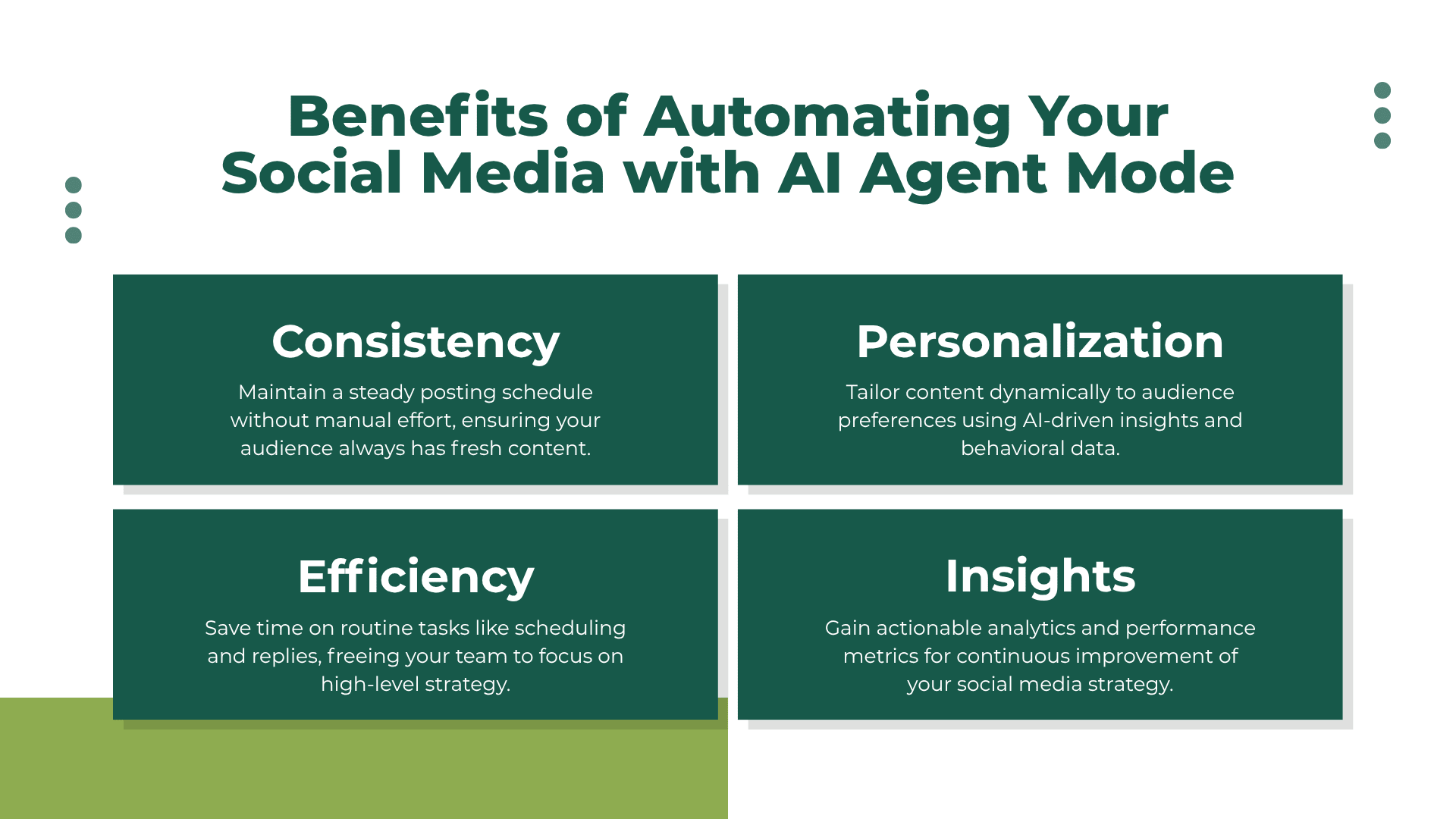
AI social media automation can provide several practical benefits when implemented correctly.
Greater consistency
A structured workflow makes it easier to maintain a regular publishing rhythm.
Less repetitive work
AI can assist with recurring research, drafting, repurposing, categorization, and administrative tasks.
Faster content development
Marketers can move from an initial idea to a reviewed draft more quickly.
Better content reuse
Existing articles, videos, webinars, reports, and other assets can be transformed into multiple social formats.
Improved workflow visibility
A centralized process can make it easier to see what is planned, drafted, approved, published, and measured.
More time for strategy
Reducing routine work gives marketers more time for creative and strategic decisions.
Scalability
Agencies and growing businesses can potentially manage larger content operations without increasing every manual task at the same rate.
The benefits depend heavily on implementation. Poor automation can create more work rather than less.
What are the limitations of AI social media automation?
AI automation also has important limitations.
AI can produce content that sounds convincing while containing inaccurate information. It may misunderstand context, produce generic messaging, repeat ideas, or fail to recognize when a topic requires sensitivity.
Automation can also create a false sense of productivity.
A business may publish consistently and still fail to build an audience if the content lacks relevance.
Other limitations include:
Inaccurate information
Generic brand voice
Repetitive content
Weak creative judgment
Poor context awareness
Platform-specific mistakes
Over-automation
Reduced authenticity
Privacy concerns
Incorrect customer responses
For these reasons, automation should be designed around clear boundaries.
A good system automates predictable work while keeping people responsible for important decisions.
What should remain human-led in social media marketing?
Certain areas should remain strongly human-led.
Brand voice: A brand needs a recognizable personality.
Creative direction: AI can produce options, but humans determine which ideas genuinely fit the brand.
Sensitive topics: Social and cultural issues require contextual judgment.
Customer complaints: Customers should not feel that a serious issue is being handled by an impersonal automated response.
Crisis communications: Crisis situations can change quickly and require leadership-level decisions.
Claims: Marketing claims should be checked before publication.
Important announcements: Major company updates deserve careful review.
High-value conversations: Sales opportunities, partnerships, community relationships, and important customer interactions benefit from human attention.
The strongest AI marketing strategy is therefore not "automate everything."
It is "automate the right things."
How can a business decide what to automate?
A simple scoring approach can help.
For every recurring social media task, evaluate it using four questions:
Does the task happen frequently?
Does it follow a predictable process?
Does it require limited judgment?
Would automation save meaningful time?
If the answer is yes to most of these questions, the task may be a good automation candidate.
For example:
Workflow AreaManual Social Media ManagementAI-Assisted Social Media ManagementAI Agent Mode ApproachContent researchRepeated manual researchAI-assisted research and ideasCan support connected research workflowsContent creationDrafted manuallyAI generates first draftsCan fit into broader content workflowsRepurposingManual adaptationAI creates variationsCan organize repeatable transformation tasksSchedulingManual platform managementScheduling tools reduce effortCan support workflow-based publishing processes where supportedEngagementManual responsesAI-assisted response draftingCan help organize repetitive interaction workflows where supportedAnalyticsManual review and reportsAI-assisted summariesCan connect analysis to broader workflows where supportedStrategyHuman-ledHuman-led with AI supportHuman-led with AI assistance
The table highlights an important point: AI Agent Mode should not automatically be viewed as a replacement for traditional social media management. Its value depends on how effectively it fits into the wider workflow.
How can businesses implement an AI-powered social media workflow?
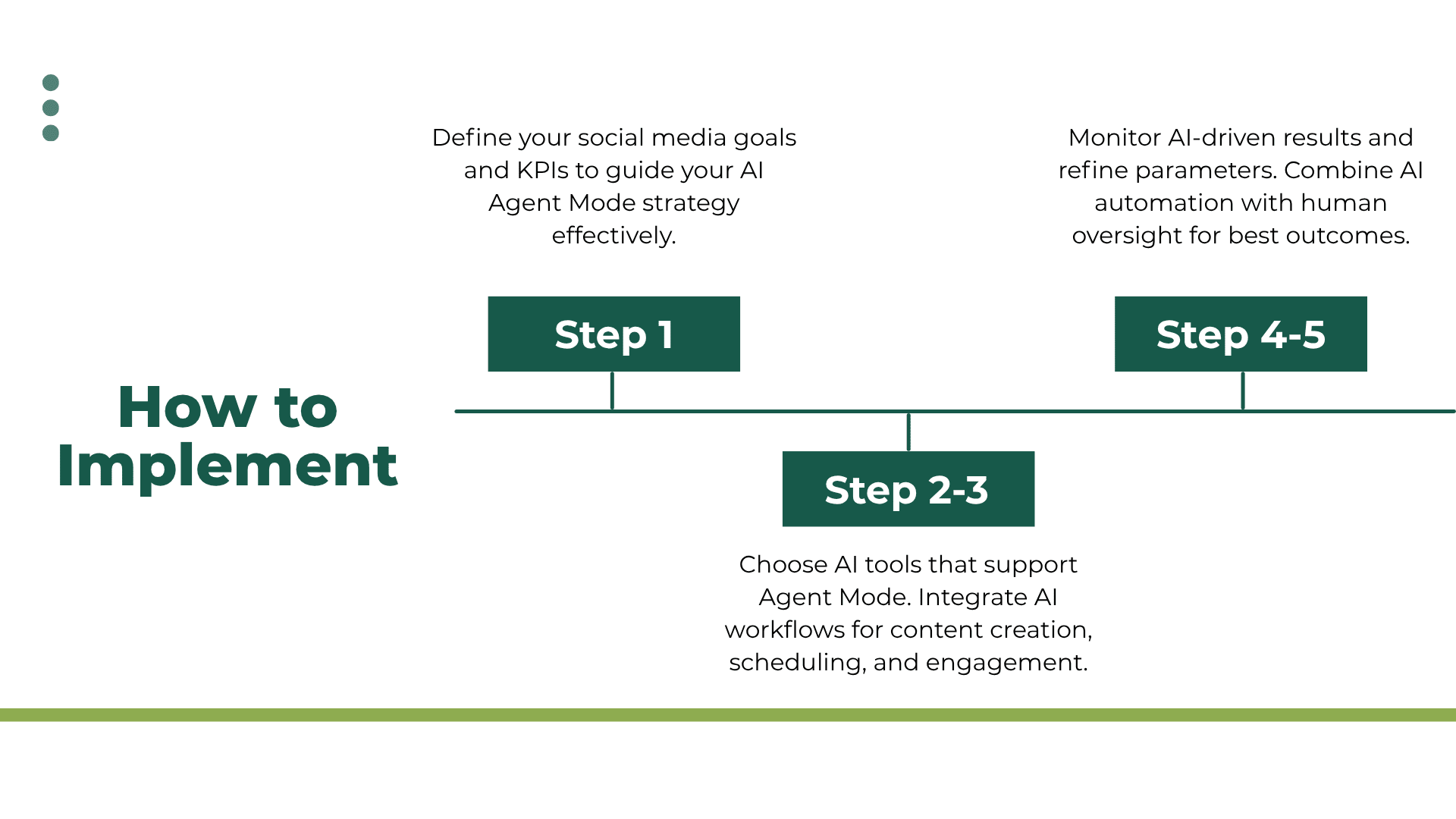
Businesses can implement AI social media automation successfully by starting with a clear process, selecting suitable tasks, establishing review points, and measuring the outcome. The most effective implementation is usually gradual: automate repetitive activities first, observe the results, then expand automation only when quality and control remain strong.
A business does not need to automate its entire marketing operation on day one.
The better approach is to build one reliable workflow at a time.
What is the first step in implementing AI social media automation?
The first step is to document the existing workflow.
Before choosing an AI marketing tool, a business should understand how social media work currently happens.
A typical process may involve:
Marketing strategy
Research
Content planning
Writing
Design
Approval
Scheduling
Publishing
Engagement
Analytics
Reporting
The team should identify where time is being lost.
For example, if content writers spend hours turning existing articles into social posts, repurposing could be the first automation opportunity.
If managers spend significant time creating weekly performance summaries, reporting could be a better starting point.
Automation should solve a real operational problem.
How should businesses define social media goals before using AI?
AI cannot determine the correct business objective simply by generating content.
The business needs to establish the destination first.
A social media goal should connect with a broader business objective.
For example:
Weak goal: Post every day.
Stronger goal: Increase qualified website visits from LinkedIn by publishing useful content for decision-makers.
The second goal gives AI-assisted workflows more context.
Content can then be evaluated according to relevance rather than volume.
Other useful goals include:
Generate qualified leads
Increase engagement among a specific audience
Improve brand visibility
Educate potential customers
Support product launches
Build a professional community
Increase traffic to useful resources
The clearer the goal, the easier it becomes to judge whether automation is actually helping.
How can AI help identify a target audience?
Audience research is another area where AI can help organize information.
A marketing team may already have:
Customer questions
Sales conversations
Website analytics
Search queries
Product feedback
Reviews
Social comments
Support tickets
AI can help summarize these sources and identify recurring themes.
For example, a software company may discover that prospects repeatedly ask about integration, pricing complexity, implementation time, and security.
Those themes can become content pillars.
The important point is that AI should work from relevant information rather than inventing an audience profile without evidence.
Real customer information produces better strategic direction.
How can businesses build an AI social media content calendar?
A useful content calendar connects topics with objectives rather than simply filling dates.
A weekly structure might include:
Monday: Educational content
Tuesday: Industry insight
Wednesday: Customer problem
Thursday: Product education
Friday: Opinion or discussion
Weekend: Community or lighter content
This is only an example. The right structure depends on the audience, platform, industry, and business goal.
AI can assist by generating topic variations within each content pillar.
For example, the topic "email marketing" could become:
Beginner guide
Common mistakes
Myth versus reality
Step-by-step tutorial
Industry example
Checklist
Frequently asked question
Expert discussion prompt
This helps prevent the content calendar from becoming repetitive.
How can AI help repurpose existing content?
Content repurposing is one of the most practical applications of AI marketing automation.
A single long-form resource can contain multiple useful ideas.
Consider a 2,000-word article about improving customer onboarding.
It could become:
A LinkedIn post
An Instagram carousel
A short video script
A series of short posts
A checklist
A discussion question
A newsletter section
A sales enablement summary
The original content becomes the source, while AI assists with transformation.
Human review remains necessary because each platform requires a different context and tone.
The objective is not to duplicate content everywhere. It is to extract the useful ideas and present them in formats that suit different audiences.
Can AI improve content personalization?
AI can support personalization by helping marketers create variations for different audiences, industries, stages of the buying journey, or content preferences.
For example, a cybersecurity company could create separate versions of an educational topic for:
Small businesses
Enterprise teams
IT managers
Business executives
The underlying subject remains similar, but the examples and concerns change.
Personalization should still be based on genuine audience differences.
Creating dozens of nearly identical posts simply to produce more content does not necessarily improve the customer experience.
Quality matters more than quantity.
How can businesses maintain brand voice when using AI?
Brand voice should be documented before large-scale AI content creation begins.
A useful brand voice guide can define:
Preferred tone
Sentence style
Vocabulary
Words to avoid
Level of formality
Communication principles
Audience expectations
Examples of good messaging
AI can then use these guidelines as context.
However, even a detailed prompt does not guarantee perfect brand alignment.
Human review remains valuable, especially for public-facing content.
A useful review process asks:
Does this sound like the brand?
Would a real customer understand it?
Does it provide something useful?
Does it make claims that can be supported?
Does it sound natural rather than generic?
These questions help protect the identity of the business.
How should AI-generated social media content be reviewed?
A review process should check five major areas.
Accuracy
Are the facts correct?
Relevance
Does the content address something the audience actually cares about?
Brand fit
Does the language match the company's communication style?
Originality
Does the post offer a useful perspective instead of repeating generic information?
Risk
Could the content create a legal, reputational, customer-service, or compliance issue?
This is especially important because convincing language does not automatically mean accurate information.
Google's current guidance emphasizes helpful, reliable, people-first content and warns against creating content primarily to manipulate search rankings. It also recommends focusing on originality, usefulness, and demonstrated expertise rather than producing large quantities of low-value material.
How can businesses measure whether AI automation is working?
Automation should be measured by both marketing results and operational efficiency.
Marketing metrics may include:
Reach
Engagement
Website traffic
Leads
Conversions
Audience growth
Video completion
Saves
Shares
Comments
Operational metrics can include:
Hours saved
Content production time
Approval time
Number of assets repurposed
Publishing consistency
Reporting time
Number of manual steps removed
Suppose a marketing team previously spent eight hours each week preparing social content and reports. After improving the workflow, that effort falls to four hours while content quality and performance remain stable.
That is a meaningful productivity improvement.
However, if automation reduces production time but engagement, accuracy, and brand quality also decline, the workflow needs adjustment.
What are common mistakes when automating social media?
Several mistakes appear repeatedly in AI-assisted marketing workflows.
Automating before defining the strategy
AI can produce content quickly, but speed without direction can create noise.
Publishing too much
More content does not automatically create more value.
Removing human review
Important content should not be published blindly.
Using identical content everywhere
Different platforms require different approaches.
Ignoring audience feedback
Automation should not become a barrier between the brand and its audience.
Focusing only on vanity metrics
Likes and impressions can be useful, but they should be connected to meaningful objectives.
Trusting AI-generated claims without checking them
Every factual claim should be evaluated according to its importance and potential risk.
Creating generic content
AI-generated content becomes weak when it simply repeats information that is already everywhere.
Google's guidance for generative AI search similarly emphasizes unique, valuable, non-commodity content and warns against approaches designed mainly to manipulate visibility.
How can agencies use AI agents for social media?
Agencies are particularly suited to workflow automation because they manage recurring processes across multiple accounts.
An agency might repeat the following activities for every client:
Research
Content planning
Caption writing
Content repurposing
Approval management
Scheduling
Reporting
Performance analysis
A standardized AI-assisted workflow can reduce repeated administrative work.
However, each client still needs a distinct strategy.
A real estate client, healthcare organization, software company, restaurant, and financial business should not receive the same generic content system.
AI can help with operational scale, while account managers maintain strategic differentiation.
The more clients an agency manages, the more important clear workflow boundaries become.
How can creators use AI Agent Mode without losing authenticity?
Creators often spend significant time moving from idea to finished content.
AI can assist with:
Research
Brainstorming
Outlining
Hook variations
Script drafts
Repurposing
Caption writing
Content organization
But the creator's perspective remains the differentiating factor.
Audiences generally follow creators because of their opinions, experiences, knowledge, personality, or style.
If automation removes those elements, the content may become efficient but less interesting.
A good creator workflow therefore uses AI as an assistant rather than a substitute for personal perspective.
How can small teams start with AI marketing automation?
Small teams should start with one workflow that causes a clear bottleneck.
For example:
Problem: Social media ideas take too long to organize.
Automation opportunity: AI-assisted topic research and content planning.
Once that process works reliably, the team can add another stage.
For example:
Stage 1: Content research
Stage 2: Content planning
Stage 3: Draft creation
Stage 4: Human review
Stage 5: Scheduling
Stage 6: Performance analysis
This gradual approach reduces the risk of creating a complicated automation system that nobody uses consistently.
What should businesses look for in an AI social media automation solution?
The right solution should be evaluated based on workflow fit rather than the number of features listed on a website.
Important evaluation criteria include:
Ease of use
Workflow flexibility
Integration options
Content quality
Human approval controls
Platform compatibility
Analytics support
Data handling
Reliability
Scalability
Transparency around capabilities
Overall fit with the marketing team's process
Businesses should also distinguish between features that are available today and capabilities described as future possibilities.
For teams evaluating The Viral Marketing's AI Agent Mode, the official product page should be checked for the latest capabilities, workflow options, and product details before implementation. Review The Viral Marketing's AI Agent Mode
How can a business create a 30-day AI social media automation plan?
A gradual 30-day plan can help a business move from experimentation to a repeatable workflow.
Days 1–7: Audit
Document current social media activities.
Identify repetitive tasks.
Measure how much time is spent on content production, scheduling, engagement, and reporting.
Days 8–14: Design
Choose one or two tasks to automate.
Create brand voice guidelines.
Define approval rules.
Set content goals and audience priorities.
Days 15–21: Test
Run the AI-assisted workflow on a small batch of content.
Review accuracy, quality, consistency, and time savings.
Identify errors or unnecessary steps.
Days 22–30: Improve
Refine prompts and workflow instructions.
Create reusable processes.
Measure performance.
Decide whether another stage should be automated.
This approach makes automation a controlled business improvement rather than a sudden change to the entire marketing operation.
How can AI Agent Mode support a continuous social media strategy?
A strong social media workflow is not finished when a post is published.
The most valuable system creates a feedback loop.
That loop looks like:
Plan → Create → Review → Publish → Monitor → Analyze → Improve → Plan again
AI can assist at several points within that cycle.
For example, performance data can help identify which topics deserve further exploration. Audience questions can become future content ideas. High-performing articles can be repurposed into new formats. Underperforming content can be reviewed for potential weaknesses.
The result is an evolving automated social media strategy rather than a static content calendar.
What does the future of AI agents for social media look like?
AI marketing agents are likely to become increasingly connected to broader marketing workflows.
Rather than using separate AI tools for isolated tasks, businesses may increasingly expect AI systems to work across multiple stages of a process.
That could mean more connected workflows involving:
Research
Planning
Content production
Campaign coordination
Audience analysis
Reporting
Optimization
The exact direction will depend on platform capabilities, integrations, privacy requirements, business adoption, and how much control organizations want to retain.
The important shift is from isolated AI prompts toward structured workflows.
Instead of asking an AI system to "write a caption," marketers can think in terms of a larger objective:
Find a relevant topic, develop the idea, adapt it to the right audience, prepare the content, route it for approval, publish it through the appropriate workflow, and learn from the result.
That is closer to how an AI agent can become useful within marketing operations.
Will AI replace social media managers?
AI is unlikely to eliminate the need for strong social media management in every organization because strategy, creativity, communication, and judgment remain important.
The role may change, however.
Social media professionals may spend less time on repetitive execution and more time on:
Strategy
Audience research
Creative direction
Brand development
Campaign planning
Community building
Performance interpretation
Relationship management
The marketer who knows how to design and supervise AI workflows may become more valuable than the marketer who simply produces content manually.
That makes AI literacy an increasingly practical skill for social media professionals.
How can businesses avoid over-automation?
The simplest safeguard is to create explicit human approval points.
For example:
AI research → human topic selection → AI draft → human editing → AI-assisted scheduling → human monitoring
This model keeps automation where it provides efficiency while preserving human control over important decisions.
Businesses can also establish rules such as:
No automatic publishing for sensitive topics
Human approval for major announcements
Human review of factual claims
Escalation for complaints
Human approval for crisis communication
Regular audits of automated workflows
Automation should make the team more capable, not less aware of what the brand is communicating.
How can businesses use AI without damaging content quality?
The answer is to measure quality alongside efficiency.
A useful review framework can score content based on:
Relevance: Does it matter to the audience?
Originality: Does it add something beyond common information?
Accuracy: Are claims supported?
Clarity: Can the intended audience understand it quickly?
Brand alignment: Does it sound appropriate for the business?
Actionability: Does the reader gain something useful?
Engagement potential: Does it give people a reason to respond, save, share, or continue learning?
AI can help produce drafts faster, but these standards should remain human-controlled.
Is AI social media automation good for SEO and search visibility?
AI social media automation can support a broader content strategy, but automation itself does not guarantee search visibility.
Google's current guidance states that its AI search features continue to rely on foundational SEO and content-quality principles. There are no special "AI search hacks" that guarantee inclusion; useful, unique, people-first content remains central.
For marketers, that means social automation should not be built around generating large quantities of content simply because AI makes production faster.
A better strategy is to use automation to improve the process behind genuinely useful content.
Social posts can support visibility indirectly by distributing useful information, encouraging discovery, generating conversations, and directing audiences toward deeper resources.
The quality of the underlying content still matters.
How should businesses balance AI automation and human creativity?
A useful division of responsibility is straightforward.
AI is strong at:
Repetition
Organization
Drafting
Summarization
Variation
Categorization
Workflow support
Pattern recognition
Humans are strong at:
Judgment
Context
Empathy
Original perspective
Strategic decisions
Creative direction
Relationship building
Risk assessment
The best social media systems combine these strengths.
A business should not ask AI to replace the part of marketing that makes the brand distinctive. It should use AI to reduce the operational work that prevents marketers from doing that distinctive work.
What is the best way to get started with AI Agent Mode?
The best starting point is a specific workflow rather than a broad promise to automate everything.
A business can begin by identifying one recurring social media task that consumes significant time and has a predictable structure.
For example:
"The marketing team spends too much time turning existing articles into social content."
That problem can become an automation experiment.
The team can define:
What information the AI receives.
What output it should produce.
Which platforms are involved.
What quality standards apply.
Where human approval is required.
How the result will be measured.
Once that workflow becomes reliable, another task can be added.
This approach makes AI automation measurable, manageable, and easier to improve.
Frequently Asked Questions About AI Agent Mode and Social Media Automation
What is AI Agent Mode?
AI Agent Mode is an AI-assisted approach designed around completing or supporting broader tasks and workflows rather than responding to only one isolated instruction. In social media marketing, it can be used as part of workflows involving research, planning, content creation, organization, engagement support, and analysis, depending on the capabilities of the specific platform.
Can AI automate social media management?
AI can automate or assist with many repetitive parts of social media management, including content research, drafting, repurposing, organization, scheduling support, engagement assistance, and reporting. Human oversight remains important for strategy, sensitive conversations, factual claims, brand voice, and major communications.
How can AI Agent Mode help with social media marketing?
AI Agent Mode can help organize connected marketing tasks into a more structured workflow. Instead of using AI only for isolated content generation, businesses can explore how agent-based workflows may support several stages of their social media process. The exact capabilities depend on the solution being used.
Can AI create social media content automatically?
AI can generate social media drafts, captions, hooks, post ideas, scripts, and variations. However, automatically generated content should be reviewed for accuracy, relevance, brand voice, originality, and platform suitability before publication.
Is AI social media automation suitable for small businesses?
Yes. Small businesses can benefit from automation because they often have limited marketing resources and many repetitive tasks. Starting with a single high-value workflow, such as content planning, repurposing, or reporting, can make adoption easier.
Can AI agents manage multiple social media tasks?
AI agents can potentially support multiple connected tasks, depending on the platform, integrations, permissions, and workflow design. Businesses should verify the current capabilities of any specific AI solution rather than assuming that every agent can independently manage every social media function.
How much of a social media strategy should be automated?
Only the parts that are repetitive, predictable, and appropriate for automation should be automated. Strategy, brand positioning, creative direction, sensitive communications, crisis response, and important customer relationships should retain meaningful human involvement.
What should businesses look for in an AI social media automation tool?
Businesses should look for workflow fit, ease of use, integrations, content quality, review controls, platform compatibility, analytics, scalability, reliability, and transparency around capabilities. The best tool is not necessarily the one with the longest feature list; it is the one that solves a real workflow problem.
Is human oversight still needed when using AI for social media?
Yes. Human oversight remains important for brand voice, sensitive subjects, customer complaints, factual claims, crisis communications, major announcements, and high-value conversations. Human review also helps prevent repetitive or generic content from becoming the dominant voice of the brand.
How can businesses get started with AI Agent Mode?
Businesses can start by identifying one repetitive social media task, documenting its current process, defining the desired output, establishing review rules, testing the workflow, and measuring the results. The Viral Marketing's AI Agent Mode can then be explored as a potential solution within that broader automation strategy. Explore AI Agent Mode from The Viral Marketing
Final Thoughts
AI social media automation is most useful when it solves a real workflow problem.
The objective should not be to publish more content simply because AI makes content production faster. A stronger objective is to build a system that helps marketing teams research more efficiently, organize ideas, repurpose valuable material, reduce repetitive work, maintain consistency, and learn from performance.
AI Agent Mode fits into this shift from isolated AI prompts toward connected workflows. It can be especially relevant for businesses, creators, agencies, and marketing teams looking for ways to structure repetitive social media activities more efficiently.
Still, automation should have boundaries.
The strongest model combines AI automation, human strategy, and editorial oversight. AI can handle appropriate repetitive work, while people remain responsible for the decisions that require context, creativity, empathy, accuracy, and judgment.
Businesses evaluating solutions such as The Viral Marketing's AI Agent Mode should begin with their existing workflow, identify the areas where automation can create measurable value, and then verify the current capabilities of the platform before implementation.
The future of social media marketing is unlikely to be purely human or purely automated. It is more likely to be a collaboration in which AI handles more operational complexity while marketers focus their time and attention on the work that machines cannot replace easily: understanding people, developing meaningful ideas, protecting brand trust, and making better strategic decisions.
For businesses ready to explore that approach, The Viral Marketing's AI Agent Mode is one solution worth reviewing as part of a broader AI-powered social media workflow. Explore The Viral Marketing's AI Agent Mode