Ethereum remains the foundation of decentralized finance, NFTs, blockchain gaming, and Web3 infrastructure in 2026. However, one challenge continues to frustrate users: Ethereum gas fees. Even after major network upgrades, Ethereum transaction fees still spike during periods of heavy demand.
That is why Layer 2 Scaling Solutions have become one of the most important innovations in crypto scalability solutions. These technologies reduce Ethereum gas fees, improve Ethereum transaction speed, and make blockchain scalability practical for millions of users.
This guide explains how Layer 2 Scaling Solutions work, why Ethereum fees still exist in 2026, and which Layer 2 blockchain ecosystems are leading the market.
Why are Ethereum gas fees still expensive despite Ethereum upgrades in 2026?
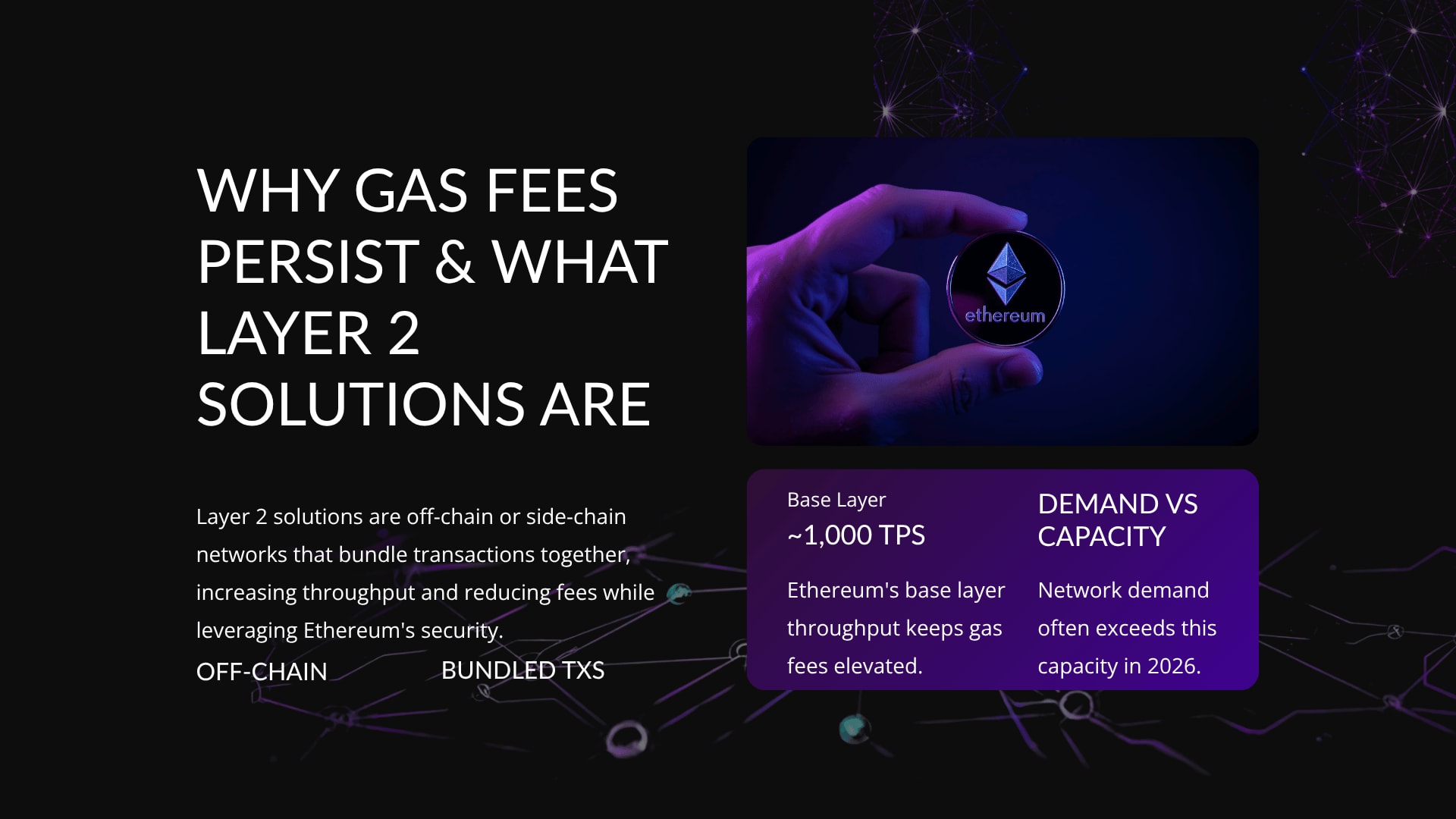
Layer 2 Scaling Solutions are necessary because Ethereum’s base layer still has limited throughput. Even after Proof of Stake and scaling improvements, Ethereum processes far fewer transactions than global payment networks. High demand from DeFi, NFTs, AI-integrated dApps, and meme coin trading continues to increase Ethereum gas fees.
Ethereum upgrades improved efficiency, but they did not completely eliminate congestion. Ethereum prioritizes decentralization and security over raw speed, which means Layer 1 capacity remains intentionally limited.
What causes Ethereum gas fees to spike during high network activity?
Ethereum gas fees increase whenever users compete for limited block space. Since Ethereum can only process a certain number of transactions per second, users often pay higher fees to get faster confirmations.
Common causes include:
NFT mint events
Meme coin trading frenzies
Large DeFi liquidations
Token launches
AI-powered on-chain applications
Web3 gaming activity
When network demand exceeds available capacity, validators prioritize transactions with higher fees.
How do NFT launches and meme coin trading increase Ethereum transaction fees?
NFT drops and meme coin speculation create sudden transaction surges. Thousands of users try to execute transactions simultaneously, causing Ethereum gas fees to skyrocket.
For example:
A new NFT collection launches
Thousands of wallets compete to mint immediately
Users raise gas bids to avoid missing out
Ethereum blocks become overcrowded
Transaction fees rapidly increase
This competitive fee environment can push simple transfers from a few dollars to over $100 during peak congestion.
Meme coin markets create similar spikes because traders aggressively compete for early entry positions.
Why does Ethereum congestion affect transaction confirmation times?
Ethereum congestion slows transaction confirmation because validators process transactions in order of profitability. Lower-fee transactions remain stuck in pending queues while higher-fee transactions receive priority.
This creates several problems:
Slower swaps on decentralized exchanges
Failed NFT purchases
Delayed bridge transfers
Increased transaction uncertainty
Poor user experience for beginners
Layer 2 Scaling Solutions solve this issue by processing transactions outside the Ethereum main chain while still relying on Ethereum security.
How has Ethereum scalability evolved since the move to Proof of Stake?
Ethereum’s transition to Proof of Stake significantly reduced energy consumption and prepared the network for future scalability upgrades. However, Proof of Stake alone was never designed to solve Ethereum scaling completely.
Major improvements since the transition include:
Lower energy usage
Faster block finality
Improved validator efficiency
Better infrastructure for Rollups
Enhanced data availability layers
Despite these upgrades, Ethereum Layer 1 still focuses on settlement and security rather than mass transaction throughput.
Did Ethereum upgrades fully solve scalability problems?
No. Ethereum upgrades improved the network foundation, but Layer 2 Scaling Solutions remain essential for mass adoption.
Ethereum developers intentionally designed the ecosystem around Rollups and Layer 2 networks instead of massively increasing Layer 1 throughput. This strategy preserves decentralization while enabling scalability through external execution layers.
In practice, Ethereum evolved into:
A secure settlement layer
A data availability layer
A foundation for Rollups
A decentralized trust network
Meanwhile, Layer 2 blockchain ecosystems handle most user activity.
Why is Ethereum transaction speed still limited on Layer 1?
Ethereum transaction speed remains limited because increasing throughput directly on Layer 1 would increase hardware requirements and reduce decentralization.
If Ethereum processed tens of thousands of transactions directly:
Running validators would become expensive
Fewer people could participate
Centralization risks would rise
Network security could weaken
Layer 2 Scaling Solutions solve this by shifting computation away from the main chain while using Ethereum for final security verification.
Why are users searching for Layer 2 Scaling Solutions in 2026?
Users search for Layer 2 Scaling Solutions because they dramatically reduce Ethereum transaction fees while improving transaction speed. In 2026, most active Web3 users rely on Layer 2 networks for DeFi, gaming, NFTs, and consumer applications.
Ethereum adoption expanded far beyond early crypto users. Millions of people now interact with blockchain applications daily, making affordable scalability essential.
Key reasons for Layer 2 adoption include:
Lower Ethereum gas fees
Faster confirmations
Better user experience
Cheaper DeFi trading
Scalable blockchain gaming
Affordable NFT activity
Consumer-friendly Web3 onboarding
How do Layer 2 blockchain networks reduce transaction costs?
Layer 2 networks reduce costs by bundling many transactions together before submitting compressed data to Ethereum.
Instead of processing every transaction individually on Layer 1:
Transactions execute on Layer 2
Data is compressed into batches
The batch is submitted to Ethereum
Users share the cost collectively
This dramatically lowers Ethereum transaction fees for each participant.
Why are developers migrating dApps to Layer 2 ecosystems?
Developers migrate to Layer 2 ecosystems because users refuse to pay excessive fees for routine activity.
Modern Web3 applications require:
Fast transaction speeds
Low fees
Mobile-friendly onboarding
Scalable infrastructure
Predictable transaction costs
Projects building social apps, games, AI-integrated tools, and consumer marketplaces increasingly rely on Layer 2 blockchain environments.
Many startups now launch directly on Layer 2 instead of Ethereum mainnet.
Platforms like YourSiteChat are also exploring scalable Web3 infrastructure because affordable blockchain interactions are becoming critical for AI-integrated applications.
What industries are most affected by high Ethereum gas fees?
Several industries depend heavily on affordable blockchain scalability.
The most affected sectors include:
DeFi
NFTs
Blockchain gaming
AI-powered Web3 apps
Consumer finance
Creator economies
Metaverse ecosystems
How do DeFi users lose money from expensive transaction fees?
High Ethereum gas fees directly reduce DeFi profitability.
Common issues include:
Small trades becoming unprofitable
Expensive yield farming interactions
High liquidation costs
Reduced arbitrage opportunities
Costly governance voting
For smaller users, Layer 1 fees often exceed investment returns.
Layer 2 Scaling Solutions solve this by making DeFi transactions inexpensive enough for mainstream participation.
Why are blockchain gaming and NFT projects moving to Layer 2 blockchain networks?
Gaming and NFT ecosystems require high-frequency, low-cost transactions.
Examples include:
In-game asset transfers
NFT crafting
Marketplace trading
Character upgrades
Reward distributions
These interactions become impractical on expensive Layer 1 infrastructure.
Layer 2 blockchain ecosystems provide:
Near-instant confirmations
Very low fees
Better scalability
Improved user retention
Mainstream-friendly onboarding
How do Layer 2 Scaling Solutions reduce Ethereum gas fees and improve transaction speed?
Layer 2 Scaling Solutions reduce Ethereum gas fees by processing transactions off-chain while using Ethereum for security and settlement. These systems bundle transactions together, lowering costs and increasing Ethereum transaction speed dramatically.
Instead of executing every transaction directly on Ethereum mainnet, Layer 2 networks handle computation externally and periodically submit proofs or compressed transaction data back to Ethereum.
What are Layer 2 Scaling Solutions in Ethereum?
Layer 2 Scaling Solutions are blockchain systems built on top of Ethereum that improve scalability without sacrificing Ethereum security.
Popular Layer 2 technologies include:
Optimistic Rollups
zk-Rollups
zkEVM systems
Validiums
Hybrid scaling networks
These systems allow Ethereum to scale far beyond its native limitations.
How does a Layer 2 blockchain work alongside Ethereum?
A Layer 2 blockchain operates as a secondary execution environment connected to Ethereum.
The process usually works like this:
Users transact on Layer 2
Transactions are grouped into batches
Data is compressed
Ethereum stores verification data
Final settlement occurs on Ethereum
This structure significantly reduces congestion on the main chain.
Why are Layer 2 Scaling Solutions considered critical for Ethereum scalability?
Ethereum scalability depends heavily on Layer 2 adoption because Ethereum itself cannot process global-scale activity directly.
Without Layer 2 Scaling Solutions:
Fees remain expensive
Transaction speed stays limited
Consumer adoption slows
Web3 usability suffers
Rollup-centric scaling became Ethereum’s primary long-term strategy.
How do Optimistic Rollups lower Ethereum transaction fees?
Optimistic Rollups lower Ethereum transaction fees by assuming transactions are valid unless challenged. This allows transactions to process quickly and cheaply while Ethereum provides dispute resolution security.
Optimistic Rollups are among the most widely used Layer 2 Scaling Solutions in 2026.
Examples include:
Arbitrum
Optimism
Base
These systems batch transactions together and post compressed transaction data to Ethereum.
What is the difference between Optimistic Rollups and Ethereum Layer 1 validation?
Ethereum Layer 1 validates every transaction individually. Optimistic Rollups validate transactions collectively.
Main differences include:
Lower computation costs
Reduced Ethereum congestion
Shared transaction fees
Faster execution environments
This creates substantial efficiency improvements.
Why is fraud-proof verification important in Optimistic Rollups?
Fraud proofs protect Optimistic Rollups from invalid transactions.
The process works as follows:
Transactions are assumed valid
A challenge window exists
Validators can dispute fraudulent activity
Invalid batches are rejected
This security mechanism allows scalability without sacrificing trust.
How do zk-Rollups improve Ethereum scalability and transaction speed?
zk-Rollups improve Ethereum scalability by using cryptographic proofs to verify large batches of transactions instantly. They offer faster finality, lower fees, and higher efficiency than many traditional blockchain systems.
zk-Rollups are increasingly viewed as the future of Ethereum scaling.
Popular zk-based projects include:
Starknet
zkSync
Polygon zkEVM
Why are zk-Rollups considered faster than traditional Ethereum processing?
zk-Rollups use mathematical proofs instead of replaying every transaction individually.
Benefits include:
Faster verification
Lower data usage
Improved throughput
Reduced blockchain congestion
This enables thousands of transactions per second.
How do zero-knowledge proofs reduce blockchain data load?
Zero-knowledge proofs compress transaction validity into small cryptographic proofs.
Instead of storing full transaction details repeatedly:
A compact proof verifies correctness
Ethereum validates the proof
Data requirements decrease dramatically
This improves blockchain scalability substantially.
What is the difference between Optimistic Rollups and zk-Rollups?
Both systems improve Ethereum scaling, but they use different verification methods.
Layer 2 SolutionAverage FeesSpeedBest Use CaseArbitrumLowFastDeFiBaseVery LowFastConsumer AppsPolygonLowVery FastGaming & NFTsStarknetVery LowHigh Throughputzk Applications
Which Layer 2 Scaling Solution is cheaper for Ethereum users in 2026?
zk-Rollup ecosystems increasingly offer the lowest fees because of superior compression efficiency.
However, costs vary depending on:
Network demand
Data availability pricing
Application complexity
Transaction volume
Consumer-focused ecosystems like Base also maintain very low costs.
Which Layer 2 blockchain offers faster transaction finality?
zk-Rollups often achieve faster finality because cryptographic proofs confirm validity immediately.
Optimistic Rollups usually require challenge periods before full finalization.
Still, both systems provide significantly faster user experiences than Ethereum Layer 1.
How do Layer 2 Scaling Solutions improve Ethereum transaction speed?
Layer 2 networks improve Ethereum transaction speed by processing transactions in parallel environments optimized for scalability.
Advantages include:
Reduced congestion
Faster confirmations
High throughput
Lower latency
Better application responsiveness
Can Layer 2 blockchain networks process thousands of transactions per second?
Yes. Many Layer 2 blockchain systems now process thousands of transactions per second.
This scalability supports:
Web3 gaming
Consumer payments
AI applications
Social platforms
High-frequency trading
Why is transaction batching important for Ethereum scalability?
Batching combines many transactions into a single submission.
Benefits include:
Lower data overhead
Shared transaction costs
Reduced Layer 1 congestion
Improved throughput efficiency
Batching remains one of the core foundations of crypto scalability solutions.
Are Layer 2 Scaling Solutions secure for large-scale Ethereum adoption?
Most modern Layer 2 Scaling Solutions inherit Ethereum security while improving scalability. However, bridge risks, smart contract vulnerabilities, and centralized sequencer concerns still require careful monitoring.
Security has improved significantly across major Layer 2 ecosystems.
How do Layer 2 networks inherit Ethereum security?
Layer 2 networks rely on Ethereum for:
Data availability
Transaction settlement
Proof verification
Final consensus security
This creates stronger trust guarantees than independent blockchains.
What are the risks of bridging assets between Ethereum and Layer 2 blockchain networks?
Bridge vulnerabilities remain a major concern.
Potential risks include:
Smart contract exploits
Validator compromise
Centralized bridge operators
Liquidity fragmentation
Users should always verify official bridge providers before transferring assets.
How do Ethereum bridges work with Layer 2 Scaling Solutions?
Ethereum bridges transfer assets between Layer 1 and Layer 2 ecosystems.
The process typically involves:
Locking assets on Ethereum
Minting equivalent assets on Layer 2
Allowing transactions within the Layer 2 ecosystem
Redeeming assets back to Ethereum
Why are cross-chain bridges important for Ethereum users?
Bridges allow users to access cheaper ecosystems while maintaining Ethereum asset ownership.
Benefits include:
Lower transaction fees
Faster application usage
Expanded liquidity access
Multi-network compatibility
What security risks exist in Layer 2 bridge protocols?
Bridge protocols remain attractive hacker targets because they hold large asset pools.
Users should evaluate:
Audit history
Decentralization level
Security architecture
Insurance mechanisms
Community trust
Which Layer 2 Scaling Solutions are dominating Ethereum in 2026?
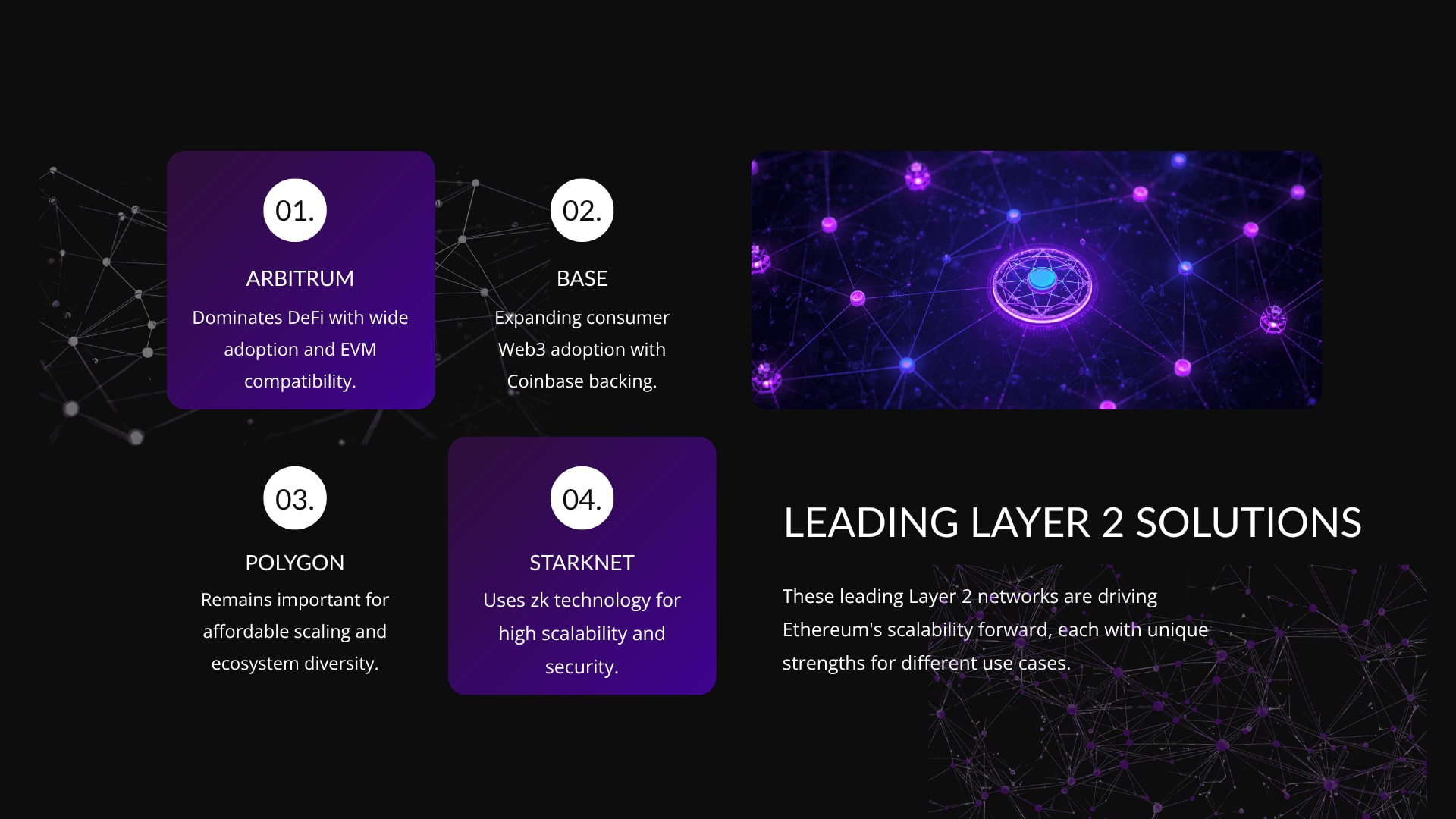
Arbitrum, Base, Polygon, and Starknet are leading Layer 2 Scaling Solutions in 2026. Each ecosystem specializes in different use cases including DeFi, gaming, consumer applications, and zk-powered scalability.
The Ethereum scaling landscape has become highly competitive.
Why is Arbitrum leading the Optimistic Rollups ecosystem?
Arbitrum became dominant because it attracted major DeFi liquidity early.
Its strengths include:
Strong developer ecosystem
High liquidity
Mature infrastructure
Reliable scalability
Extensive dApp support
How does Arbitrum reduce Ethereum gas fees for DeFi users?
Arbitrum batches DeFi transactions efficiently, dramatically lowering trading costs.
This benefits:
Swaps
Yield farming
Perpetual trading
Lending protocols
DAO governance
What makes Arbitrum popular among Ethereum developers?
Developers prefer Arbitrum because it supports Ethereum-compatible tooling with minimal friction.
Advantages include:
EVM compatibility
Large user base
Mature documentation
Strong ecosystem liquidity
How is Base expanding Layer 2 blockchain adoption?
Base focuses heavily on consumer accessibility and mainstream onboarding.
Its growth strategy emphasizes:
Simple onboarding
Mobile-friendly experiences
Social applications
Consumer payments
Creator economies
Why are mainstream applications launching on Base?
Base benefits from strong integration with consumer platforms and simplified user onboarding.
Applications choose Base because it offers:
Lower fees
Better UX
Scalable infrastructure
Easier onboarding for non-crypto users
How does Base improve Ethereum transaction speed for everyday users?
Base prioritizes usability and rapid confirmations.
This creates smoother experiences for:
Consumer apps
Web3 social platforms
NFT marketplaces
Digital payments
Why is Polygon still relevant in Ethereum scalability discussions?
Polygon remains highly relevant because it expanded beyond simple sidechains into advanced Ethereum scaling infrastructure.
Polygon now supports:
zkEVM technology
Enterprise adoption
Gaming ecosystems
NFT scalability
Multi-chain interoperability
How does Polygon combine sidechains and Layer 2 Scaling Solutions?
Polygon operates multiple scaling products simultaneously.
Its ecosystem includes:
Sidechains
zkEVM Rollups
Data availability solutions
Enterprise scaling tools
This flexibility attracts diverse developers.
What advantages does Polygon offer for gaming and NFTs?
Polygon became extremely popular for gaming and NFTs because of:
Low fees
Fast transactions
Strong brand partnerships
Consumer-friendly onboarding
Large gaming studios increasingly prefer Polygon infrastructure.
How is Starknet using zk-Rollups to scale Ethereum?
Starknet uses advanced zk-Rollup technology to achieve high scalability while maintaining Ethereum security.
Its architecture focuses on:
High throughput
Efficient cryptographic proofs
Advanced application scalability
Long-term zk infrastructure
Why is Starknet attracting developers building advanced dApps?
Starknet appeals to developers building complex blockchain systems because of its scalability potential.
Popular categories include:
AI-integrated dApps
Advanced DeFi
On-chain gaming
High-frequency trading
How does Starknet compare to Arbitrum and Base in scalability?
Starknet often offers superior scalability potential due to zk-proof efficiency.
However:
Arbitrum dominates DeFi liquidity
Base excels in consumer onboarding
Polygon leads gaming ecosystems
Each network specializes differently.
Which Layer 2 blockchain has the lowest Ethereum gas fees in 2026?
Fee structures constantly change depending on demand.
Generally:
zk-based networks often achieve the lowest fees
Consumer-focused chains prioritize affordability
DeFi-heavy ecosystems experience higher congestion
How do transaction costs compare between Arbitrum, Base, Polygon, and Starknet?
Typical trends include:
Arbitrum: Slightly higher during DeFi peaks
Base: Consistently low consumer fees
Polygon: Extremely cheap gaming activity
Starknet: Very efficient zk processing
Which Layer 2 Scaling Solution offers the fastest Ethereum transaction speed?
zk-Rollup ecosystems increasingly lead in raw throughput and finality speed.
However, user experience also depends on:
Wallet support
RPC infrastructure
Sequencer efficiency
Application optimization
What are the biggest challenges facing Layer 2 Scaling Solutions?
Layer 2 ecosystems still face several important challenges.
Major issues include:
Fragmented liquidity
Bridge complexity
User confusion
Security concerns
Cross-chain interoperability
Can Layer 2 fragmentation hurt Ethereum user experience?
Yes. Multiple Layer 2 ecosystems can confuse users.
Common frustrations include:
Managing multiple bridges
Switching networks
Fragmented assets
Different wallet experiences
Improved interoperability remains essential.
Will interoperability become the next major Ethereum scalability challenge?
Interoperability is becoming one of the biggest priorities for Ethereum scaling.
Future success depends on:
Seamless cross-chain transfers
Unified liquidity systems
Shared user identities
Better wallet integration
What is the future of Layer 2 Scaling Solutions beyond 2026?
Layer 2 Scaling Solutions are expected to become the primary execution layer for Ethereum. Future blockchain scalability will likely rely on zk technology, modular infrastructure, AI-integrated automation, and seamless interoperability between networks.
Ethereum’s future increasingly revolves around Layer 2 ecosystems.
Will Ethereum eventually depend entirely on Layer 2 blockchain ecosystems?
Many experts believe Ethereum will eventually function primarily as:
A settlement layer
A security layer
A decentralized data availability system
Most user interactions may occur entirely on Layer 2 networks.
How could AI, modular blockchain architecture, and zk technology shape Ethereum scalability?
Several trends are shaping the next generation of Ethereum scaling:
AI-powered transaction optimization
Modular blockchain architecture
Advanced zkEVM systems
Cross-chain interoperability
Automated Rollup infrastructure
These innovations could dramatically improve scalability and usability.
Platforms like YourSiteChat may also benefit from scalable blockchain infrastructure as AI and Web3 ecosystems become increasingly connected.
Conclusion
Layer 2 Scaling Solutions have become the foundation of Ethereum scalability in 2026. Instead of forcing Ethereum Layer 1 to process every transaction directly, Rollups and Layer 2 blockchain ecosystems now handle most user activity efficiently and affordably.
This transition solved many of the problems that once limited Ethereum adoption:
Lower Ethereum gas fees
Faster transaction confirmations
Better Web3 user experiences
Scalable gaming ecosystems
Affordable DeFi participation
Consumer-ready blockchain applications
Arbitrum, Base, Polygon, and Starknet each demonstrate how specialized Layer 2 networks can support different segments of the crypto economy.
As Ethereum scaling continues evolving, the focus will shift toward:
Better interoperability
More efficient zk technology
AI-integrated blockchain infrastructure
Unified user experiences
Global-scale Web3 adoption
For businesses, developers, and users exploring the future of blockchain scalability, understanding Layer 2 Scaling Solutions is no longer optional. It is becoming essential for participating in the next phase of Ethereum growth.
FAQs About Layer 2 Scaling Solutions in 2026
What are Layer 2 Scaling Solutions in simple terms?
Layer 2 Scaling Solutions are blockchain systems built on top of Ethereum that reduce Ethereum gas fees and improve transaction speed by processing transactions outside the main Ethereum chain.
Which Layer 2 network has the lowest fees in 2026?
zk-based Layer 2 networks like Starknet and Polygon zkEVM often provide some of the lowest Ethereum transaction fees, although pricing changes based on network activity.
Are Layer 2 networks safer than alternative blockchains?
Most major Layer 2 networks inherit Ethereum security, making them generally more secure than many independent blockchains.
Why are Ethereum gas fees still high in 2026?
Ethereum Layer 1 still has limited throughput. High demand from DeFi, NFTs, AI applications, and meme coin trading continues to create congestion.
What is the difference between Optimistic Rollups and zk-Rollups?
Optimistic Rollups assume transactions are valid unless challenged, while zk-Rollups use cryptographic proofs to verify transactions instantly.
Is Polygon a Layer 2 Scaling Solution?
Polygon operates multiple Ethereum scaling products, including sidechains and zkEVM-based Layer 2 infrastructure.
Which Layer 2 blockchain is best for gaming?
Polygon remains one of the strongest ecosystems for gaming and NFTs because of low fees and fast transaction speeds.
Why are developers building on Base?
Base attracts developers because of low fees, strong onboarding experiences, and growing consumer-focused Web3 infrastructure.
Will Ethereum eventually rely entirely on Layer 2 networks?
Many blockchain experts believe Ethereum will increasingly function as a settlement and security layer while most user activity happens on Layer 2 ecosystems.