
Customer support has become one of the biggest operational expenses for modern businesses. Companies are expected to provide instant responses across email, live chat, social media, and phone calls while maintaining high customer satisfaction. This growing demand often leads to larger teams, longer working hours, and rising costs.
That is exactly why businesses are investing heavily in artificial intelligence. Understanding how AI reduces customer support costs helps organizations improve efficiency, automate repetitive tasks, and deliver better customer experiences without continuously expanding support teams.
AI-powered customer service tools can answer common questions, route tickets, analyze customer behavior, and assist human agents in real time. From startups to global enterprises, businesses across industries are using AI customer support software to reduce expenses and improve service quality.
This guide explains how customer service AI works, which automation strategies deliver the highest return on investment, and how companies can successfully implement AI-powered support systems.
How does AI reduce customer support costs for businesses?
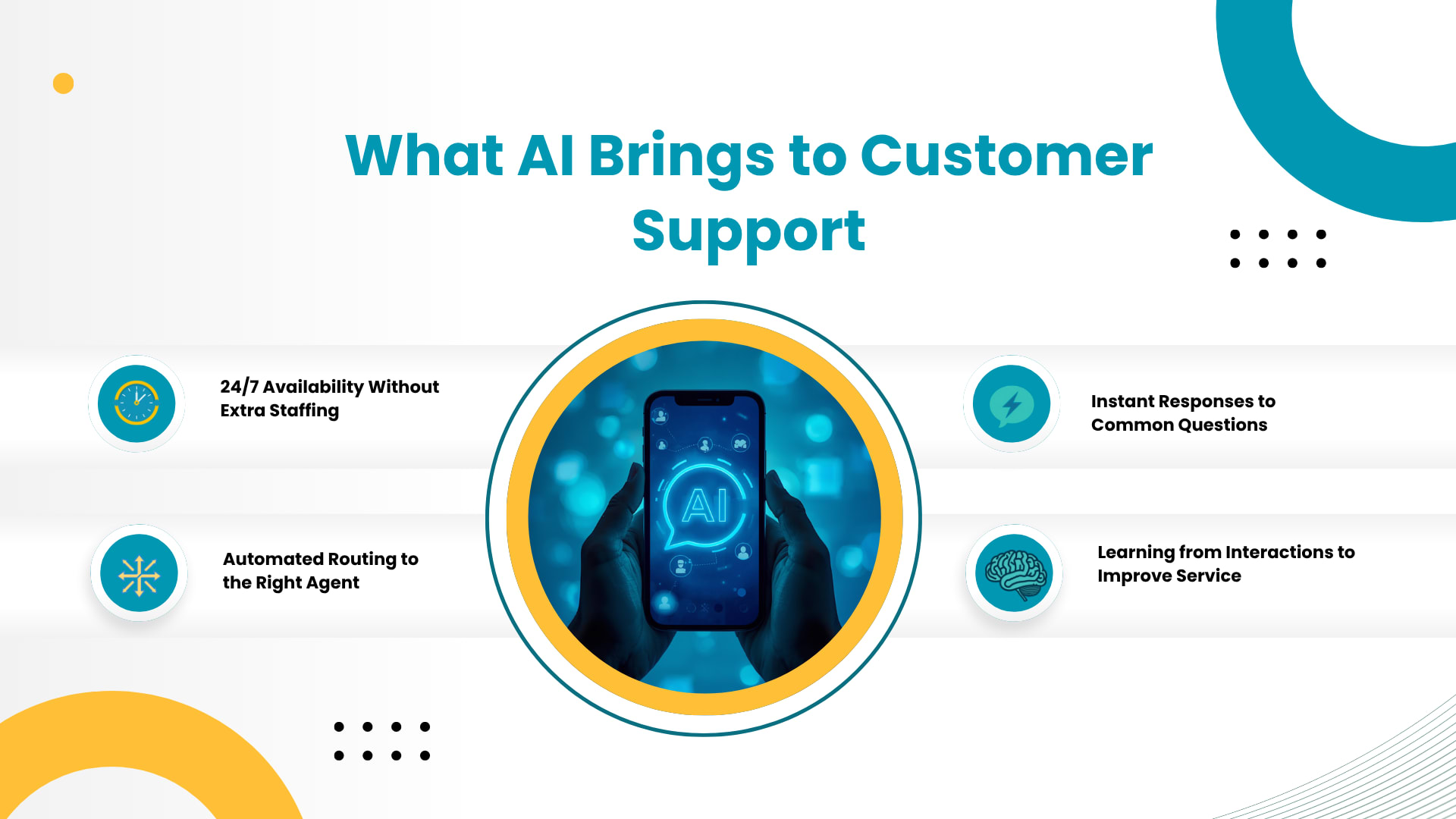
How AI reduces customer support costs comes down to automation, efficiency, and smarter resource allocation. AI systems handle repetitive customer interactions, reduce response times, improve agent productivity, and provide support around the clock. Businesses can serve more customers without proportionally increasing staffing expenses.
Traditional customer support models depend heavily on human agents. As customer expectations grow, businesses often face difficult choices: hire more staff or risk declining service quality.
AI changes this equation by automating large portions of customer interactions while keeping human teams focused on more complex issues.
Businesses use AI customer support software to:
Automate frequently asked questions.
Provide 24/7 customer service.
Reduce ticket resolution times.
Improve agent productivity.
Lower operational costs.
Scale support during peak demand.
Increase customer satisfaction.
The cost benefits extend beyond salaries. AI also reduces expenses related to:
Agent training.
Overtime payments.
Customer churn.
Support infrastructure.
Manual ticket handling.
Repetitive administrative work.
The result is a more efficient support operation that scales without dramatically increasing costs.
What is AI customer support, and how does it work?
AI customer support uses technologies such as machine learning, natural language processing, and conversational AI to automate customer interactions. These systems understand customer questions, generate responses, route requests, and assist support agents, making customer service faster and more cost-effective.
Unlike traditional software that follows fixed rules, modern AI systems continuously improve by learning from customer conversations and historical support data.
Most AI customer support platforms operate through four key steps:
A customer submits a question.
The AI analyzes the intent behind the message.
The system searches relevant information.
A response is generated or routed to the correct team.
For example, an ecommerce customer asking, “Where is my order?” can instantly receive shipping updates without waiting for a human representative.
AI support systems are commonly integrated into:
Websites.
Mobile applications.
Email platforms.
Live chat widgets.
Social media accounts.
Help desks.
Messaging applications.
As customer service volumes increase, these systems help businesses maintain quality without significantly expanding their support workforce.
How do AI customer service tools differ from traditional support software?
Traditional customer service software primarily organizes tickets and stores customer records. AI customer service tools go much further by actively participating in the support process.
Key differences include:
Traditional Customer SupportAI Customer SupportRelies heavily on human agentsAutomates repetitive interactionsLimited operating hoursAvailable 24/7Manual ticket routingIntelligent ticket assignmentRule-based workflowsLearns from customer behaviorSlower response timesInstant responsesHigher staffing requirementsLower operational costs
Traditional systems act as management platforms, while AI-powered customer support acts as an active participant in customer interactions.
What technologies power AI-powered customer support?
Several technologies work together behind modern AI customer support software.
These include:
Natural Language Processing (NLP).
Machine learning algorithms.
Conversational AI.
Predictive analytics.
Sentiment analysis.
Generative AI models.
Knowledge management systems.
Natural language processing enables AI to understand customer language, while machine learning helps systems improve over time.
According to research published by the National Institute of Standards and Technology, advances in language processing and machine learning continue to improve the accuracy of AI systems in real-world applications.
Together, these technologies create customer support experiences that feel faster, smarter, and more personalized.
Why are customer support costs increasing for modern businesses?
Understanding how AI reduces customer support costs starts with understanding why those costs keep rising. Businesses now manage more communication channels, higher customer expectations, labor shortages, and growing service complexity, all of which increase operational expenses.
A decade ago, businesses primarily handled customer service through email and phone calls.
Today, customers expect support through:
Live chat.
Social media.
WhatsApp.
Mobile apps.
Community forums.
Self-service portals.
Video calls.
Supporting all these channels requires additional employees, training programs, and technology investments.
Businesses also face growing expectations around:
Faster response times.
Personalized experiences.
Twenty-four-hour availability.
Multilingual support.
Consistent service quality.
Without automation, scaling customer support becomes increasingly expensive.
What are the biggest cost drivers in customer service?
Several factors contribute to rising customer support costs.
The largest cost drivers include:
Employee salaries and benefits.
Training and onboarding.
Staff turnover.
Infrastructure expenses.
Overtime costs.
Ticket management systems.
Quality assurance programs.
Peak-season staffing.
Many organizations underestimate the hidden costs of customer support.
For example, every new support agent requires:
Product training.
System access.
Process documentation.
Supervision.
Performance monitoring.
These indirect costs accumulate quickly as businesses grow.
How do staffing shortages impact customer support expenses?
Staffing shortages create a chain reaction that increases customer service costs.
When businesses cannot hire enough qualified agents, they often experience:
Longer response times.
Increased overtime.
Higher burnout rates.
Employee turnover.
Lower customer satisfaction.
Replacing experienced support staff is expensive. Recruiting, onboarding, and training new employees can take months.
AI customer support automation helps reduce dependence on large teams by handling repetitive tasks, allowing existing staff to focus on high-value interactions.
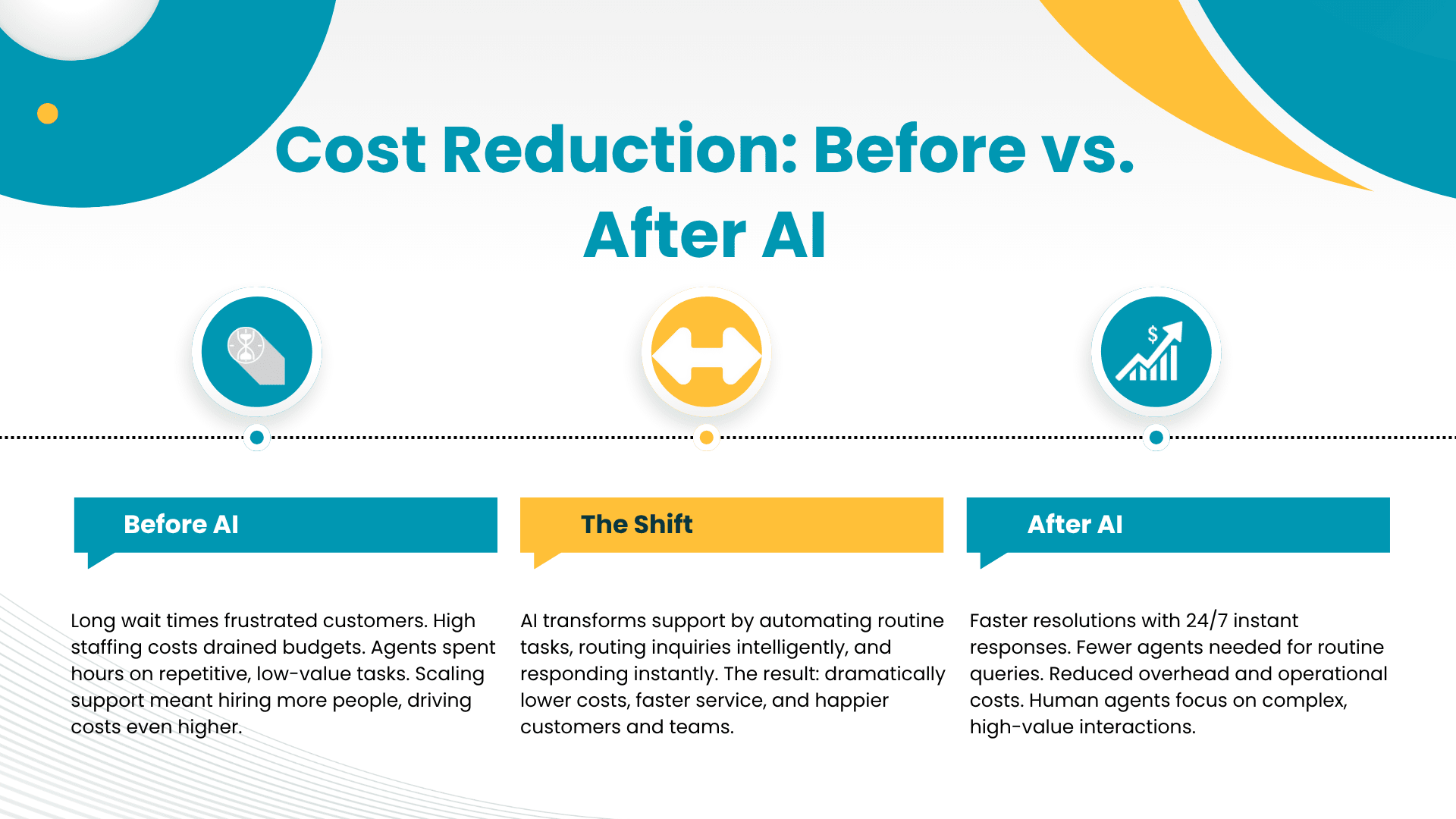
How AI Reduces Customer Support Costs across different support channels
How AI reduces customer support costs becomes even more apparent when businesses apply automation across multiple communication channels. AI tools can manage email, live chat, social media, phone support, and messaging apps from a centralized platform, reducing operational complexity.
Customers rarely use a single support channel anymore.
One customer might:
Start with live chat.
Continue through email.
Follow up on social media.
Call customer support.
Managing these interactions manually creates inefficiencies and increases staffing requirements.
AI customer support software provides consistency across channels while lowering operational costs.
How does AI support email, live chat, phone, and social media?
AI adapts to different support environments in unique ways.
Email support
AI can:
Categorize messages.
Suggest responses.
Prioritize urgent requests.
Detect sentiment.
Live chat
AI chatbots can:
Answer FAQs instantly.
Recommend products.
Resolve simple issues.
Escalate complex cases.
Phone support
Voice AI systems can:
Handle routine inquiries.
Route calls intelligently.
Authenticate customers.
Transcribe conversations.
Social media support
AI tools monitor:
Comments.
Direct messages.
Mentions.
Customer sentiment.
This multi-channel automation significantly reduces support workloads.
Can one AI platform manage multiple customer support channels?
Modern AI customer service platforms are increasingly designed to support omnichannel operations.
A single platform can often manage:
Website chat.
Email.
Instagram.
Facebook.
WhatsApp.
Telegram.
Customer portals.
For businesses looking for a unified solution, platforms such as YourSiteChat AI chatbot platform help automate customer conversations across multiple channels while improving response times and reducing support costs.
Centralized support systems provide additional advantages:
Unified customer histories.
Consistent messaging.
Better analytics.
Lower software expenses.
Easier team management.
This reduces the need for separate tools and fragmented workflows.
Which industries benefit the most from customer support AI?
How AI reduces customer support costs varies by industry, but sectors with high customer interaction volumes often see the biggest savings. Ecommerce, SaaS, healthcare, banking, and retail organizations benefit from automation, faster response times, and improved service efficiency.
Any business with frequent customer interactions can benefit from AI-powered customer support.
However, industries with large support volumes often achieve the highest returns.
Examples include:
Ecommerce.
Software-as-a-service companies.
Banking and finance.
Healthcare providers.
Telecommunications.
Retail businesses.
Education platforms.
Travel companies.
Each industry uses AI differently based on customer expectations and regulatory requirements.
How does AI help ecommerce businesses reduce support costs?
Ecommerce businesses receive thousands of repetitive customer questions every month.
Common inquiries include:
Order tracking.
Shipping updates.
Refund requests.
Product availability.
Payment issues.
Return policies.
AI chatbots can resolve many of these questions instantly.
Consider an online store during a holiday sale. Without automation, support teams may need dozens of temporary employees.
With AI customer support software, businesses can:
Handle spikes in demand.
Reduce waiting times.
Lower staffing costs.
Improve customer experiences.
This explains why ecommerce companies are among the earliest adopters of AI-powered customer service.
How does AI improve customer support in SaaS, healthcare, banking, and retail?
Different industries use customer service AI in different ways.
SaaS companies
AI helps by:
Guiding users through onboarding.
Solving technical issues.
Recommending documentation.
Automating ticket routing.
Healthcare organizations
AI supports:
Appointment scheduling.
Patient reminders.
Insurance inquiries.
Administrative tasks.
Banks and financial institutions
AI assists with:
Account questions.
Fraud alerts.
Loan inquiries.
Transaction support.
Retail businesses
AI improves:
Inventory inquiries.
Loyalty programs.
Order tracking.
Store information.
Research from IBM highlights that AI-driven automation can improve customer experiences while increasing operational efficiency across industries. IBM customer service AI insights
As AI capabilities continue to evolve, businesses across every sector are finding new ways to reduce support costs while improving customer satisfaction.
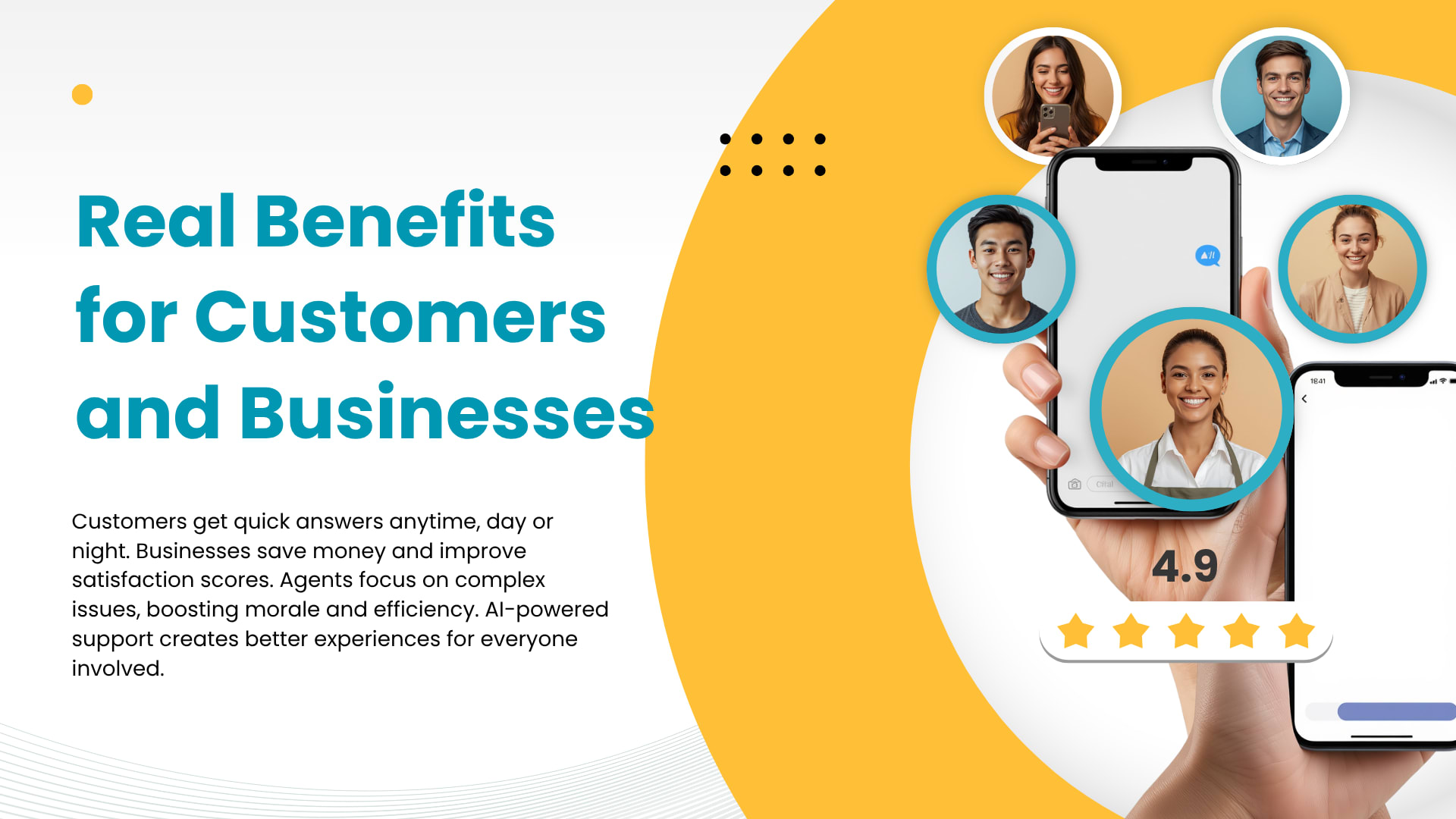
Which AI customer support tools and automation strategies save the most money?
How AI reduces customer support costs depends heavily on the tools and automation strategies a business adopts. AI chatbots, workflow automation, conversational AI, help desk software, and virtual assistants reduce manual workloads, improve response times, and help support teams handle more customer interactions without increasing operational expenses.
Not every AI solution delivers the same results. Some tools focus on answering customer questions, while others improve internal operations behind the scenes.
Businesses that see the greatest savings usually combine multiple technologies, including:
AI chatbots.
Customer support automation.
Conversational AI.
AI help desk software.
Virtual assistants.
Predictive analytics.
Knowledge management systems.
The key is not replacing human agents but removing repetitive work that consumes time and resources.
How does an AI chatbot for customer service reduce operational costs?
One of the clearest examples of how AI reduces customer support costs is through AI chatbots. These systems answer common questions instantly, reduce ticket volume, and provide round-the-clock assistance, allowing businesses to support more customers with smaller teams.
Traditional support teams often spend most of their day answering the same questions repeatedly. AI chatbots eliminate much of this workload.
An AI chatbot can:
Answer frequently asked questions.
Share order updates.
Process refund requests.
Recommend products.
Collect customer information.
Escalate complex cases.
For example, an ecommerce store receiving 5,000 customer inquiries per month may discover that nearly 70% involve order tracking or delivery status. Automating those conversations can significantly reduce support costs.
Businesses increasingly rely on AI customer support software because chatbots scale efficiently. Whether there are ten customers or ten thousand, the system continues operating without requiring additional hiring.
Solutions such as the YourSiteChat customer support automation solution allow businesses to automate website conversations while helping support teams respond faster and more consistently.
Which customer questions should AI chatbots automate first?
Not every conversation should be automated immediately. Businesses typically achieve the highest return by starting with repetitive, low-complexity requests.
Good candidates for chatbot automation include:
Password resets.
Order tracking.
Delivery updates.
Appointment scheduling.
Refund policies.
Product availability.
Subscription renewals.
Business hours.
Account status checks.
Automating these tasks often delivers immediate savings because they represent a large percentage of total support volume.
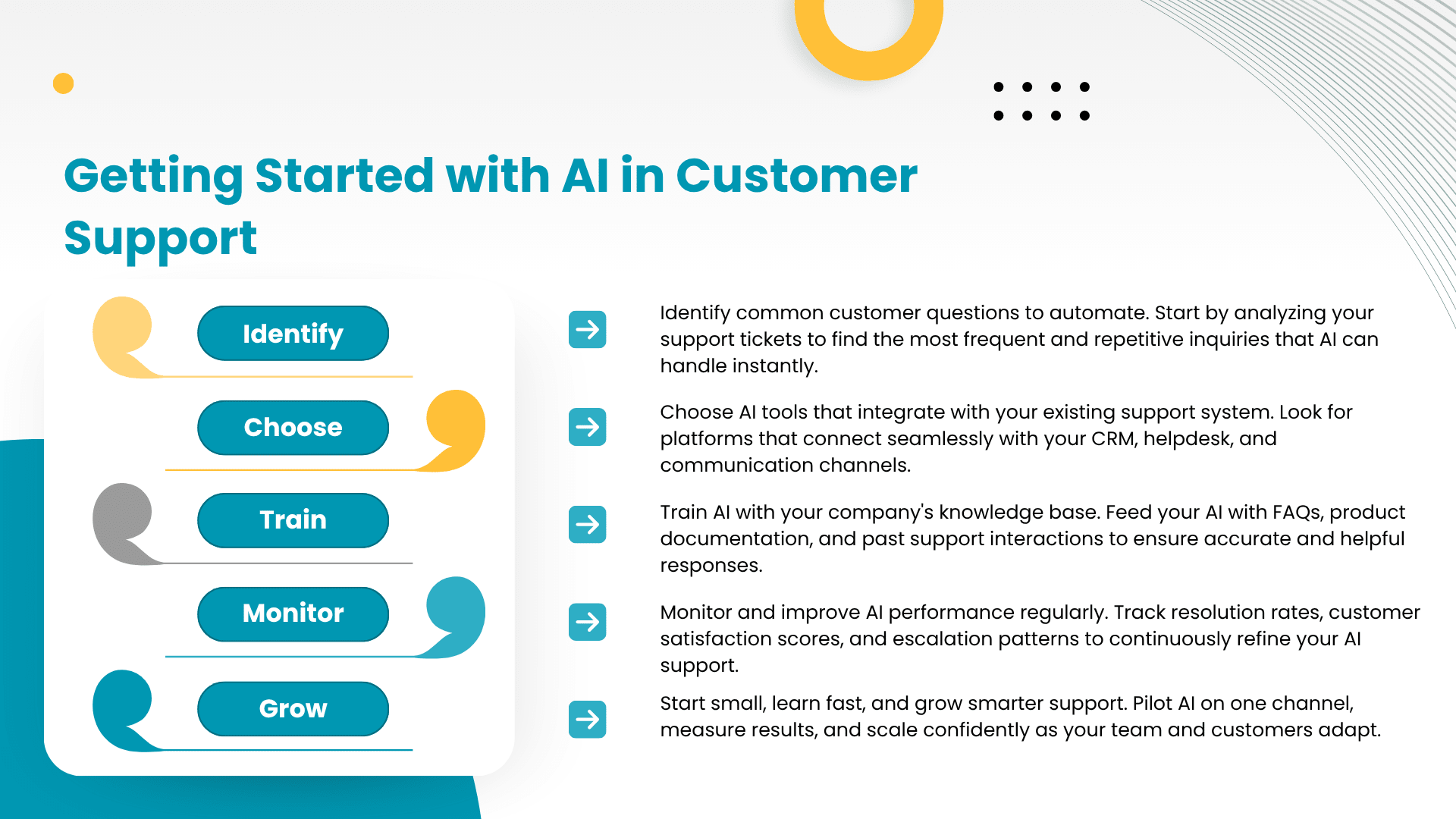
Before launching an AI chatbot, businesses should analyze support data and identify:
Frequently asked questions.
Repetitive requests.
High-volume ticket categories.
Time-consuming tasks.
Starting with these areas usually produces quick results.
When should AI transfer conversations to human agents?
Successful customer service AI knows when to stop automating.
Human intervention remains essential when customers face:
Billing disputes.
Technical failures.
Legal concerns.
Emotional complaints.
Complex product issues.
Sensitive healthcare or financial matters.
The best AI customer service platforms automatically escalate conversations when:
Customer frustration increases.
The AI confidence score drops.
Multiple failed responses occur.
Special approvals are needed.
Customers become frustrated when businesses force automation into situations that require human judgment.
How does customer support automation improve efficiency?
Customer support automation improves efficiency by reducing repetitive work, accelerating workflows, and helping teams focus on higher-value tasks. Understanding how AI reduces customer support costs means recognizing that efficiency gains often create larger savings than workforce reductions.
Many businesses assume automation only means chatbots. In reality, customer support automation affects almost every stage of service operations.
Automation can improve:
Ticket routing.
Customer onboarding.
Follow-up emails.
Internal notifications.
Data entry.
Reporting.
Escalation processes.
Support agents often lose hours every week performing administrative work. AI removes much of this burden.
Which repetitive support tasks can AI automate?
AI excels at handling repetitive, rule-based activities.
Common examples include:
Assigning tickets.
Updating customer records.
Scheduling appointments.
Sending reminders.
Generating reports.
Tagging conversations.
Tracking orders.
Processing refunds.
Managing subscriptions.
In many organizations, these tasks account for a surprisingly large portion of support workloads.
Consider a software company that receives hundreds of password reset requests every day. Automating that single process can save dozens of employee hours each week.
How does workflow automation reduce response times?
Response speed strongly influences customer satisfaction.
Workflow automation reduces delays by automatically:
Detecting customer intent.
Assigning tickets to the correct department.
Prioritizing urgent cases.
Triggering predefined actions.
Notifying customers instantly.
Without automation, tickets often sit in queues waiting for manual review.
AI-powered workflows ensure that:
Technical issues reach engineers faster.
Billing questions reach finance teams.
Sales inquiries reach account managers.
High-priority customers receive immediate attention.
According to research from the customer service platform HubSpot, faster response times consistently correlate with higher customer satisfaction and retention. HubSpot customer service research
What role does conversational AI play in customer service?
Conversational AI plays a central role in explaining how AI reduces customer support costs because it enables systems to understand natural language, maintain context, and deliver more human-like customer interactions across multiple channels.
Early chatbots relied on rigid scripts and predefined keywords.
Modern conversational AI goes much further by understanding:
Customer intent.
Context.
Sentiment.
Conversation history.
Follow-up questions.
This creates smoother interactions and reduces the number of conversations that require human assistance.
Businesses use conversational AI for:
Customer support.
Sales assistance.
Appointment scheduling.
Product recommendations.
Troubleshooting.
Account management.
How does conversational AI understand customer intent?
Conversational AI combines several technologies to interpret customer messages.
These include:
Natural language processing.
Machine learning.
Large language models.
Intent recognition systems.
Behavioral analysis.
For example, the phrases:
“Where is my package?”
“My order hasn't arrived.”
“Can someone track my delivery?”
all express the same intent.
The AI identifies the customer's goal and provides the appropriate response.
As customer interactions increase, machine learning systems become better at recognizing patterns and improving accuracy.
How does conversational AI improve customer satisfaction?
Customer satisfaction improves when support feels:
Fast.
Accurate.
Personalized.
Convenient.
Conversational AI contributes to all four.
Customers no longer need to:
Wait in long queues.
Repeat information.
Search through help articles.
Switch between channels.
Benefits include:
Instant answers.
Twenty-four-hour availability.
Personalized recommendations.
Consistent service quality.
Businesses that combine conversational AI with human support teams often achieve the best customer experience outcomes.
How does an AI help desk improve support operations?
AI help desk software reduces support costs by organizing, prioritizing, and resolving customer requests more efficiently. Businesses gain faster workflows, lower ticket handling times, and improved productivity across customer service teams.
Traditional help desks often rely on agents manually sorting tickets.
AI help desks automate much of this process by:
Categorizing requests.
Prioritizing urgent issues.
Assigning tickets.
Recommending responses.
Tracking performance.
Support teams benefit from:
Reduced administrative work.
Better organization.
Faster resolutions.
Improved reporting.
As ticket volume grows, these efficiency gains become increasingly valuable.
How does AI prioritize and route support tickets?
Not all customer requests are equally urgent.
AI analyzes:
Message content.
Customer history.
Sentiment.
Product type.
Service agreements.
The system then routes tickets accordingly.
For example:
A payment failure may receive immediate priority.
A general inquiry may enter a standard queue.
A premium customer may receive faster assistance.
This intelligent routing reduces delays and improves customer satisfaction.
How does AI categorize customer requests automatically?
Automatic categorization saves support teams countless hours.
AI systems can classify tickets based on:
Billing problems.
Technical issues.
Shipping questions.
Returns and refunds.
Product inquiries.
Account management.
The process usually works in three steps:
Analyze incoming messages.
Identify the topic.
Assign the correct category.
As more conversations are processed, classification accuracy improves.
How do AI virtual assistants support customer service teams?
AI virtual assistants reduce workloads by supporting both customers and employees. They provide instant answers, surface relevant information, and assist agents during conversations, helping businesses improve efficiency without expanding support teams.
Unlike simple chatbots, virtual assistants often work behind the scenes.
They can assist with:
Finding documentation.
Suggesting responses.
Summarizing conversations.
Updating records.
Tracking customer history.
Providing recommendations.
This support helps employees spend less time searching for information and more time solving customer problems.
Can AI virtual assistants handle complex customer conversations?
AI virtual assistants are becoming increasingly sophisticated, but their capabilities still have limits.
They perform well when handling:
Multi-step troubleshooting.
Product comparisons.
Policy explanations.
Subscription management.
However, humans remain essential for:
Negotiations.
Legal matters.
Emotional conversations.
Exceptional cases.
The strongest customer service strategies combine AI automation with experienced support agents.
How do AI assistants improve agent productivity?
Support agents often spend a significant amount of time on tasks that customers never see.
AI assistants improve productivity by:
Summarizing tickets.
Drafting responses.
Recommending solutions.
Searching knowledge bases.
Translating conversations.
Logging interactions automatically.
This allows agents to:
Resolve more tickets.
Spend more time with customers.
Reduce repetitive work.
Deliver more consistent service.
Studies from the research and consulting firm McKinsey & Company insights on generative AI productivity suggest that AI-assisted workflows can substantially increase productivity across customer-facing roles.
Which AI support software features deliver the highest ROI?
The highest-return AI customer support features include predictive analytics, AI-generated responses, sentiment analysis, and intelligent knowledge management. These capabilities help businesses reduce support costs while improving customer experiences and operational efficiency.
Companies often focus on chatbots first, but long-term savings frequently come from advanced AI features operating in the background.
The most valuable capabilities include:
Predictive analytics.
Smart ticket routing.
AI-generated replies.
Sentiment analysis.
Knowledge management.
Workflow automation.
Customer behavior analysis.
Businesses that combine these features typically achieve stronger returns than those relying on a single AI tool.
How does predictive analytics reduce customer support costs?
Predictive analytics uses historical customer data to anticipate future needs.
AI systems can predict:
Support demand spikes.
Product issues.
Customer churn risks.
Seasonal trends.
Service bottlenecks.
This allows businesses to prepare resources in advance instead of reacting after problems occur.
For example, an ecommerce company may discover that support tickets increase sharply during holiday sales and automatically adjust workflows ahead of time.
How do AI-generated replies speed up customer service?
AI-generated responses reduce the time agents spend typing repetitive messages.
The technology can:
Draft replies instantly.
Personalize responses.
Suggest solutions.
Pull information from knowledge bases.
Agents remain responsible for reviewing and approving responses, but AI dramatically shortens the process.
Common benefits include:
Faster first-response times.
More consistent communication.
Reduced workload.
Improved productivity.
How does sentiment analysis improve customer interactions?
Sentiment analysis helps businesses understand how customers feel during conversations.
AI analyzes language patterns to detect:
Frustration.
Satisfaction.
Confusion.
Urgency.
Anger.
Support teams can then prioritize sensitive interactions before they escalate.
Benefits include:
Better customer experiences.
Faster escalation.
Reduced churn.
Improved agent performance.
How does AI-powered knowledge management reduce support workload?
Many support teams waste valuable time searching for information.
AI-powered knowledge management solves this problem by:
Organizing documentation.
Surfacing relevant articles.
Updating content automatically.
Suggesting answers during conversations.
Employees spend less time hunting for information, while customers gain access to faster and more accurate support.
How does AI customer experience optimization reduce long-term service costs?
How AI reduces customer support costs is not limited to automation alone. AI also improves customer experiences through personalization and proactive support, reducing repeat inquiries, increasing loyalty, and lowering long-term operational expenses.
Poor customer experiences create hidden costs:
More support tickets.
Higher churn.
Lower retention.
Increased refunds.
Negative reviews.
AI helps businesses avoid these problems by delivering more personalized and proactive support experiences.
Can personalized support reduce repeat customer inquiries?
Yes. Personalized support often prevents customers from contacting support repeatedly.
AI can personalize interactions using:
Purchase history.
Browsing behavior.
Previous conversations.
Customer preferences.
Account information.
When customers receive accurate answers the first time, support demand naturally decreases.
How does proactive customer support lower operational expenses?
Proactive support means solving problems before customers ask for help.
AI enables businesses to:
Send delivery updates automatically.
Notify customers about outages.
Recommend solutions in advance.
Detect issues before they escalate.
Proactive customer service reduces ticket volumes and improves satisfaction, creating long-term savings that extend far beyond simple automation.