Businesses in 2026 face a familiar challenge: reaching the right audience, creating valuable content, maintaining an active online presence, and turning attention into meaningful business results. However, managing all these activities consistently can be difficult, especially for small teams with limited time and budgets. This is where AI-powered digital marketing can make a practical difference.
Artificial intelligence is changing how businesses research their audiences, plan campaigns, develop content, analyze performance, and manage repetitive marketing activities. Instead of starting every task from scratch, marketers can use AI-assisted tools to generate ideas, organize workflows, identify patterns, and make better-informed decisions.
For a small business, this could mean planning a month of social media content more efficiently. For an e-commerce brand, it could mean understanding which products attract attention and which messages encourage customers to explore further. For a startup, AI may help a small marketing team manage tasks that previously required several separate tools.
However, AI is not a substitute for a clear strategy, genuine customer understanding, or human judgment. Its effectiveness depends on how thoughtfully it is implemented, the quality of the information it receives, and the relevance of the content it helps produce.
This guide explains what AI-powered digital marketing means, how businesses can apply it in 2026, which benefits and limitations to consider, and how to select suitable solutions for long-term growth.
What Is AI-Powered Digital Marketing and How Does It Work?
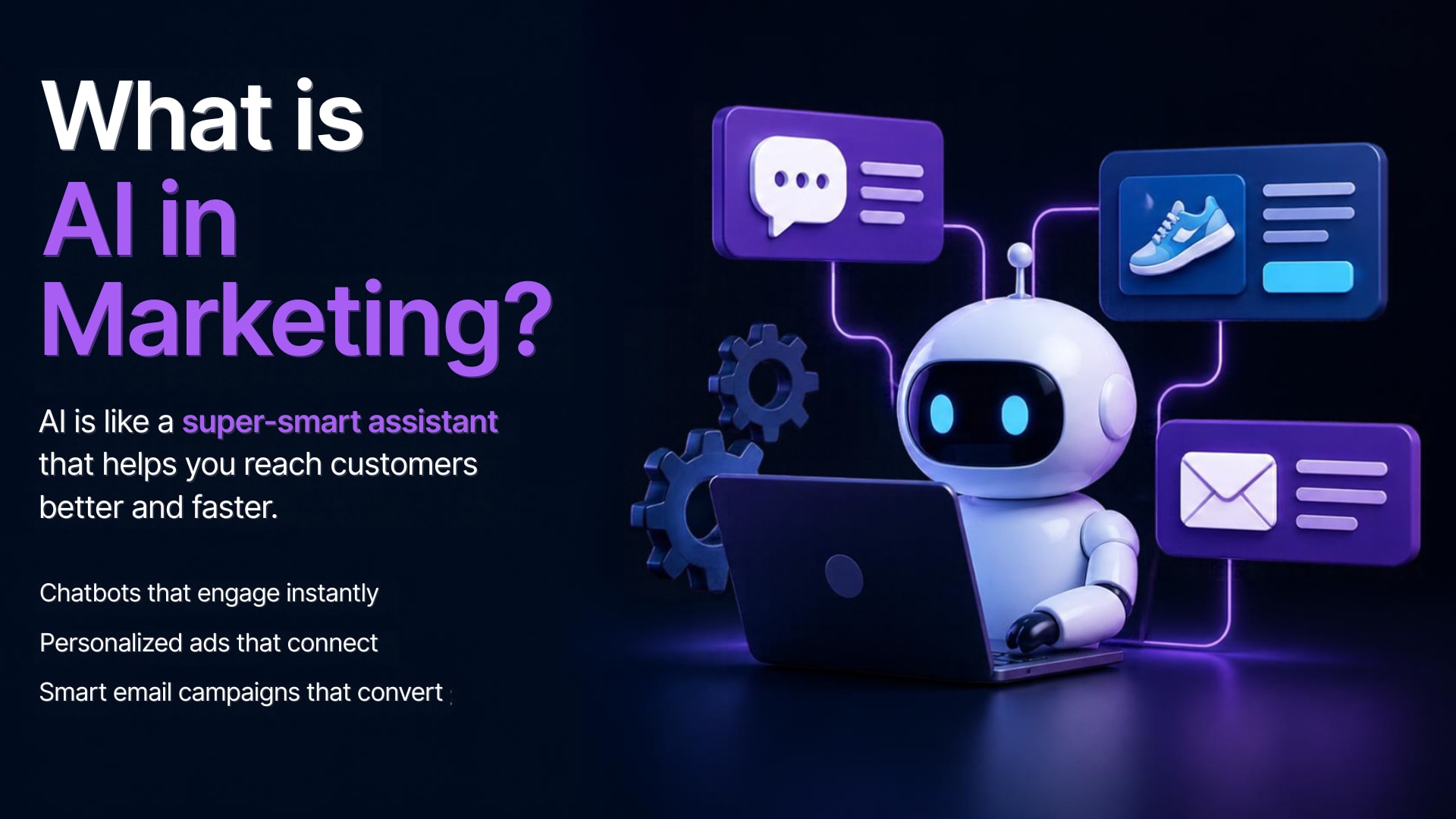
AI-powered digital marketing is the use of artificial intelligence to support online marketing activities such as content creation, audience research, social media management, search engine optimization, personalization, and performance analysis. It helps businesses organize information, automate selected tasks, and improve marketing workflows while people remain responsible for strategy, accuracy, and final decisions.
Understanding AI-Powered Digital Marketing
Traditional digital marketing relies on activities such as keyword research, content planning, advertising, email communication, social media publishing, and analytics. Many of these tasks require marketers to collect information, compare alternatives, prepare content, and evaluate results.
AI introduces tools that can assist with parts of this process. Depending on the tool, AI can interpret prompts, summarize information, generate draft content, identify patterns in available data, classify customer feedback, or recommend possible next steps.
For example, a local clothing business planning a festive-season campaign may need social media captions, product descriptions, promotional ideas, and a publishing schedule. An AI assistant can help prepare initial drafts and organize the campaign. The business owner can then review the ideas, confirm product details, adjust the language, and decide which posts are appropriate for the audience.
The important distinction is that AI supports the work rather than automatically making every marketing decision correctly.
Effective AI-powered digital marketing combines three elements:
Technology: Tools that assist with research, content, analysis, and automation.
Marketing strategy: Clear goals, audience knowledge, positioning, and campaign planning.
Human judgment: Editorial review, creative direction, ethical decisions, and relationship building.
When these elements work together, AI can help businesses make their marketing activities more organized and manageable.
How AI Supports the Digital Marketing Workflow
AI can contribute to several stages of a marketing campaign, from initial research to performance evaluation.
1. Research and planning
AI tools can help organize customer questions, brainstorm campaign themes, summarize publicly available information, and create preliminary audience profiles. Marketers can use these outputs to identify topics worth researching further.
2. Content development
Generative AI can produce first drafts of captions, blog outlines, email subject lines, product descriptions, and advertising copy. These drafts give marketers a starting point instead of requiring them to begin with a blank page.
3. Content distribution
Scheduling and automation tools can help businesses prepare posts in advance, maintain a publishing calendar, and coordinate activity across connected social media platforms.
4. Performance analysis
Some AI-enabled tools can summarize available analytics, highlight changes in engagement, and help marketers compare content formats or campaign outcomes.
5. Continuous improvement
Businesses can use performance observations to refine their messaging, test different approaches, and adjust future campaigns.
Not every AI tool supports every stage. Some focus on writing, others on analytics, and others on publishing or advertising. Businesses should understand the capabilities of each tool before incorporating it into their workflow.
AI-Assisted Content Creation
Content creation is one of the most accessible applications of AI in digital marketing. Businesses regularly need educational articles, social media captions, short videos, email newsletters, landing-page copy, and product descriptions.
Creating this material manually can consume significant time, particularly when the same campaign needs to be adapted for different channels.
AI content marketing tools can help marketers:
Generate topic ideas based on customer interests.
Develop blog outlines and initial drafts.
Rewrite content for different audiences.
Suggest headlines, introductions, and calls to action.
Prepare alternative captions for testing.
Turn longer educational content into shorter social posts.
Identify gaps in an existing content plan.
Consider an Indian home décor business preparing for Diwali. Its marketing team could use AI to brainstorm decoration tips, gifting guides, product-care posts, and short video concepts. The team could then select ideas that match its products, verify relevant details, and create original content using its own photographs and brand voice.
This process can make content planning more efficient without making every post sound identical.
The main limitation is that generated content may contain incorrect details, generic advice, repetitive language, or claims that cannot be verified. Publishing drafts without reviewing them can weaken credibility.
A better approach is to treat AI as a content assistant. Give it specific information about the business, intended audience, tone, and purpose. Review the result, add relevant experience or original insights, and edit the final content before publication.
Audience Research and Customer Segmentation
Understanding customers is central to effective marketing. Businesses need to know what people are looking for, which problems they want to solve, and what information helps them make purchasing decisions.
AI can assist with organizing customer information and identifying patterns within data that a business is permitted to use. Depending on the available information and tools, marketers may analyze customer feedback, product questions, survey responses, website interactions, or historical campaign results.
For example, an online skincare retailer might discover through customer feedback that people frequently ask about ingredient suitability, product routines, and packaging sizes. These recurring questions can inform educational content and product-page improvements.
Similarly, a coaching institute might categorize common enquiries into course fees, class schedules, eligibility, and placement support. The categories could help the institute prepare clearer website information and more relevant responses.
However, audience segmentation should not rely on unsupported assumptions. AI-generated customer profiles are hypotheses, not proof of what every customer wants.
Businesses should also avoid collecting unnecessary personal information or using sensitive data without an appropriate legal basis. The quality of the insights depends on the quality, relevance, and responsible use of the underlying data.
Marketing Analytics and Reporting
Marketing analytics helps businesses understand what happens after a campaign goes live. Without measurement, a company may spend time producing content without knowing whether it attracts relevant visitors, generates enquiries, or supports sales.
AI-assisted reporting can help summarize large amounts of information, identify unusual changes, and make reports easier to interpret.
For instance, a business might compare social media posts by reach, engagement, website clicks, and enquiries. An analytics assistant could help organize these observations and suggest possible questions for further investigation.
If educational videos consistently attract more qualified website visits than product announcements, the team might test more educational videos. It should still check whether the difference is meaningful and whether other factors, such as paid promotion or seasonal demand, influenced the result.
AI-generated analysis should not be accepted blindly. A tool may overlook context, misunderstand a metric, or suggest a relationship that does not establish cause and effect.
Businesses should define their key performance indicators before analyzing results. These might include qualified leads, conversion rate, cost per lead, customer acquisition cost, organic search clicks, or revenue attributable to a campaign.
The objective is not simply to produce reports faster. It is to make decisions using reliable evidence.
AI-Powered SEO and Content Optimization
Search engine optimization helps businesses make their websites easier to discover when people search for relevant products, services, and information.
AI can support keyword research, topic clustering, content briefs, title development, internal-link planning, and the identification of missing information within existing articles.
For example, a company offering accounting software could research questions about invoicing, expense tracking, tax preparation, and financial reporting. These topics could form a content plan around the problems potential customers want to solve.
AI can also help content teams identify whether an article answers its central question early, uses clear headings, explains unfamiliar terms, and includes relevant examples.
Answer Engine Optimization (AEO) focuses on making information easy to understand and extract for direct-answer experiences. Generative Engine Optimization (GEO) is commonly used to describe efforts to improve the visibility and usefulness of content in AI-generated search experiences.
These approaches overlap with strong traditional SEO practices. Clear explanations, accurate information, logical structure, useful examples, and relevant supporting evidence help both readers and search systems understand a page.
Google's official guidance emphasizes creating unique, valuable content for people rather than generating large volumes of pages simply to influence search rankings. Its guidance for generative AI search also reinforces the importance of established SEO fundamentals and helpful, original information.
Businesses should therefore use AI to improve research and editorial efficiency, not to produce hundreds of nearly identical articles. AI assistance alone does not guarantee search rankings or inclusion in AI-generated answers.
AI in Social Media Marketing
Social media marketing requires more than publishing occasional promotional posts. Businesses need a consistent content calendar, relevant visuals, platform-appropriate captions, community interaction, and regular performance reviews.
AI can support many of these activities by helping teams brainstorm ideas, draft captions, prepare creative concepts, organize campaigns, and analyze available engagement data.
A restaurant, for example, might plan content around signature dishes, kitchen preparation, customer questions, seasonal menus, and local events. AI could help organize these ideas into a weekly calendar while staff members provide genuine photographs, confirm menu details, and respond to customers.
A service business could develop educational posts answering common customer questions, while an e-commerce company might alternate product demonstrations, buying guides, customer education, and promotional content.
Social media automation can further simplify the process by scheduling approved content in advance. However, automated publishing should not eliminate human oversight. Current offers, prices, event dates, product availability, and customer-sensitive messages still need attention.
Businesses should also distinguish between activity and outcomes. Publishing more posts does not automatically lead to better engagement, qualified enquiries, or sales.
Personalization and Customer Communication
Personalization means making communication more relevant to the individual or audience receiving it. AI can help businesses adapt messaging to customer interests, previous interactions, stated preferences, or the context of an enquiry when appropriate information is available.
An online bookstore might organize recommendations around broad reading preferences. A training provider could prepare separate information for people interested in beginner courses and those exploring advanced programs.
AI can also help draft responses to frequently asked questions, classify incoming enquiries, or summarize conversations for a support team.
Nevertheless, personalization should remain useful and respectful. Customers should not feel that a business is using unexpected personal information or making intrusive assumptions about them.
Organizations need suitable privacy practices, access controls, and review procedures. Automated replies should be checked for accuracy, especially when discussing payment terms, refunds, legal requirements, health-related matters, or other high-impact subjects.
AI Assistance Versus Human Decision-Making
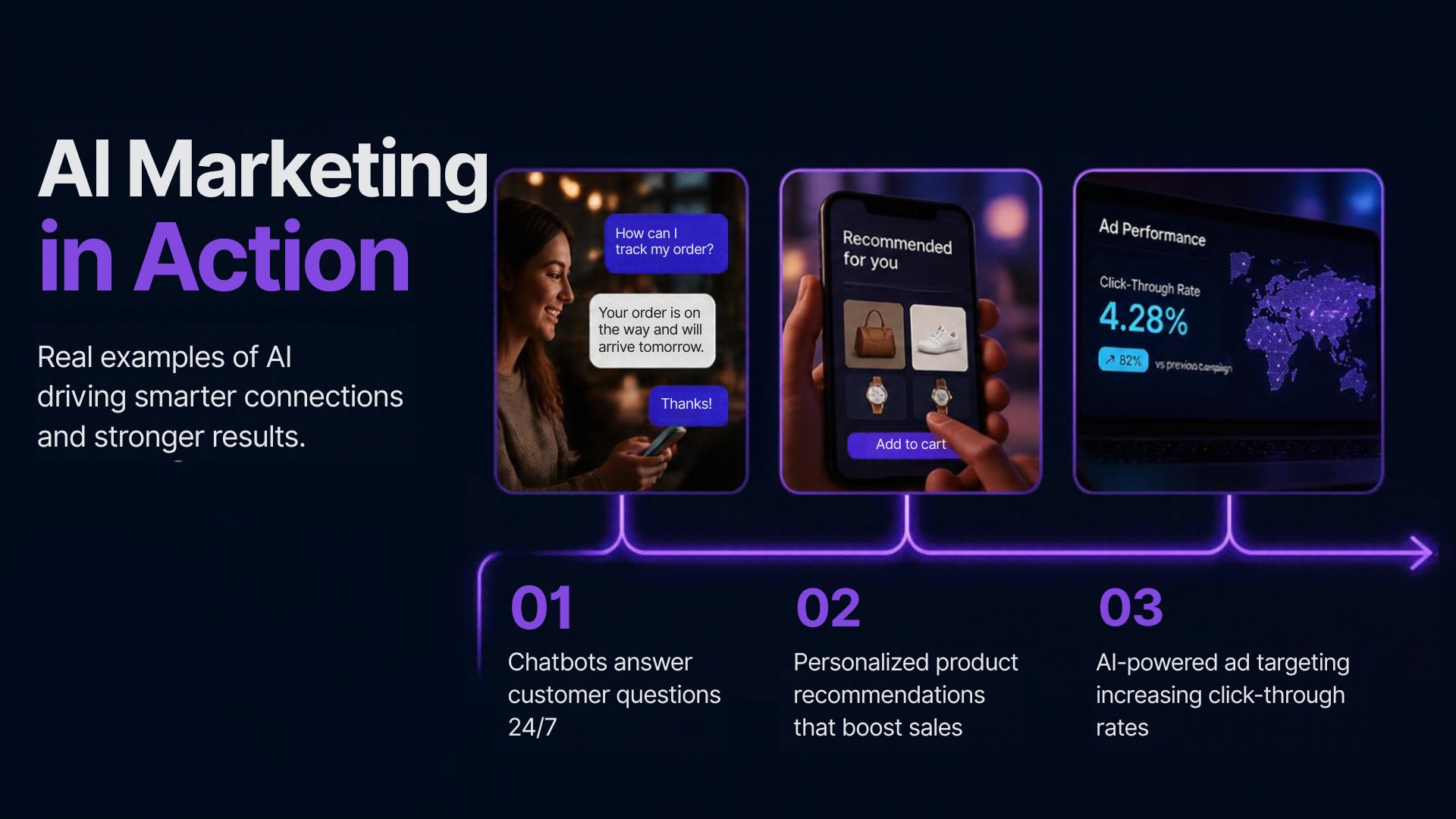
AI is useful for producing options, organizing information, and reducing repetitive work. Human marketers remain essential for deciding what a brand should communicate, which audiences it should serve, what claims it can substantiate, and how it should respond to customers.
An AI tool might suggest a promotional campaign based on a seasonal trend. A human marketer must decide whether the trend suits the brand, whether the offer is commercially viable, and whether the proposed message is appropriate.
Human review is especially important when content involves cultural context, customer complaints, sensitive subjects, regulated industries, or claims about product performance.
The most effective workflow assigns tasks according to their strengths. AI handles suitable repetitive work and preliminary analysis, while people provide strategic direction, factual verification, creative judgment, and accountability.
This balanced approach helps businesses benefit from automation without losing the trust and distinctiveness that make their marketing valuable.
How Can AI-Powered Digital Marketing Help Businesses Grow Faster in 2026?
AI-powered digital marketing can support business growth by reducing repetitive work, improving content planning, organizing customer insights, and helping teams evaluate campaigns more consistently. These capabilities can make marketing more manageable for small businesses and growing companies, but results depend on the offer, audience, execution, budget, and quality of measurement.
Saving Time on Repetitive Marketing Tasks
One of the most practical benefits of AI is the ability to speed up routine work.
Marketing teams often spend considerable time brainstorming topics, rewriting captions, formatting reports, preparing content calendars, and adapting the same message for different channels. AI can assist with these tasks so that people can spend more time reviewing quality, speaking with customers, and improving campaigns.
For example, a small consultancy might prepare a weekly LinkedIn post, a short newsletter, and a website article around one central topic. AI can help convert the original topic into an outline and suggest variations for each channel.
The consultant can then add professional insights, correct the terminology, and ensure that each version suits its audience.
The time saved will vary depending on the task, the tool, and the amount of review required. Businesses should not assume that every automated workflow is automatically faster or cheaper. Complicated setups, poor outputs, and repeated corrections can reduce the benefits.
A useful starting point is to identify tasks that are frequent, predictable, and relatively low risk. Automating these activities first makes it easier to evaluate whether the change genuinely improves productivity.
Developing Better Content Ideas and Campaign Plans
Many businesses struggle with deciding what to publish. They may post product promotions repeatedly because they have not developed a broader content strategy.
AI can help generate ideas around customer questions, seasonal opportunities, educational topics, product use cases, and different stages of the buying journey.
A useful content plan typically includes several categories:
Educational content: Explains a problem or answers a common question.
Product or service content: Shows what the business offers and how it works.
Trust-building content: Communicates expertise, processes, policies, and verified customer experiences.
Engagement content: Invites relevant questions, discussions, or feedback.
Conversion-focused content: Helps interested people take the next appropriate step.
For example, an Indian interior design company could create posts about small-apartment layouts, material selection, lighting, storage, budgeting, and project planning. Promotional content can then connect naturally to the services it provides.
AI can organize these themes into a draft calendar and suggest variations for different platforms.
However, the final plan should reflect actual business priorities. A list of trending topics is not a substitute for understanding the target customer or deciding what the company wants its marketing to achieve.
Improving Social Media Consistency
Consistency helps businesses maintain an active presence and give potential customers regular opportunities to understand their products or services.
Yet social media often becomes irregular when owners are busy with operations, sales, fulfilment, or customer support.
AI-assisted planning and social media marketing automation can reduce this burden. Businesses can prepare content in batches, schedule approved posts, and manage a calendar rather than creating everything at the last minute.
A local bakery, for example, might schedule content about its menu, preparation process, seasonal products, ordering information, and frequently asked questions. Staff can then focus on producing fresh content and responding to customers instead of repeatedly deciding what to post.
Consistency should not mean publishing content without purpose. The business should periodically review which posts attract the right audience and whether the content supports its wider objectives.
It should also leave room for timely announcements, unexpected events, and customer conversations that need a personal response.
Understanding Audience Interests More Clearly
Marketing becomes more relevant when it responds to genuine customer needs.
AI can help organize feedback, group common questions, summarize survey responses, and compare available performance data. These insights can guide content development, landing-page improvements, and campaign messaging.
Imagine a coaching institute receiving enquiries through its website and social media accounts. Prospective students repeatedly ask about course duration, eligibility, class timings, and practical training.
The institute can use those recurring questions to improve its website, prepare a frequently asked questions page, and create educational posts addressing common concerns.
This approach may reduce confusion and help prospective students find the information they need.
However, the business should confirm its observations against actual feedback. AI may overlook important differences between customer groups or interpret limited information incorrectly.
Audience insights are most useful when they lead to practical improvements that can be tested and measured.
Supporting SEO and Content Planning
AI can help marketing teams plan content around customer questions instead of publishing disconnected articles.
For a business selling accounting software, relevant subjects might include invoice creation, expense management, financial reporting, payment reminders, and bookkeeping workflows. A structured content plan could connect these topics through useful internal links and clear service pages.
AI can assist with identifying related topics, preparing outlines, reviewing content structure, and suggesting missing explanations.
It can also help marketers rewrite technical language into simpler wording, making content more accessible to readers unfamiliar with the subject.
However, keyword research and content generation should be guided by genuine search intent. A business should not create an article merely because a keyword appears attractive. The topic should match its expertise, offerings, and audience needs.
Before publishing, editors should check factual accuracy, originality, current information, and whether the article offers something useful beyond information already available elsewhere.
Strong SEO depends on the overall quality and relevance of the website, not simply the presence of AI-generated keywords.
Improving Campaign Measurement
Marketing decisions are stronger when businesses understand which activities produce useful outcomes.
AI-enabled analytics can help organize campaign data and identify patterns in traffic, engagement, enquiries, or conversions. This can make performance reports easier to review, particularly when a business uses several marketing channels.
Consider a business running two different campaigns: one designed to attract website visitors and another intended to generate consultation enquiries.
The first campaign might receive more clicks, while the second produces fewer visits but more relevant leads. Without clearly defined goals, the business might incorrectly conclude that the campaign with more clicks is the better investment.
A sensible measurement framework connects each activity to its intended result.
For awareness campaigns, useful indicators may include reach, impressions, and relevant audience growth. For website content, marketers may review organic clicks, engaged visits, and relevant page interactions. For lead-generation campaigns, qualified enquiries, conversion rates, and cost per qualified lead may matter more.
AI can help summarize these measurements, but the business must interpret them within the campaign's context. Attribution is not always straightforward, and changes in results may reflect seasonality, pricing, competition, or other external factors.
Supporting Lead Generation and Customer Engagement
Lead generation involves attracting people who may have a genuine interest in a business's products or services.
AI can support this process by helping teams create useful lead magnets, prepare landing-page drafts, organize incoming enquiries, and develop responses to common questions. Some automation systems can also categorize leads according to predefined criteria.
For example, a web development company might publish an educational guide explaining what businesses should prepare before redesigning a website. Visitors who request the guide could receive relevant follow-up information, provided the business has the appropriate permission and communication process.
The company can then identify which enquiries require a detailed conversation with a team member.
AI should not be used to manufacture misleading claims, send indiscriminate messages, or treat every enquiry as a qualified sales opportunity. Lead quality matters more than raw volume.
Businesses should also ensure that automated responses accurately represent their services, prices, delivery timelines, and terms.
Practical AI Marketing Opportunities for Small Businesses
Small businesses do not need to automate every marketing activity at once. A focused approach is often more manageable because it allows owners to understand the workflow before adding more tools.
Here are several practical applications.
Local service providers
A salon, repair service, or coaching centre can use AI to brainstorm educational posts, prepare responses to frequently asked questions, and organize a monthly content calendar. Business owners should verify service availability, opening hours, and promotional details before publishing.
E-commerce businesses
An online retailer can use AI to draft product descriptions, create category-page outlines, suggest campaign themes, and repurpose product education into social media content. Product specifications and claims must be verified against the actual inventory.
Startups
A startup with a small marketing team can use AI to develop initial campaign briefs, research customer questions, organize competitor observations, and prepare different messaging options for testing.
Professional services
Consultants, accountants, and technology providers can use AI to simplify explanations of complex services and plan content around common customer problems. Subject-matter experts should review all technical and professional claims.
Restaurants and local shops
Businesses can plan seasonal campaigns, share menu or product updates, and prepare location-relevant content. Current prices, operating hours, availability, and event details should be checked before publication.
These examples illustrate possible workflows, not guaranteed outcomes. Each business should choose activities based on its goals, available resources, and customer expectations.
Using AI Marketing in the Indian Business Environment
Indian businesses often serve audiences with different languages, purchasing preferences, regional traditions, and levels of familiarity with digital products. Marketing that works for one audience may not be equally effective for another.
AI can help businesses develop alternative versions of content, simplify explanations, brainstorm regional campaign themes, and adapt messages for different platforms.
For example, a regional food brand could prepare a campaign around a local festival while maintaining consistent product information across English and Hindi versions. A training institute could explain its courses using simpler language for first-time learners. A local retailer could plan content around seasonal shopping needs.
These applications require cultural and factual review. Automated translation may miss local expressions, introduce awkward wording, or misunderstand the intended tone.
Businesses should also consider which channels their customers actually use. A strategy designed for an urban online audience may not suit a business whose customers primarily discover services through local search, referrals, or messaging platforms.
AI should help businesses understand and serve their audience more effectively, rather than encouraging every company to follow the same digital marketing formula.
Common AI Marketing Mistakes to Avoid
AI tools can make marketing easier, but poor implementation can create new problems.
Publishing unedited content: Generated text may contain errors, generic claims, and repetitive phrasing. Every important piece of content needs review.
Following every trend: A trend may be popular without being relevant to the brand. Businesses should prioritize topics that connect with their audience and offerings.
Automating everything: Customer complaints, unusual enquiries, sensitive topics, and important business decisions often require human attention.
Buying too many tools: Overlapping subscriptions can increase costs and complicate workflows. Start with a clearly defined need.
Ignoring originality: Rewriting existing articles without adding useful insights does not create a strong content strategy. Businesses should contribute relevant examples, expertise, and information.
Measuring vanity metrics alone: Likes and impressions may provide useful context, but they do not automatically indicate qualified leads or revenue.
Assuming AI guarantees SEO success: AI can support content production and analysis, but it cannot guarantee rankings, visibility in AI answers, or conversions.
Neglecting privacy: Customer data should be handled responsibly, with suitable access controls and compliance with applicable privacy requirements.
Avoiding these mistakes requires clear processes, realistic expectations, and regular evaluation.
Responsible Use of Customer Data
Responsible data practices are essential when businesses introduce AI into marketing workflows.
Customer information may include contact details, purchase history, enquiry messages, preferences, and website interactions. Not every tool requires access to all this information.
Businesses should identify what data is genuinely necessary for a task, review the provider's data-handling terms, and restrict access where appropriate. Sensitive customer information should not be pasted into general-purpose AI tools without confirming that the use is authorized and appropriate.
Organizations operating in India should consider applicable requirements, including relevant provisions of the Digital Personal Data Protection Act, 2023, and rules or other legal requirements in force for their specific activities. Businesses serving international customers may have additional obligations depending on their location and circumstances.
Consent, transparency, security, and appropriate retention practices should be considered when collecting and using personal data.
Automated marketing messages should also respect communication preferences and applicable rules governing electronic communications.
Responsible AI marketing protects customers and helps businesses maintain credibility. It should be part of the workflow from the beginning, rather than an afterthought added after a problem occurs.
https://theviralmarketing.co/
How to Measure Whether AI Marketing Is Working
Businesses should evaluate AI marketing according to the improvement it produces in their actual workflow and business outcomes.
A practical measurement process begins with a baseline. Before introducing a new tool, record how long a task takes, how much it costs, and what results it currently produces.
Next, define a specific target. For example, the business might want to reduce the time needed to prepare a weekly content calendar without reducing editorial quality.
After implementation, compare the new workflow with the original process. Track the time spent on drafting, reviewing, correcting, and publishing rather than counting only the minutes saved during generation.
Depending on the campaign, relevant measures may include:
Time spent preparing and reviewing content.
Percentage of scheduled content published as planned.
Website visits from relevant marketing channels.
Qualified enquiries and lead conversion rates.
Cost per lead or customer acquisition cost.
Engagement from the intended audience.
Revenue or other outcomes that can reasonably be attributed to the campaign.
For example, a company may discover that AI reduces the initial drafting time but increases editing time because the prompts are poorly structured. Improving the instructions or narrowing the tool's responsibilities could make the workflow more efficient.
A fair evaluation includes costs such as subscriptions, implementation, staff training, review, and maintenance. It also considers risks, including incorrect content and customer dissatisfaction.
AI marketing should be retained, changed, or discontinued according to evidence rather than novelty.
A Practical Example: Planning a Small Business Campaign
Imagine a small Indian handmade-gifts business preparing for a festive sales period. The owner has limited time, a small advertising budget, and no dedicated marketing team.
The business could use a simple AI-assisted workflow.
First, the owner identifies the main objective: helping relevant customers discover the products and understand how to order them.
Second, the owner lists the products, verified prices, delivery areas, ordering process, and important deadlines. This information becomes the reference for content preparation.
Third, AI helps brainstorm educational posts, gift-selection guides, product demonstrations, short video concepts, and frequently asked questions.
Fourth, the owner reviews the ideas, removes unsuitable suggestions, prepares genuine product photographs, and checks every claim.
Fifth, selected posts are organized into a publishing calendar. Approved content is scheduled through an appropriate tool if scheduling is available.
Finally, the owner reviews website visits, enquiries, orders, and customer questions. The next campaign is adjusted according to the results.
This example demonstrates how AI can support a marketing process without requiring a complicated technology setup.
The business still needs a suitable product, accurate information, a clear offer, reliable fulfilment, and a way for customers to complete their purchases. AI helps organize the work, but the fundamentals of running the business remain essential.
What AI Cannot Replace in Digital Marketing
AI can assist with research and execution, but it cannot independently guarantee that a business has chosen the right market, developed a compelling product, or built a trustworthy brand.
It may produce plausible information that is incorrect. It may recommend generic campaigns that overlook local competition. It may misinterpret a customer comment or generate language that does not fit the brand.
Marketing also involves relationships, reputation, creativity, and decisions under uncertainty. These responsibilities require people who understand the business and are accountable for its actions.
For example, an AI tool may draft a response to a dissatisfied customer, but a team member should assess the situation, verify what happened, and determine the appropriate resolution.
Similarly, a tool can suggest campaign ideas, but the business owner must decide whether the proposed offer is financially sustainable and operationally realistic.
The most useful question is not whether AI can perform every marketing task. It is whether a specific use of AI improves the quality, efficiency, or consistency of work without creating unacceptable risks.
That principle keeps AI-powered digital marketing focused on practical business value.