Businesses are increasingly comparing digital staff with human staff as artificial intelligence becomes part of everyday operations. Digital staff can answer questions, handle repetitive communication, support lead engagement, and operate continuously, while human staff bring empathy, creativity, judgment, relationship-building, and accountability. The real question is not simply whether AI can replace people. It is how each type of workforce can promote better business performance.
For some companies, digital employees can improve response times and reduce repetitive workloads. For others, human employees remain essential because customers expect understanding, negotiation, creativity, or personal attention. Many businesses may find that combining both approaches creates a stronger workforce than choosing only one.
The World Economic Forum’s Future of Jobs Report 2025 reflects this broader shift. Its research suggests that human and technology-based work will increasingly overlap, with employers expecting a greater share of tasks to be completed through a combination of people and technology by 2030.
This makes the digital staff vs human staff debate less about replacement and more about workforce design.
How Can Digital Staff Promote Business Growth?
Digital staff can promote business growth by handling repetitive communication, responding quickly to routine questions, supporting lead engagement, and maintaining consistent service outside traditional working hours. They can allow human employees to spend more time on complex conversations, strategic work, relationship management, and decisions that require judgment.
What Is Digital Staff?
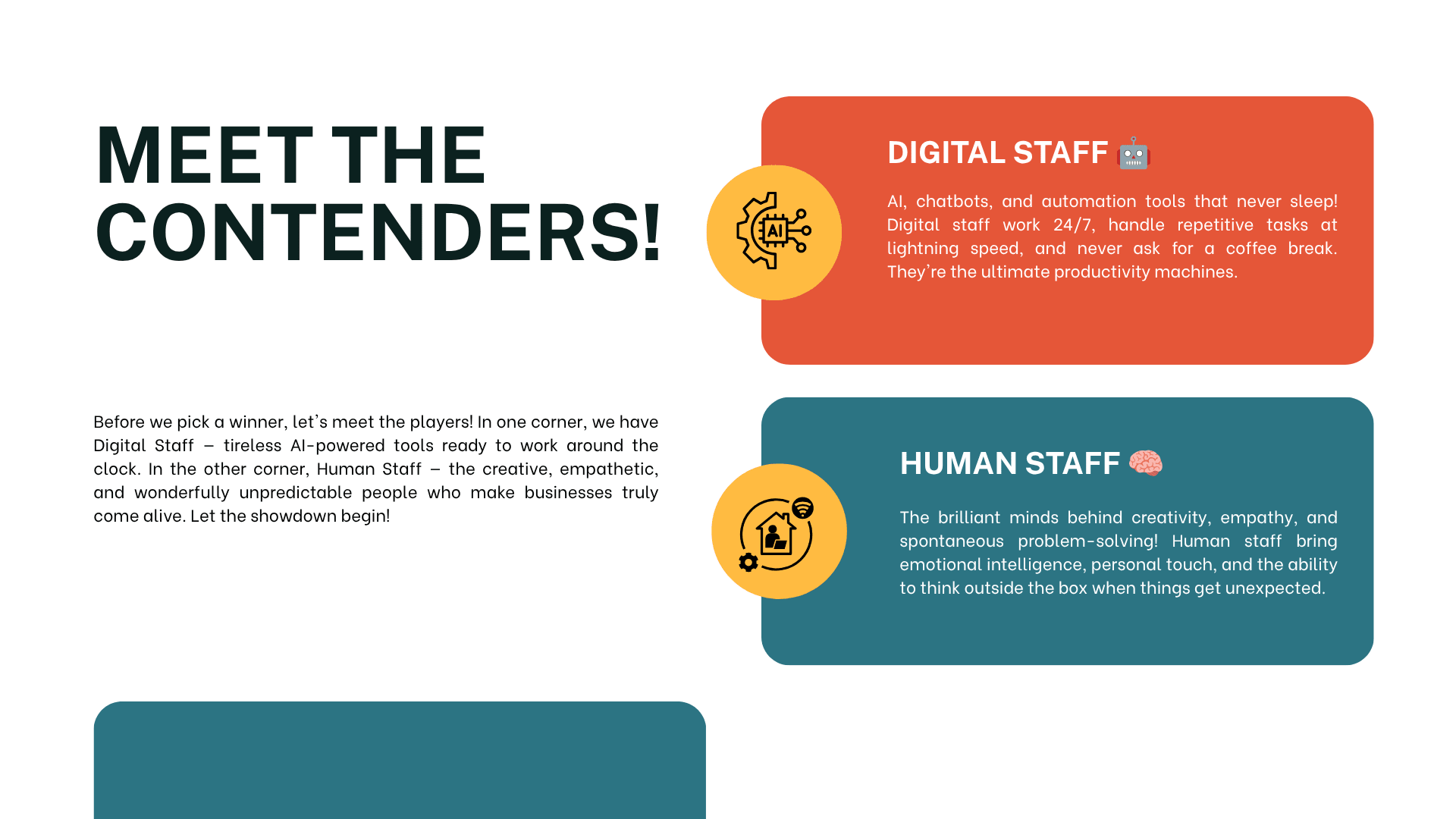
Digital staff refers to software-based systems that perform tasks traditionally handled by employees. These systems may use artificial intelligence, automation, conversational interfaces, workflow tools, or other digital technologies to complete specific business activities.
A digital employee does not necessarily represent a complete replacement for a human role. In many cases, it performs selected tasks within a broader workflow.
Examples can include:
AI-powered customer support assistants
Digital receptionists
Automated lead qualification systems
Virtual sales assistants
AI scheduling assistants
Automated FAQ agents
Digital onboarding assistants
Internal knowledge assistants
Automated follow-up systems
AI-based communication tools
The term "digital staff" therefore covers a wide range of capabilities.
A chatbot answering a customer's delivery question is a form of digital assistance. A system collecting lead information before transferring a prospect to a salesperson is another. A more advanced AI workforce may combine several automated tasks into a connected workflow.
The important distinction is that digital staff generally operate within defined capabilities. Human employees can adapt their behavior much more broadly when circumstances change.
How Does Digital Staff Differ From Human Staff?
Digital staff primarily work through software, data, automation rules, and AI models. Human staff work through experience, reasoning, communication, emotional understanding, physical presence, and personal judgment.
The difference becomes clearer when a business examines the nature of a task.
A repetitive question such as "What are the business hours?" may not require a human employee every time. A customer saying, "I have received the wrong product for the third time and need this fixed immediately," may require a human who can understand frustration, investigate the situation, negotiate a solution, and take responsibility.
Digital staff are generally strongest when the task is:
Repetitive
Predictable
High-volume
Rules-based
Text-based
Available through digital channels
Easy to measure
Supported by reliable information
Human staff are generally stronger when the task involves:
Empathy
Ambiguous situations
Negotiation
Leadership
Complex judgment
Creativity
Personal relationships
Sensitive communication
Physical activity
Accountability
The strongest workforce strategy recognizes these differences rather than treating every business task as interchangeable.
Can Digital Staff Handle Customer Communication?
Yes, digital staff can handle many forms of routine customer communication, particularly when customers need quick answers to common questions or straightforward assistance.
For example, an online retailer may receive hundreds of questions about delivery times, payment methods, return policies, product availability, or order processes. A digital assistant can answer many of these questions without requiring a customer-service employee to respond manually each time.
This can create several operational advantages:
Faster initial responses
Continuous availability
Consistent answers
Lower repetitive workload
More efficient lead handling
Better use of human support time
However, automated communication works best when the system has reliable information and a clear path for human escalation.
A customer should not be trapped in an automated conversation when the situation requires a person.
That principle is also reflected by YourSiteChat, which describes its AI chatbot as working alongside support teams rather than replacing them. Its platform is positioned around handling repetitive, high-volume questions while human agents focus on more complex conversations.
Can Digital Staff Reduce Repetitive Work?
Digital staff can reduce repetitive work when tasks are sufficiently structured for automation.
Consider a company receiving the same questions every day. Human employees may spend significant time repeatedly explaining basic policies, collecting simple information, or directing customers to the correct resource.
When a digital assistant handles those interactions, employees can focus on work that creates greater value.
For example:
A customer visits a business website.
The digital assistant answers a common question.
The system collects basic information if the customer has a specific request.
A qualified or complex inquiry is transferred to a human employee.
The employee continues the conversation with the available context.
This workflow does not remove the human employee.
It removes unnecessary repetition.
How Can Digital Staff Promote Business Efficiency?
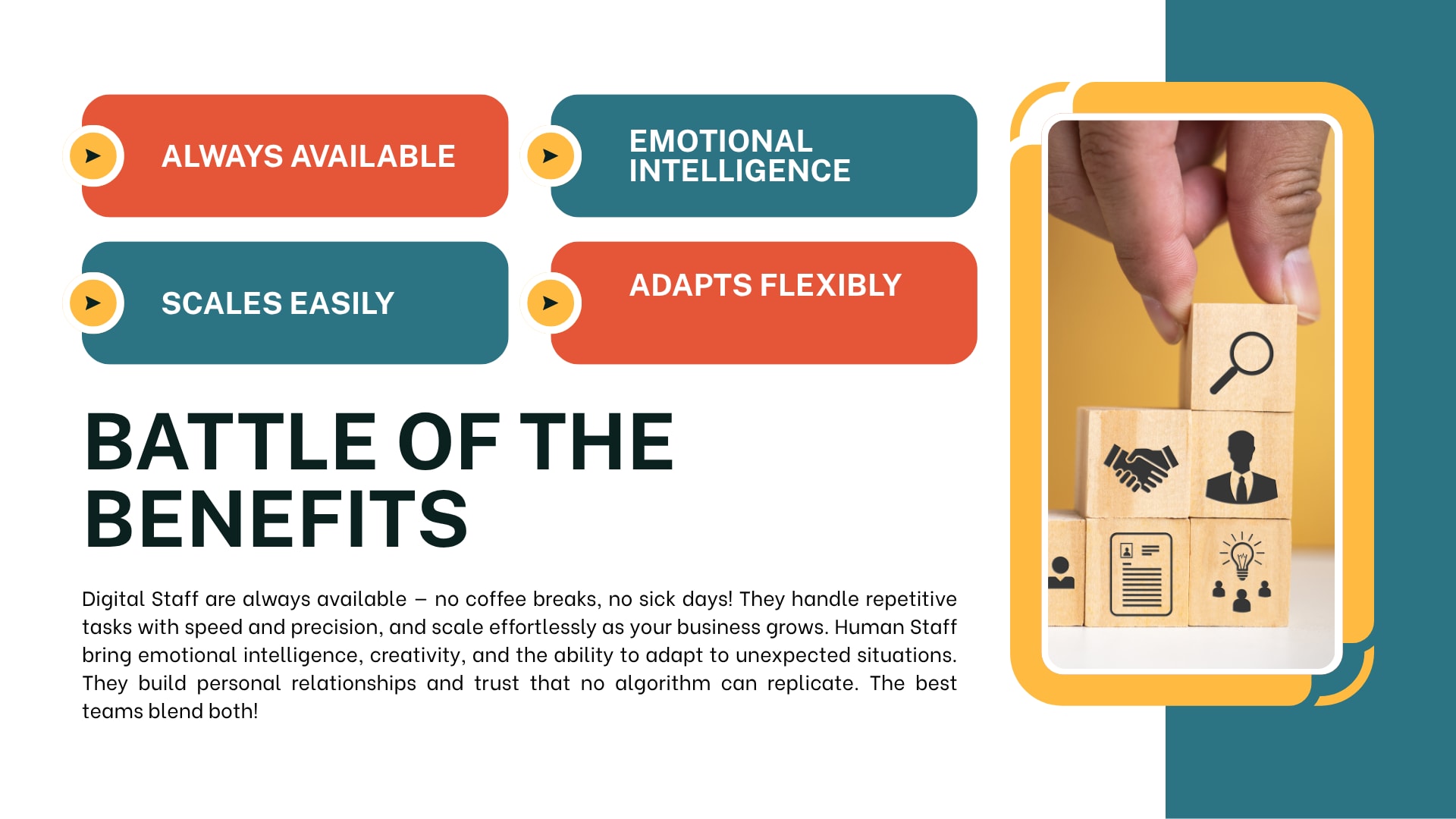
Digital staff can promote operational efficiency by making routine processes faster, more consistent, and easier to scale. The greatest benefit often comes not from replacing an entire employee role but from removing low-value tasks that consume employee time.
A business may find that employees spend too much time:
Answering the same questions
Copying information between systems
Responding to basic inquiries
Sorting incoming requests
Collecting initial customer details
Providing routine updates
Handling simple scheduling requests
Following predictable communication processes
Automating appropriate portions of these workflows can give human employees more time for higher-value responsibilities.
That distinction matters because productivity is not simply about doing more work. It is about directing available human effort toward work that genuinely requires human capability.
Are Digital Staff Available Around the Clock?
Digital staff can operate continuously when the underlying system is available and properly configured.
This can be especially useful for businesses serving customers across different time zones or receiving website inquiries outside normal office hours.
For example, a small online business may close its office at 6 p.m., but customers can still visit its website at midnight. A digital assistant can provide basic information during that period and collect inquiries for the human team.
The next morning, employees can review those conversations instead of starting from zero.
That can improve continuity without requiring a human employee to remain available all night.
However, 24/7 availability does not mean that every interaction should remain automated. Availability and capability are different concepts.
Is Digital Staff More Scalable Than Human Staff?
Digital staff can often scale routine digital interactions more easily than a traditional human-only workforce. A single automated system can potentially handle many simultaneous conversations, whereas human employees have physical and time limitations.
This is particularly useful for businesses experiencing sudden increases in demand.
Imagine an e-commerce company launching a major promotion. Customer questions may increase rapidly. Hiring and training enough temporary employees to handle every additional inquiry may take time.
A digital support system can handle many common questions immediately, while human employees manage unusual requests, complaints, refunds, escalations, and high-value customer conversations.
Scalability therefore becomes one of the strongest arguments for digital staff.
But scalability should not be confused with universal suitability.
A system can scale a poor customer experience just as efficiently as a good one if it is badly designed.
Are Human Staff Still Better for Complex Business Work?
Human staff remain essential for work requiring empathy, contextual judgment, creativity, leadership, negotiation, relationship-building, physical action, and accountability. Digital systems can assist these responsibilities, but many situations still require people who can understand circumstances beyond predefined information and respond with genuine human judgment.
Why Do Human Employees Remain Important?
Human employees bring capabilities that are difficult to reduce to a fixed set of automated responses.
A customer may not simply need information. The customer may need reassurance.
An employee may need to recognize that a customer's words do not fully express the underlying problem. A manager may need to resolve conflict between employees. A salesperson may need to understand an organization's political and financial concerns before negotiating a contract.
These situations involve context.
Human employees can draw upon experience, intuition, emotional awareness, and social understanding when making decisions.
The World Economic Forum reports that human capabilities such as analytical thinking, resilience, flexibility, leadership, collaboration, and creative thinking are expected to remain important as technology skills grow in demand.
This suggests that the future workforce is unlikely to be purely technological.
Instead, businesses will increasingly need both technological and human capabilities.
Are Human Staff Better at Building Customer Relationships?
Human staff are generally better suited to customer relationships that depend on trust, empathy, negotiation, and personal understanding.
Consider two customers.
The first wants to know whether a product is available.
The second has been a loyal customer for five years and is considering leaving because of a serious service problem.
The first interaction may be handled effectively by digital staff.
The second may require a human employee who can listen carefully, understand the history, acknowledge the problem, and negotiate a suitable solution.
The difference is not simply complexity.
It is emotional significance.
Customers often remember how a business made them feel, especially when something goes wrong. Human employees can respond to frustration, uncertainty, disappointment, and emotional nuance in ways that automated systems may struggle to reproduce consistently.
Can Human Employees Handle Unexpected Problems Better?
Human employees are generally better equipped for situations that fall outside established workflows.
Suppose a customer requests something that is not covered by the company's standard policy. A digital system may identify the policy but struggle to determine whether an exception is reasonable.
A trained employee can consider:
The customer's history
The seriousness of the situation
Business policy
Commercial value
Possible risks
Available alternatives
Long-term relationship impact
The employee can then make or recommend a decision.
This is why human oversight remains important even when automation becomes sophisticated.
Are Human Employees More Creative?
Human employees remain particularly valuable in creative work that depends on original thinking, cultural awareness, personal experience, strategic interpretation, and subjective judgment.
Creative work can include:
Brand strategy
Leadership
Campaign concepts
Product direction
Negotiation
Storytelling
Relationship development
Business strategy
Organizational problem-solving
AI tools can assist with brainstorming, drafting, analysis, and pattern recognition.
Assistance, however, is different from responsibility.
A business still needs people who understand why a particular idea fits the organization's goals, customers, brand, values, and circumstances.
Are Human Employees More Expensive?
Human employees generally create more direct staffing costs because businesses may need to account for salaries, benefits, recruitment, training, management, leave, workspace, equipment, and employee turnover.
Digital staff may reduce some of these costs for specific automated tasks.
However, the cost comparison is not as simple as comparing a software subscription with a salary.
A business also needs to consider:
Implementation costs
Integration expenses
AI or software usage costs
Maintenance
Data management
Monitoring
Security
Training
Human oversight
Error correction
Customer escalation
An inexpensive automated system can become costly if it produces errors that employees must repeatedly correct.
Likewise, a human employee who appears expensive on paper may generate significant value through sales, customer retention, creativity, leadership, or problem-solving.
The right comparison is therefore cost versus business value, not simply salary versus software.
What Happens When a Business Relies Too Much on Digital Staff?
Over-reliance on digital staff can create problems when automation is used for tasks that require human judgment or when customers cannot easily reach a person.
Potential problems include:
Frustrated customers
Incorrect automated answers
Poor handling of unusual situations
Reduced trust
Lack of accountability
Difficulty resolving complaints
Overdependence on system-generated information
Brand damage
Automation should make customer experiences easier, not create another barrier.
A good system knows when it has reached its limits.
What Does the Digital Staff vs Human Staff Comparison Look Like?
Business FactorDigital StaffHuman StaffCostOften lower for repetitive digital tasks, depending on implementationGenerally higher direct staffing costsAvailabilityCan operate continuouslyUsually limited by working schedulesScalabilityHigh for many digital and repetitive interactionsLimited by available employees and working hoursCustomer interactionStrong for routine questions and structured communicationStrong for complex and personal conversationsEmotional intelligenceLimited compared with humansStrongRepetitive tasksHighly suitableCan become inefficient when workload is repetitiveComplex decision-makingRequires defined rules, information, or human oversightStronger for ambiguous situationsSpeedVery fast for suitable automated tasksDepends on workload and employee availabilityConsistencyCan provide consistent responses when properly configuredCan vary between employeesBest use casesFAQs, initial support, lead capture, routine communicationNegotiation, leadership, complaints, relationships, complex decisions
The comparison shows why neither workforce is universally better.
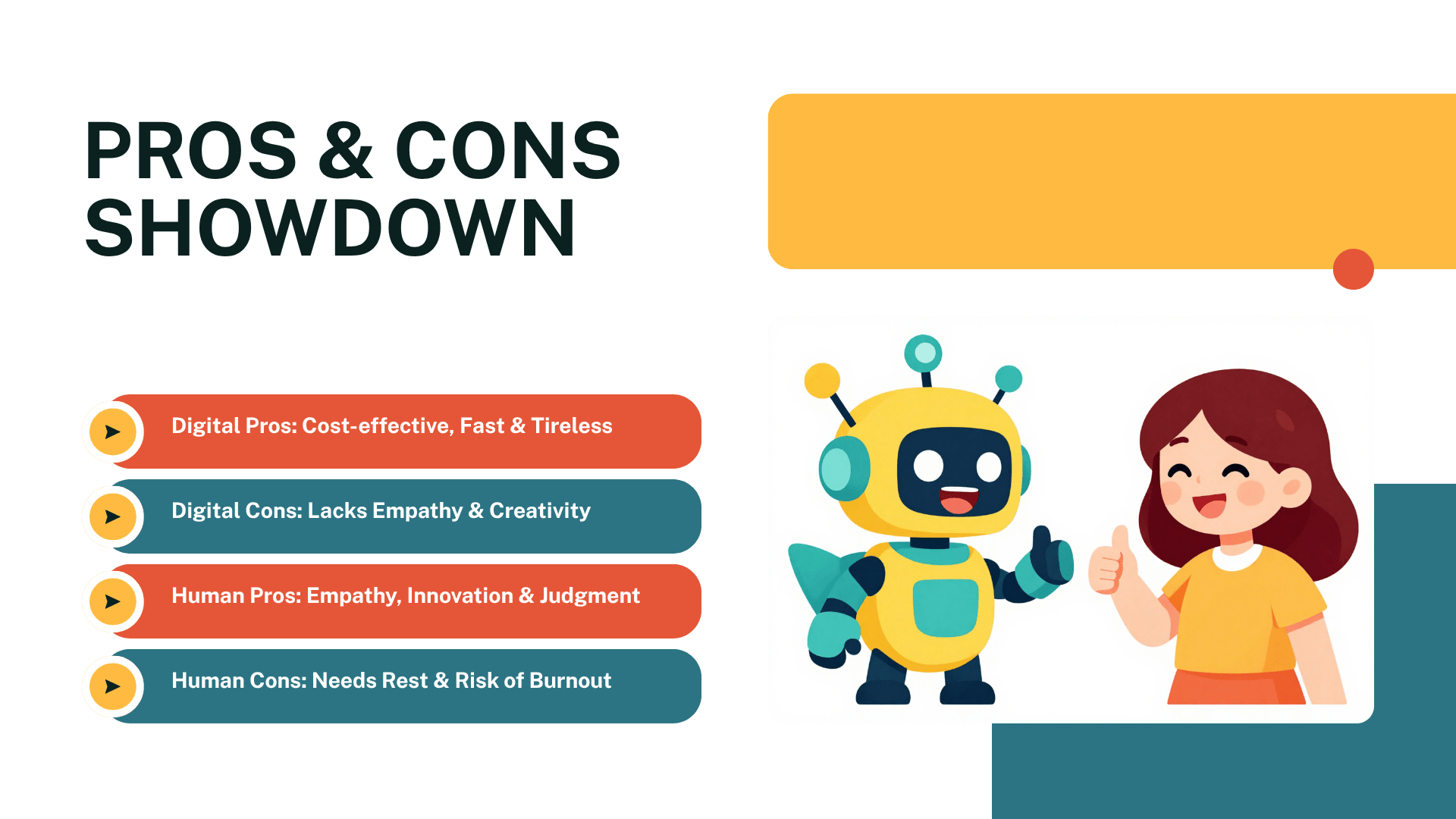
Digital staff are strongest where consistency, speed, availability, and repetition matter.
Human staff are strongest where judgment, empathy, creativity, trust, and accountability matter.
When Should a Business Choose Digital Staff?
Digital staff can make sense when a business has a significant volume of predictable, repetitive, digital interactions.
Common examples include:
Website customer questions
Basic product information
Appointment inquiries
Lead qualification
Frequently asked questions
Initial customer support
Routine status updates
Basic information collection
Simple internal knowledge searches
A small company with limited staff may particularly benefit because automation can provide additional operational capacity without immediately expanding the human workforce.
When Should a Business Choose Human Staff?
Human staff are essential when the work involves complex judgment, emotional sensitivity, physical presence, leadership, negotiation, or high-value relationships.
Examples include:
Handling serious complaints
Managing important accounts
Closing complex sales
Negotiating contracts
Leading teams
Managing sensitive situations
Developing business strategy
Resolving unusual customer problems
Providing professional judgment
Building long-term relationships
A company should not automate a task simply because technology can technically perform part of it.
The better question is whether automation improves the outcome.
How Can Businesses Combine Digital Staff and Human Staff?
A hybrid workforce can combine digital staff for speed, scale, and repetitive work with human staff for judgment, empathy, creativity, and relationship management. This approach allows businesses to automate suitable tasks while maintaining human involvement where customers and employees benefit most from personal expertise.
What Is a Hybrid Workforce?
A hybrid workforce is a business model in which humans and digital systems work together.
The digital side handles appropriate automated activities.
The human side manages activities requiring judgment, responsibility, creativity, or personal interaction.
This approach is increasingly relevant because the future of work is not simply about choosing machines over people. The ILO's 2025 research on generative AI found that most jobs exposed to the technology are more likely to be transformed than completely eliminated because human input remains necessary.
That distinction is important for business planning.
How Can a Small Business Use a Hybrid Workforce?
A small business can use digital staff as a first layer of communication while keeping human employees responsible for important conversations.
For example, consider a hypothetical online consulting company.
The digital assistant could:
Welcome website visitors.
Answer common questions.
Explain available services.
Collect basic lead information.
Identify the reason for the inquiry.
Direct complex inquiries to a human employee.
The human employee could then focus on understanding the prospect's needs, discussing the project, answering detailed questions, negotiating scope, and building trust.
This model allows the company to maintain human service without forcing employees to answer every basic question manually.
How Can E-Commerce Businesses Use Digital Staff?
An e-commerce company can use digital staff for repetitive customer communication while reserving human employees for situations where intervention matters.
Digital staff may assist with questions about:
Product availability
Delivery information
Return procedures
Payment methods
Basic product specifications
Order-related information
Store policies
Human employees can handle:
Complex returns
Angry customers
Damaged products
Repeated service failures
High-value customers
Special requests
Unusual order problems
This division can improve efficiency without removing human customer service.
How Can YourSiteChat Fit Into a Hybrid Workforce?
YourSiteChat can serve as an example of the hybrid model because its website presents its AI chatbot platform as a tool for customer communication rather than a complete replacement for support teams. The platform describes AI handling repetitive, high-volume questions while human agents focus on complex, high-value conversations.
Its published information also describes capabilities such as lead capture, analytics, custom branding, API access, webhook support, and mobile-friendly chatbot deployment on its pricing pages.
That makes the platform relevant to businesses considering a digital-first communication layer.
The practical value, however, depends on how a company configures the system, what information it provides, how conversations are monitored, and when human escalation occurs.
How Should a Business Decide Which Tasks to Automate?
A business can evaluate each task rather than attempting to automate entire job titles.
A practical process includes five steps:
List repetitive activities.
Identify tasks employees perform repeatedly during the week.Separate simple from complex work.
Determine which activities follow predictable patterns and which require judgment.Identify customer-sensitive tasks.
Consider whether mistakes or poor communication could seriously damage trust.Test automation on low-risk activities.
Begin with tasks where errors can be easily detected and corrected.Create a human escalation path.
Make it clear when a person should take over.
This task-based approach is usually more effective than deciding that an entire department should become automated.
What Should Businesses Consider Before Introducing Digital Staff?
Businesses should evaluate more than the technology itself.
Important questions include:
What problem is the system solving?
How repetitive is the task?
What information does the system need?
How accurate does the response need to be?
What happens when the system is uncertain?
Can customers reach a human easily?
How will performance be monitored?
Who is responsible for correcting errors?
What customer data will be processed?
How will employees interact with the system?
Security and governance also deserve attention.
The more sensitive the information involved, the more carefully the business should assess its technology providers, access controls, data handling, and compliance requirements.
Can Digital Staff Promote Business Growth Without Replacing Employees?
Yes. Digital staff can promote growth by increasing the capacity of existing employees rather than eliminating their roles.
A salesperson who spends two hours every day answering basic questions has less time for qualified prospects.
A support employee who spends most of the day responding to repetitive FAQs has less time for difficult customer problems.
A manager who manually checks routine information has less time for strategic planning.
Automation can shift this balance.
The goal becomes:
Digital systems handle repetition. Human employees handle value.
This does not mean every employee becomes more productive automatically. Businesses still need thoughtful workflows, training, monitoring, and clear responsibilities.
What Are the Main Risks of a Hybrid Workforce?
A hybrid workforce can create strong results, but it also introduces new management responsibilities.
Potential risks include:
Poorly configured automation
Incorrect information
Unclear human escalation
Employee overdependence on AI
Customer frustration
Privacy or security concerns
Lack of system monitoring
Inconsistent processes
Failure to update business information
Treating AI output as automatically correct
The solution is not to avoid automation.
The solution is responsible implementation.
Employees should understand what digital systems can do, what they cannot do, and when human judgment must take over.
How Should Businesses Measure Digital Staff Performance?
Digital staff should be evaluated using business outcomes rather than novelty.
Useful measurements may include:
Response time
Resolution rate
Escalation rate
Lead completion rate
Customer satisfaction
Conversion rate
Employee time saved
Error rate
Cost per interaction
Customer retention
For example, if an automated assistant answers thousands of questions but customer satisfaction falls, the system may not be delivering meaningful value.
Likewise, a system that reduces repetitive work while maintaining customer satisfaction may be producing a valuable operational improvement.
Measurement creates accountability.
Does the Future of Work Favor Digital Staff or Human Staff?
The future of work is likely to favor collaboration between digital technology and human capabilities rather than a complete shift toward one side.
The World Economic Forum expects substantial changes in job tasks and skills through 2030, while emphasizing the continuing importance of human capabilities alongside technology skills.
The ILO similarly reports that generative AI exposure is widespread but that most affected jobs are expected to experience transformation rather than complete redundancy because human involvement remains important.
This means businesses should prepare employees to work with technology instead of treating technology and employees as opposing forces.
What Skills Will Human Employees Need in an AI Workforce?
Human employees may increasingly need skills that complement automated systems.
These can include:
Critical thinking
Communication
Leadership
Creativity
Relationship management
Problem-solving
Adaptability
Emotional intelligence
Strategic thinking
AI literacy
The World Economic Forum identifies analytical thinking as a leading core skill while also highlighting resilience, flexibility, leadership, collaboration, and creative thinking as important capabilities in the changing labor market.
The implication for businesses is straightforward: technology adoption should be accompanied by workforce development.
What Is the Best Staffing Strategy for Different Businesses?
There is no single answer because the ideal workforce depends on the company's customers, industry, operating model, budget, and type of work.
A useful framework looks like this:
Small online businesses:
Digital staff can handle FAQs, initial inquiries, lead capture, and routine customer communication while owners or employees manage important conversations.
E-commerce companies:
Digital systems can support repetitive customer questions, while human agents handle complaints, exceptions, refunds, and complex issues.
Professional services:
Digital staff can assist with initial information and scheduling, while professionals handle advice, diagnosis, strategy, negotiation, and relationship management.
Sales organizations:
Automation can assist with lead qualification and initial communication, while human salespeople handle discovery, negotiation, objections, and closing.
Large enterprises:
A combination of AI workforce tools and human teams can support customer service, internal knowledge access, operations, and employee productivity while maintaining governance and specialized human oversight.
The more sensitive, complex, or relationship-driven the task becomes, the stronger the case for human involvement.
How Can a Business Build a Hybrid Workforce Step by Step?
A business can introduce a hybrid workforce gradually instead of changing its entire staffing model at once.
Map current employee tasks.
List the activities performed across customer service, sales, administration, operations, and support.Identify repetitive work.
Highlight tasks that occur frequently and follow predictable patterns.Select low-risk automation opportunities.
Begin with simple processes that can be monitored easily.Choose appropriate digital tools.
Evaluate reliability, integration, security, usability, scalability, and support.Define human escalation rules.
Decide exactly when a digital system must transfer the interaction to an employee.Train employees.
Human workers should understand how the technology supports their role.Monitor performance.
Review customer satisfaction, accuracy, response time, employee workload, and business outcomes.Improve the workflow continuously.
Automation should be adjusted when customer behavior, products, policies, or business needs change.
This gradual approach reduces unnecessary disruption and gives businesses evidence before expanding automation.
Is Digital Staff Better Than Human Staff?
Digital staff are better for some tasks, while human staff are better for others. Digital systems are generally stronger at repetitive, scalable, high-volume, and predictable activities. Human employees remain stronger at empathy, complex judgment, creativity, negotiation, leadership, and relationship-building. For many businesses, the strongest option is a combination of both.
The central question should therefore not be:
"Which workforce should replace the other?"
A better question is:
"Which tasks should technology handle, and where should human expertise remain involved?"
That question produces a much more practical workforce strategy.
What Should Businesses Know Before Choosing Digital or Human Staff?
Businesses should make staffing decisions according to task requirements rather than technology trends. Digital staff can provide speed, availability, consistency, and scalability, while human staff provide judgment, empathy, creativity, and accountability. The strongest decision usually comes from identifying which responsibilities benefit from automation and which require genuine human involvement.
Is Digital Staff Better Than Human Staff?
Digital staff are not universally better than human staff. Digital employees are highly useful for repetitive and predictable work, while human employees are essential for complex decisions, emotional situations, relationships, leadership, and creativity.
Can Digital Staff Replace Human Employees?
Digital staff can automate certain tasks within human roles, but complete replacement is not appropriate for every position. Many jobs contain a mixture of repetitive activities and responsibilities requiring human judgment. A hybrid model can allow businesses to automate suitable tasks while keeping people involved where they add the most value.
Are Digital Employees Cheaper Than Human Employees?
Digital employees can reduce costs for some repetitive processes, but they are not automatically cheaper in every situation. Businesses should consider implementation, software, integration, monitoring, maintenance, security, and human oversight alongside direct staffing costs.
How Can Digital Staff Promote Business Growth?
Digital staff can promote growth by helping businesses respond faster, support customers outside normal working hours, manage repetitive communication, qualify leads, and reduce routine workloads. When employees spend less time on repetitive work, they may have more capacity for sales, customer relationships, strategy, and other high-value activities.
What Tasks Should Businesses Give to Digital Staff?
Suitable tasks often include FAQs, initial customer support, basic information delivery, lead capture, routine communication, simple qualification, and other predictable digital processes.
What Tasks Should Remain With Human Employees?
Human employees should generally remain responsible for complex complaints, sensitive conversations, negotiation, leadership, strategic decisions, relationship management, creative direction, and situations where significant judgment or accountability is required.
Is a Hybrid Human and Digital Workforce Better?
For many businesses, a hybrid workforce is the most practical approach. Digital staff can provide speed and scale while human employees provide empathy, judgment, creativity, and relationship management. The exact balance should depend on the company's customers, processes, industry, risk level, and goals.
How Can Businesses Know What to Automate First?
Businesses should begin with tasks that are repetitive, predictable, measurable, and relatively low-risk. Processes involving sensitive decisions, complex customer relationships, or significant consequences should generally receive stronger human oversight.
What Is the Future of Business Staffing?
The future of staffing is likely to involve closer cooperation between people and digital systems. Businesses will continue adopting AI and automation while relying on human employees for capabilities that technology cannot consistently reproduce, particularly judgment, leadership, empathy, creativity, and relationship-building.
Final Thoughts on Digital Staff vs Human Staff
The digital staff vs human staff debate does not have a universal winner.
Digital staff can provide speed, consistency, scalability, continuous availability, and support for repetitive work. Human staff provide qualities that remain central to strong businesses: empathy, creativity, judgment, leadership, trust, negotiation, and personal relationships.
For a small business, digital staff may provide much-needed support without immediately expanding the team. For an e-commerce company, automation may reduce repetitive customer questions while human agents focus on difficult cases. For a professional services company, digital tools may assist with initial communication while experts remain responsible for advice and decisions.