
In today's highly competitive digital landscape, businesses are constantly searching for smarter ways to attract prospects, convert visitors, and retain customers. One of the most effective solutions emerging across industries is the implementation of chatbot marketing strategies. From lead generation and customer support to personalized recommendations and automated follow-ups, chatbots have transformed how brands interact with consumers.
Modern customers expect instant responses, personalized experiences, and seamless communication across multiple channels. Traditional marketing methods often struggle to meet these expectations consistently. This is where AI chatbot marketing and conversational marketing solutions create a significant competitive advantage.
Businesses that successfully deploy chatbot marketing strategies often experience increased lead capture rates, improved customer engagement, higher conversion rates, and lower operational costs. Whether used on websites, social media platforms, landing pages, or mobile applications, chatbots help businesses engage customers at every stage of the buying journey.
This guide explores proven chatbot marketing strategies that work, including lead generation techniques, conversion optimization tactics, customer retention workflows, and future trends shaping conversational marketing.
What Are Chatbot Marketing Strategies and Why Are They Essential for Modern Business Growth?
Chatbot marketing strategies are structured approaches that use automated conversations to attract, engage, qualify, convert, and retain customers. These strategies help businesses deliver personalized experiences at scale while improving efficiency, customer satisfaction, and revenue generation.
As customer expectations continue to evolve, businesses increasingly rely on conversational marketing and AI-powered marketing tools to provide instant assistance and personalized communication.
What is chatbot marketing and how does it work?
Chatbot marketing involves using automated conversational systems to interact with website visitors, prospects, and customers throughout the customer journey.
These interactions can include:
Answering questions
Recommending products
Capturing leads
Scheduling appointments
Processing orders
Supporting customers
Delivering personalized content
Chatbots function through predefined workflows, artificial intelligence, or a combination of both. They can engage users through websites, social media channels, messaging platforms, mobile applications, and customer portals.
A typical chatbot interaction includes:
User initiates a conversation.
Chatbot identifies intent.
Chatbot provides relevant information.
Data is collected.
User receives personalized recommendations.
Lead or customer action is completed.
The result is a smoother customer experience and improved conversion opportunities.
Why are chatbot marketing strategies becoming a core part of digital marketing?
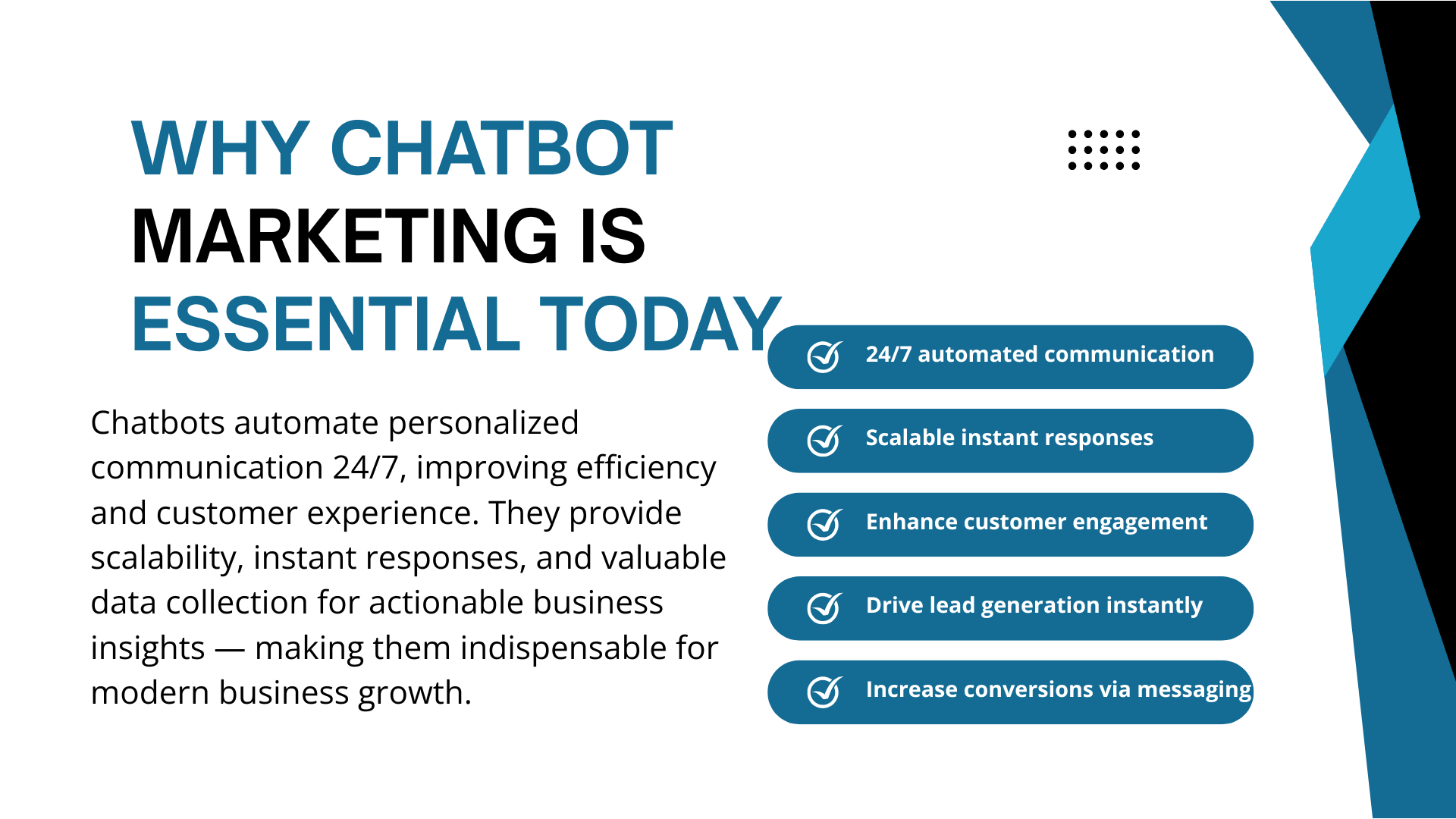
Consumer behavior has shifted dramatically toward instant communication.
Modern customers expect:
Immediate responses
Personalized experiences
24/7 availability
Frictionless support
Traditional communication channels often struggle to meet these expectations consistently.
Chatbot marketing strategies solve these challenges by:
Automating repetitive interactions
Reducing response times
Personalizing engagement
Improving lead qualification
Enhancing customer journeys
Organizations increasingly view chatbots as essential components of digital transformation initiatives.
How do AI-powered chatbots differ from traditional chatbots?
AI-powered chatbots use machine learning, natural language processing, and conversational intelligence to understand user intent and generate dynamic responses.
Traditional chatbots operate primarily through predefined decision trees.
FeatureTraditional ChatbotsAI-Powered ChatbotsResponsesPredefinedDynamicLearning AbilityLimitedContinuousPersonalizationBasicAdvancedUser Intent RecognitionRule-BasedAI DrivenConversation FlexibilityLowHighCustomer ExperienceStandardizedPersonalized
What role does conversational AI play in customer interactions?
Conversational AI enables chatbots to:
Understand natural language
Interpret user intent
Detect context
Personalize responses
Improve customer satisfaction
Instead of forcing users through rigid workflows, conversational AI creates human-like interactions that feel more engaging and relevant.
How do rule-based and AI chatbots support different marketing goals?
Rule-based chatbots work best for:
FAQs
Appointment scheduling
Basic lead capture
Customer support workflows
AI chatbots excel in:
Personalized recommendations
Lead qualification
Customer segmentation
Sales assistance
Predictive engagement
Many organizations combine both approaches for maximum effectiveness.
Which industries benefit the most from chatbot marketing strategies?
Nearly every industry can benefit from chatbot marketing, but some sectors experience particularly strong results.
How are ecommerce brands using chatbot marketing for revenue growth?
Ecommerce companies use customer engagement chatbots to:
Recommend products
Recover abandoned carts
Answer product questions
Upsell complementary items
Improve customer support
These interactions help increase revenue while reducing support costs.
Why are B2B companies investing in chatbot lead generation?
B2B organizations use chatbot lead generation to:
Qualify prospects automatically
Schedule sales meetings
Collect business information
Route leads to sales teams
This reduces manual effort and improves sales efficiency.
How do service-based businesses use chatbots to increase conversions?
Service businesses use chatbots for:
Appointment booking
Consultation scheduling
Service recommendations
Quote generation
These workflows reduce friction and accelerate conversions.
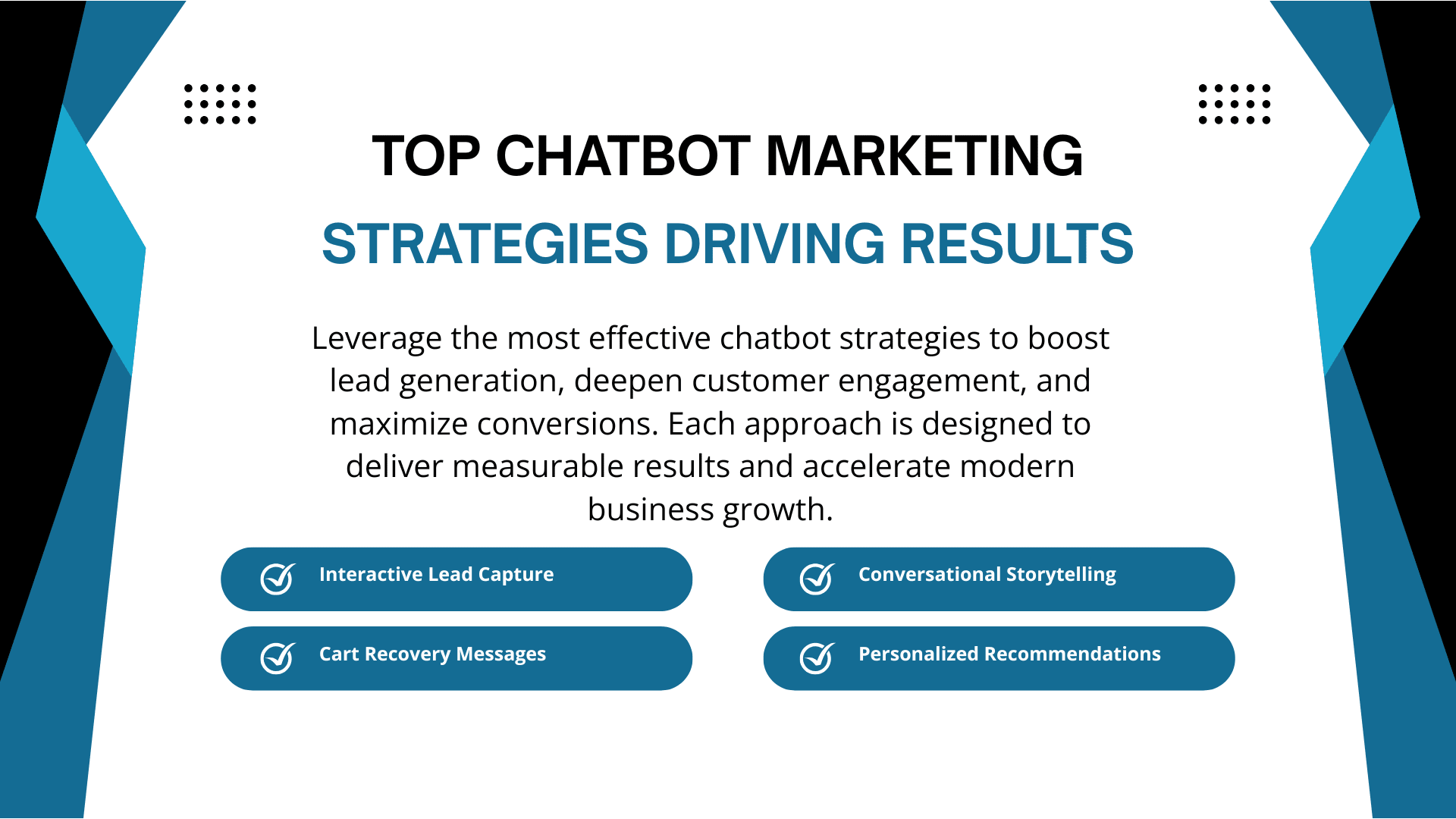
What are the biggest advantages of implementing chatbot marketing strategies?
Businesses implementing chatbot marketing strategies often experience measurable improvements across marketing, sales, and customer service functions.
How do chatbots improve customer experience and satisfaction?
Benefits include:
Faster responses
Consistent communication
Personalized recommendations
Convenient support
Customers appreciate immediate assistance without waiting for human representatives.
Can chatbot marketing reduce operational costs?
Yes. Chatbots automate repetitive tasks such as:
FAQs
Lead qualification
Appointment scheduling
Order tracking
This allows human teams to focus on higher-value activities.
How do chatbots support 24/7 customer engagement?
Unlike human teams, chatbots remain available around the clock.
Benefits include:
Global accessibility
Faster issue resolution
Continuous lead generation
Improved customer satisfaction
Which Chatbot Marketing Strategies Generate the Best Results for Lead Generation, Engagement, and Conversions?
The most successful chatbot marketing strategies focus on personalization, proactive engagement, lead qualification, conversion optimization, and customer retention. Businesses that align chatbot workflows with customer intent often achieve significantly better marketing outcomes.
How do chatbot marketing strategies improve customer engagement?
Effective engagement starts with relevant conversations.
Modern customer engagement chatbots:
Initiate conversations strategically
Provide personalized recommendations
Offer immediate assistance
Guide users toward desired outcomes
What conversational tactics keep users interacting longer?
Successful tactics include:
Personalized greetings
Interactive quizzes
Product recommendation flows
Dynamic questions
Gamification elements
Instant rewards
These techniques create engaging experiences that encourage continued interaction.
How can chatbots personalize customer experiences in real time?
Personalization can be based on:
Browsing behavior
Purchase history
Location
User preferences
Engagement history
AI chatbots continuously adapt conversations based on available customer data.
What chatbot marketing strategies generate the highest-quality leads?
High-performing chatbot lead generation systems focus on qualification rather than simple lead collection.
How do chatbots qualify leads automatically?
Lead qualification often involves collecting:
Company size
Industry
Budget
Timeline
Business challenges
Qualified leads can then be routed directly to sales teams.
Which lead capture questions increase conversion rates?
Effective questions include:
What solution is being researched?
What challenges exist?
What is the preferred timeline?
What is the budget range?
Short, relevant questions typically perform best.
How can chatbots segment prospects based on intent?
Intent segmentation helps identify:
Information seekers
Product evaluators
Purchase-ready buyers
Existing customers
This allows personalized follow-up strategies.
How can chatbot marketing strategies increase website conversions?
Chatbots reduce friction throughout the buyer journey.
Where should chatbots be placed on high-converting landing pages?
High-performing locations include:
Product pages
Pricing pages
Checkout pages
Lead capture pages
Placement should support user intent without becoming intrusive.
How do proactive chatbot messages influence purchasing decisions?
Proactive messages can:
Offer assistance
Address objections
Provide recommendations
Highlight promotions
These interactions often increase conversion rates.
What chatbot CTAs drive more conversions?
Examples include:
Get My Free Demo
Schedule Consultation
Compare Plans
Find My Solution
Speak With an Expert
Clear action-oriented language performs best.
How do chatbot marketing strategies support ecommerce growth?
Ecommerce businesses frequently achieve some of the strongest chatbot ROI.
How can chatbots reduce cart abandonment?
Chatbots help recover carts through:
Reminder messages
Discount offers
Product support
Checkout assistance
What chatbot workflows increase average order value?
Effective workflows include:
Cross-selling
Upselling
Bundling recommendations
Personalized offers
How do product recommendation chatbots improve sales?
Recommendation engines help customers discover relevant products based on preferences and behavior.
This often increases:
Conversion rates
Average order value
Customer satisfaction
How can chatbots improve email marketing performance?
Chatbots and email marketing work exceptionally well together.
How do chatbots grow email subscriber lists?
Methods include:
Content upgrades
Lead magnets
Newsletter signups
Webinar registrations
Can chatbot conversations improve email segmentation?
Yes. Chatbots gather valuable data that helps marketers create highly targeted email campaigns.
How do chatbots support lead nurturing campaigns?
Chatbots nurture leads by:
Sharing educational content
Providing recommendations
Delivering reminders
Encouraging next actions
How do chatbot marketing strategies enhance social media marketing?
Social platforms are increasingly becoming conversational channels.
How do Facebook Messenger and Instagram chatbots increase engagement?
These chatbots:
Respond instantly
Deliver promotions
Answer questions
Capture leads
What automated chatbot campaigns work best on social platforms?
Popular campaigns include:
Product launches
Event registrations
Giveaways
Customer support
How can chatbots convert social media traffic into leads?
Chatbots guide users through structured conversations that collect information and qualify prospects.
How can chatbot marketing strategies improve customer retention?
Retention is often more profitable than acquisition.
How do chatbots support onboarding and customer success?
Onboarding chatbots help customers:
Learn features
Complete setup
Access resources
Resolve issues
What retention-focused chatbot campaigns drive repeat purchases?
Effective campaigns include:
Reorder reminders
Product updates
Personalized offers
Loyalty rewards
How can loyalty programs be integrated into chatbot workflows?
Chatbots can:
Track points
Deliver rewards
Promote incentives
Encourage repeat purchases
What chatbot marketing strategies help businesses collect valuable customer data?
Data-driven marketing depends on accurate customer insights.
How do chatbots gather zero-party and first-party data?
Chatbots collect:
Preferences
Interests
Goals
Purchase intentions
directly from customers.
Which chatbot survey techniques produce higher response rates?
Best practices include:
Short surveys
Conversational questions
Progressive profiling
Incentivized participation
How can customer insights improve future marketing campaigns?
Collected insights support:
Better segmentation
Improved targeting
Personalization
Higher conversion rates
How Can Businesses Create, Optimize, and Scale Chatbot Marketing Strategies That Work?
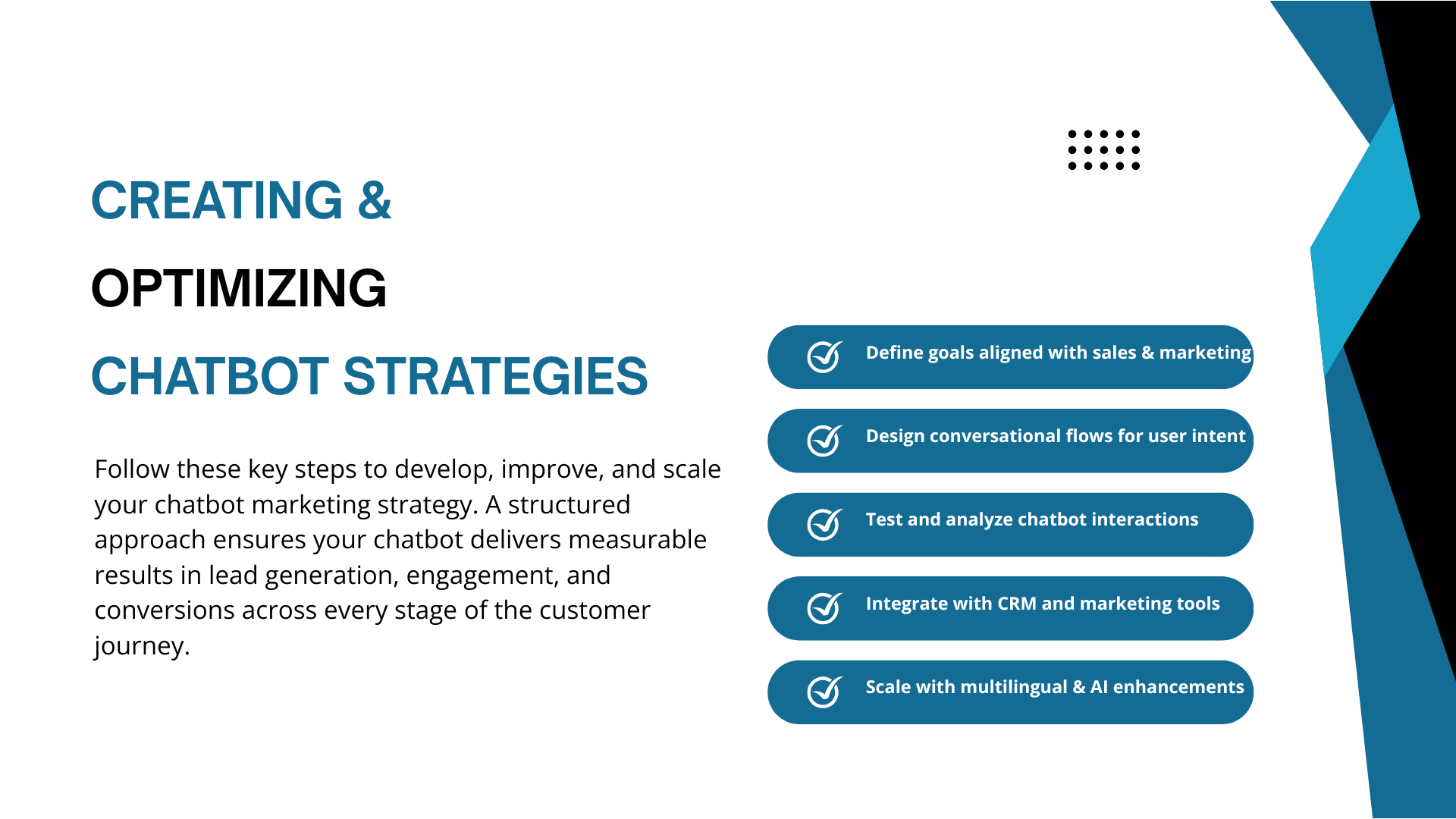
Businesses can create successful chatbot marketing strategies by aligning chatbot functionality with business goals, customer needs, and measurable outcomes. Continuous optimization ensures long-term performance and scalability.
How do you create an effective chatbot marketing strategy from scratch?
A successful chatbot strategy starts with planning.
What business goals should define chatbot implementation?
Common goals include:
Lead generation
Customer support
Conversion optimization
Retention improvement
Revenue growth
How do you identify the right audience for chatbot campaigns?
Audience research should examine:
Customer behavior
Demographics
Pain points
Preferred channels
What customer journey stages should chatbot interactions support?
Chatbots can assist across:
Awareness
Consideration
Decision
Retention
Advocacy
Which chatbot marketing tools and platforms are best for businesses?
The ideal platform depends on business requirements.
Businesses evaluating chatbot solutions should explore platforms such as https://www.yoursitechat.com/ when assessing conversational marketing, lead generation automation, customer engagement workflows, and chatbot marketing automation capabilities.
What features should marketers look for in a chatbot platform?
Key features include:
AI capabilities
CRM integration
Analytics
Automation tools
Omnichannel support
How do AI chatbot platforms compare with traditional chatbot solutions?
AI platforms provide:
Better personalization
Greater scalability
More natural conversations
Improved intent recognition
Which integrations are essential for marketing automation?
Important integrations include:
CRM systems
Email platforms
Analytics tools
Ecommerce platforms
Customer support software
How do you design high-converting chatbot conversations?
Conversation design significantly impacts performance.
What conversational design principles improve user experience?
Principles include:
Clarity
Brevity
Relevance
Personalization
Simplicity
How do businesses create natural chatbot flows?
Natural flows:
Anticipate user intent
Minimize friction
Provide clear options
Support flexible responses
Which chatbot scripts produce better engagement rates?
High-performing scripts:
Focus on customer goals
Use conversational language
Offer immediate value
Include strong CTAs
How can businesses measure chatbot marketing success?
Measurement is essential for optimization.
Which chatbot KPIs matter most?
Important KPIs include:
Lead conversion rate
Engagement rate
Completion rate
Customer satisfaction score
Revenue influenced
How do you track chatbot conversion rates?
Track:
Leads captured
Purchases completed
Appointments booked
Revenue generated
What metrics reveal customer engagement and satisfaction?
Useful metrics include:
Session duration
Repeat interactions
CSAT scores
Retention rates
What are the most common chatbot marketing mistakes to avoid?
Avoiding common mistakes improves performance.
Why do some chatbot campaigns fail to generate results?
Common causes include:
Poor targeting
Weak conversation design
Lack of personalization
Overcomplicated workflows
How can businesses avoid overly complex chatbot workflows?
Best practices:
Keep conversations simple
Focus on user goals
Reduce unnecessary steps
Test continuously
What privacy and compliance considerations should marketers address?
Organizations should prioritize:
Data transparency
Consent management
Security standards
Regulatory compliance
How do chatbot marketing strategies evolve with AI and automation trends?
AI innovation continues to reshape conversational marketing.
How is generative AI transforming chatbot marketing?
Generative AI enables:
Human-like responses
Dynamic content creation
Advanced personalization
Intelligent customer interactions
What emerging chatbot marketing trends should businesses watch?
Emerging trends include:
Voice-enabled chatbots
Predictive engagement
Hyper-personalization
Omnichannel automation
How can companies future-proof their chatbot marketing strategies?
Organizations should:
Invest in AI capabilities
Prioritize data quality
Continuously optimize workflows
Monitor industry developments
What are real-world examples of chatbot marketing strategies that work?
Many successful organizations have demonstrated measurable ROI through chatbot implementation.
Which chatbot campaigns delivered measurable ROI?
Examples include:
Cart recovery campaigns
Automated lead qualification
Personalized product recommendations
Customer onboarding programs
What lessons can businesses learn from successful chatbot implementations?
Key lessons include:
Focus on customer value
Start simple
Measure continuously
Optimize frequently
How can small businesses replicate enterprise chatbot success?
Small businesses can:
Begin with one use case.
Automate lead capture.
Integrate CRM workflows.
Scale gradually.
What is the future of chatbot marketing strategies in customer acquisition and retention?
The future of chatbot marketing strategies centers on AI-driven personalization, predictive engagement, and seamless omnichannel experiences. Businesses that embrace conversational marketing will be better positioned to acquire, convert, and retain customers in increasingly competitive markets.
Will AI chatbots replace traditional marketing channels?
AI chatbots are unlikely to replace traditional channels entirely.
Instead, they will enhance:
Email marketing
Social media marketing
Content marketing
Customer support
How will conversational marketing shape the future customer journey?
Conversational marketing will make customer journeys:
Faster
More personalized
More efficient
More engaging
What should businesses do next to stay competitive with chatbot marketing strategies?
Businesses should:
Audit current customer journeys
Identify automation opportunities
Implement AI-powered marketing tools
Measure performance consistently
Optimize based on customer behavior
Conclusion
Chatbot marketing strategies have evolved from simple customer service tools into powerful growth engines that support lead generation, conversion optimization, customer engagement, and long-term retention. Businesses across ecommerce, B2B, SaaS, healthcare, education, and professional services are increasingly using AI chatbot marketing to create personalized customer experiences while reducing operational costs.
The most effective chatbot marketing strategies combine conversational marketing principles with intelligent automation, real-time personalization, and data-driven decision-making. Organizations that implement customer engagement chatbots strategically often achieve stronger lead quality, higher conversion rates, improved customer satisfaction, and increased revenue.
As generative AI, automation, and conversational technologies continue to advance, chatbot marketing automation will become an even more important component of digital marketing success. Businesses that invest today in scalable chatbot solutions, continuous optimization, and customer-centric conversational experiences will be better positioned to compete and grow in the future.
Frequently Asked Questions
1. What are chatbot marketing strategies?
Chatbot marketing strategies are structured methods of using chatbots to attract prospects, engage customers, generate leads, improve conversions, and support customer retention through automated conversations.
2. How effective is chatbot lead generation?
Chatbot lead generation can significantly improve lead quality by qualifying prospects in real time, collecting relevant information, and routing high-intent leads directly to sales teams.
3. Can chatbot marketing increase website conversions?
Yes. Chatbots reduce friction, answer objections, provide recommendations, and guide visitors toward desired actions, often improving conversion rates.
4. What industries benefit most from chatbot marketing?
Ecommerce, SaaS, B2B services, healthcare, education, finance, real estate, and professional services frequently achieve strong results from chatbot implementation.
5. How do AI-powered chatbots differ from traditional chatbots?
AI-powered chatbots understand intent, learn from interactions, and generate dynamic responses, while traditional chatbots rely on predefined rules and scripted workflows.
6. How do chatbots improve customer engagement?
Chatbots provide instant responses, personalized recommendations, proactive assistance, and continuous support, helping customers stay engaged throughout their journey.
7. What KPIs should businesses track for chatbot marketing?
Important metrics include lead conversion rate, engagement rate, completion rate, customer satisfaction score, revenue attribution, and retention rate.
8. What is the future of chatbot marketing?
The future of chatbot marketing involves generative AI, predictive personalization, omnichannel experiences, conversational commerce, and deeper integration with marketing automation platforms.