
Can AI Replace Your Sales Team?
For many business owners, the question is no longer whether artificial intelligence belongs in sales. The real question is whether AI has become capable enough to replace an entire sales team. With AI sales assistants answering questions instantly, qualifying leads around the clock, and booking meetings without human involvement, the possibility seems more realistic than ever.
Still, replacing a sales team is very different from improving one.
Modern AI excels at repetitive, data-driven work. It can respond to thousands of website visitors simultaneously, identify promising prospects, and automate routine conversations. Yet many buying decisions—especially those involving large budgets, multiple stakeholders, or long-term partnerships—still depend on trust, negotiation, and human judgment.
Understanding where AI creates value and where people remain indispensable is the key to making better business decisions.
Can AI Replace Your Sales Team Completely?
The short answer is no. While AI can automate many sales activities, it cannot fully replace experienced sales professionals in every situation. Businesses achieve the best results when AI handles repetitive processes and human representatives focus on relationship building, strategic discussions, and closing complex deals.
The rapid growth of AI sales automation has transformed the way organizations attract, engage, and convert customers. Tasks that once required hours of manual effort can now happen in seconds.
For example, a visitor lands on a company's website at midnight looking for pricing information. Instead of waiting until the next morning, an AI sales chatbot immediately answers common questions, recommends relevant products, captures contact details, and schedules a product demonstration if the visitor is interested.
From the customer's perspective, the experience feels fast and convenient.
From the business perspective, valuable opportunities are captured instead of being lost.
This is why organizations across industries are investing heavily in AI-powered sales solutions.

Why are businesses adopting AI faster than ever?
Several trends have accelerated AI adoption in sales.
Customers expect immediate answers.
Businesses operate across multiple time zones.
Competition has increased in nearly every industry.
Hiring and training large sales teams has become expensive.
AI addresses many of these challenges by automating repetitive communication while maintaining consistent availability.
Instead of replacing every salesperson, companies often reduce administrative work so sales professionals spend more time speaking with qualified prospects.
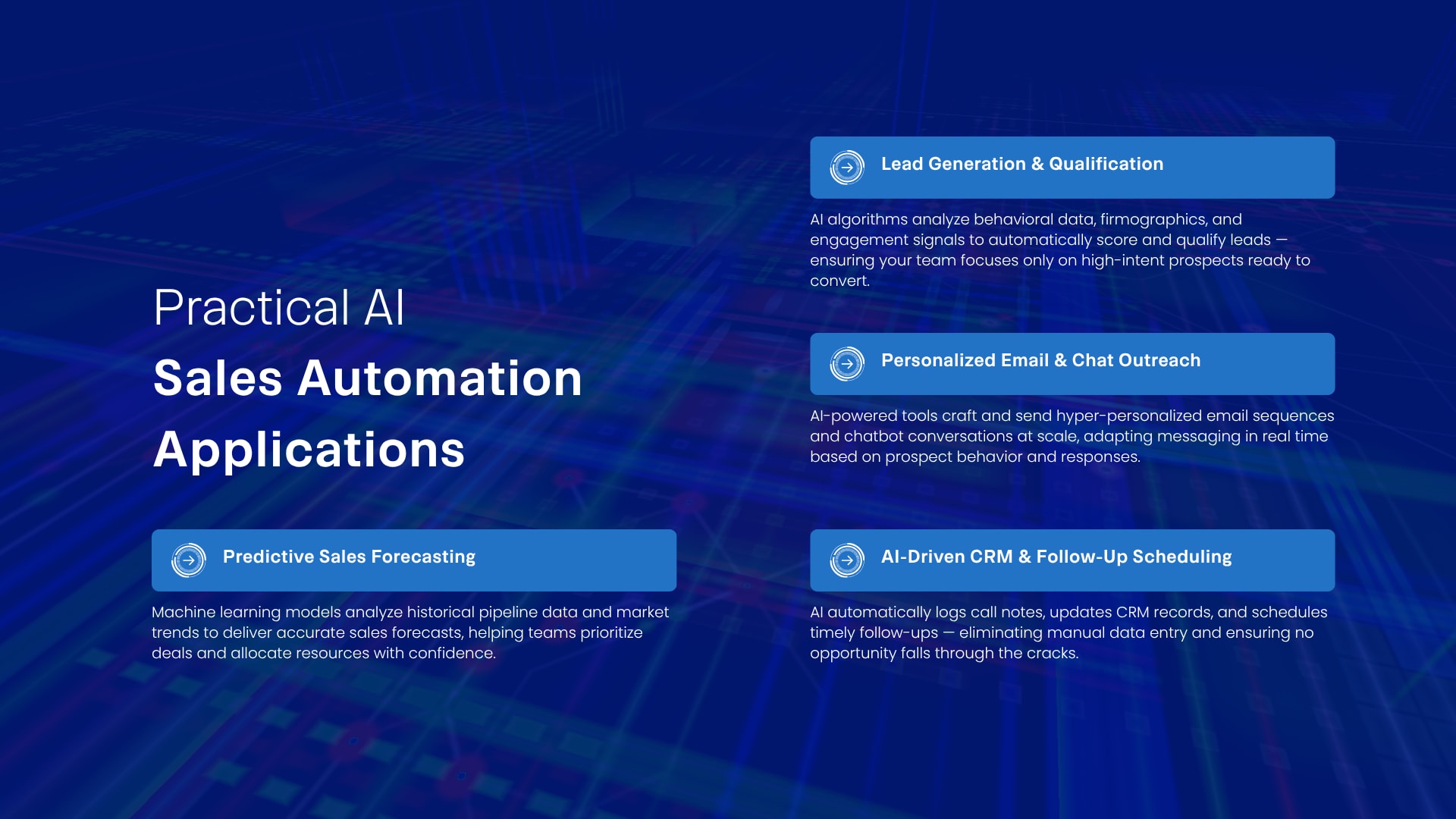
Which sales activities can AI automate today?
Modern AI sales tools are surprisingly capable.
They can:
Answer frequently asked questions
Qualify incoming leads
Recommend products
Schedule appointments
Send follow-up messages
Route inquiries to the appropriate department
Summarize conversations
Update CRM records
Analyze customer intent
Support multilingual conversations
Each of these activities saves valuable time for human teams.
What Makes AI Sales Automation So Effective?
AI is not faster simply because computers process information quickly. Its real advantage comes from consistency.
Unlike people, AI never becomes tired during long conversations, forgets to follow up with a prospect, or misses a website inquiry because the office is closed.
Imagine a software company receiving hundreds of inquiries every day.
Without automation:
Many visitors leave before receiving answers.
Sales representatives spend hours responding to repetitive questions.
High-quality leads wait alongside casual browsers.
Response times vary depending on staff availability.
With AI sales automation:
Every visitor receives an immediate response.
Prospects are categorized based on buying intent.
Meetings are booked automatically.
Human representatives receive only qualified opportunities.
This workflow dramatically improves productivity without sacrificing customer experience.
AI never sleeps
One of AI's greatest strengths is continuous availability.
Potential customers rarely shop according to business hours. Someone researching software in another country may visit a website while the sales office is closed.
Instead of losing that opportunity, conversational AI continues the conversation, answers questions, collects contact information, and prepares everything for the sales team to review later.
For global businesses, this alone can significantly increase lead generation.
AI processes data at scale
Sales professionals often rely on experience and intuition.
AI complements that experience by analyzing far more information than a person could reasonably process.
It can evaluate customer behavior, identify buying patterns, recognize frequently asked questions, and recommend the next best action based on historical data.
The result is a more informed sales process.
Rather than replacing human judgment, AI enhances it.
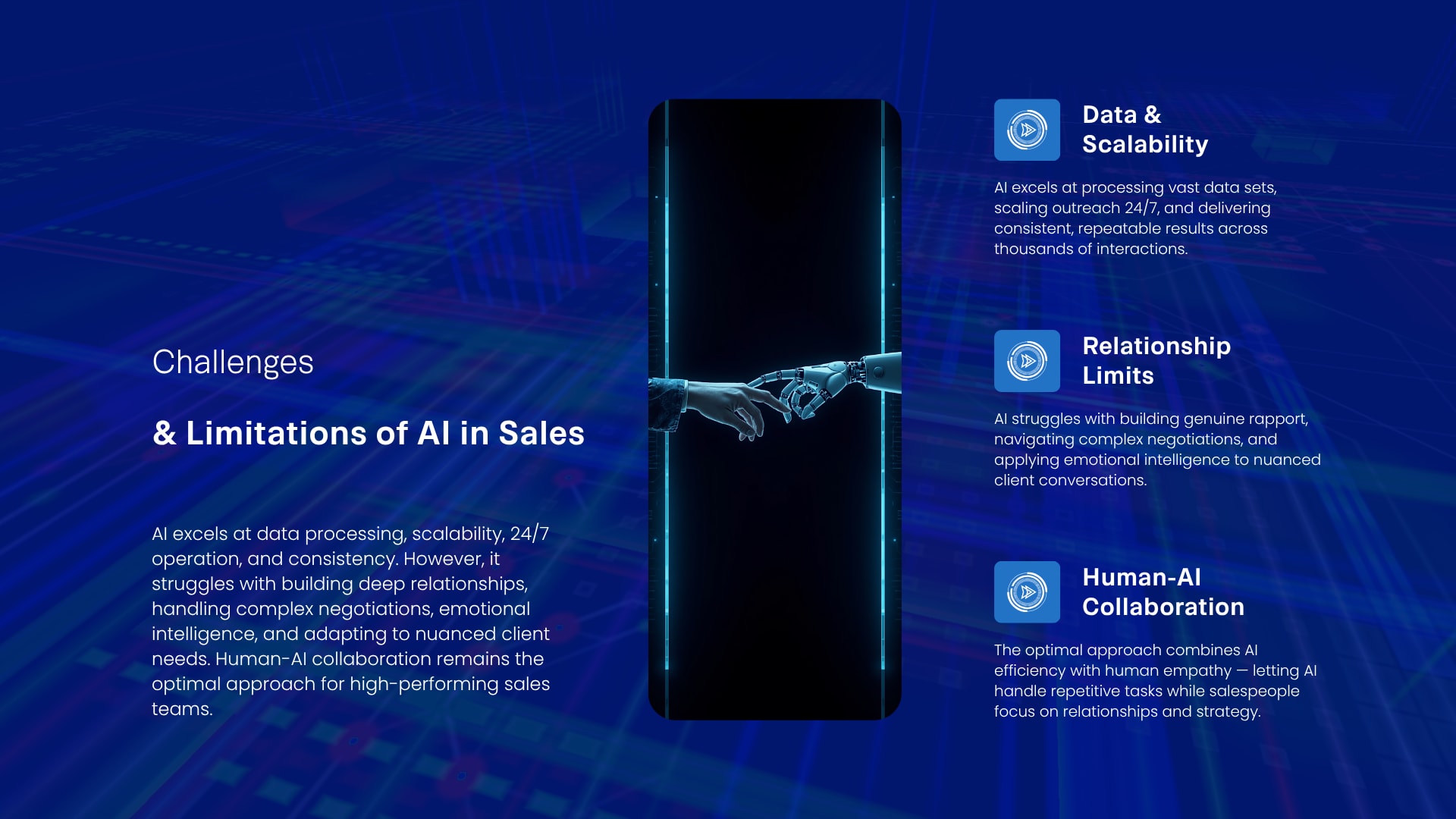
Where Human Sales Representatives Continue to Outperform AI
Despite rapid improvements, AI still has important limitations.
Sales is ultimately about people.
When customers make significant investments, they rarely base decisions on information alone. They also evaluate credibility, confidence, industry expertise, and trust.
These qualities remain difficult for AI to replicate.
Building genuine relationships
Enterprise software purchases often involve months of conversations.
Decision-makers expect personalized advice, strategic recommendations, and confidence that their chosen partner understands their business challenges.
While AI can answer technical questions, experienced sales professionals adapt conversations based on subtle cues, changing priorities, and emotional context.
Relationship-driven selling remains one of humanity's strongest advantages.
Managing complex negotiations
Negotiations are rarely predictable.
Pricing changes.
Requirements evolve.
Unexpected objections appear.
Several stakeholders may disagree with one another.
An experienced salesperson recognizes these dynamics and adjusts communication accordingly.
AI can provide recommendations, but it cannot fully replace the strategic thinking required during complex negotiations.
Handling unique situations
Customers sometimes present unusual requests that fall outside predefined workflows.
Perhaps they require a custom implementation, have regulatory concerns, or need exceptions to standard pricing.
These situations often require creativity, collaboration across departments, and business judgment.
Human representatives remain essential in these scenarios because they understand context beyond the available data.
Why the Future of Sales Is Collaboration, Not Replacement
Businesses asking, "Can AI Replace Your Sales Team?" are often asking the wrong question.
A better question is:
How can AI make every salesperson more productive?
Organizations achieving the strongest results rarely eliminate their sales teams.
Instead, they redesign workflows.
AI handles repetitive, time-consuming tasks while sales professionals concentrate on activities that directly influence revenue.
This collaborative model creates benefits for everyone involved.
Customers receive faster responses.
Sales representatives spend more time selling.
Managers gain better visibility into pipeline performance.
Businesses reduce operational costs while improving customer satisfaction.
The goal is not replacing people.
The goal is enabling people to perform at a much higher level.
What Can AI Do Better Than Human Sales Representatives?
Can AI Replace Your Sales Team? Not entirely, but AI clearly outperforms humans in several repetitive and data-driven sales tasks. AI sales automation delivers instant responses, works 24/7, analyzes customer behavior at scale, and automates routine workflows, allowing sales professionals to focus on relationship building and closing high-value deals.
Businesses no longer expect AI to outperform people in every area. Instead, they use AI to eliminate time-consuming work that slows down the sales process. When repetitive activities are automated, sales teams become more productive without sacrificing the human element customers value.
How does AI sales automation improve response time?
One of AI's biggest advantages is speed. Modern customers expect immediate answers, whether they visit a website during office hours or late at night. Waiting several hours for a reply often results in lost opportunities.
An AI sales assistant can engage website visitors within seconds, ensuring no inquiry goes unanswered.
Instant customer replies
Instead of making customers wait for an email or callback, AI can instantly answer common questions such as:
Product features
Pricing information
Business hours
Service availability
Delivery timelines
Demo requests
Quick responses improve customer satisfaction while increasing the likelihood of converting visitors into qualified leads.
24/7 availability
Unlike human sales representatives, AI never takes breaks or ends its workday.
This continuous availability benefits businesses that:
Serve international markets
Receive after-hours inquiries
Operate eCommerce stores
Generate leads through websites around the clock
Potential customers receive assistance whenever they need it, regardless of time zone.
How does AI lead qualification improve sales efficiency?
Not every website visitor is ready to buy. Some are simply researching, while others may already be comparing vendors or requesting demonstrations.
AI lead qualification helps businesses identify which prospects deserve immediate attention.
Instead of requiring sales representatives to manually evaluate every inquiry, AI analyzes customer responses and behavior before assigning priority.
Scoring leads automatically
AI evaluates multiple signals, including:
Pages visited
Time spent on the website
Products viewed
Budget information
Company size
Industry
Purchase intent
These insights allow businesses to prioritize prospects with the highest conversion potential.
Identifying buying intent
Conversational AI recognizes language that indicates purchase readiness.
For example, questions like:
"Can I schedule a demo?"
"Do you integrate with Salesforce?"
"What's your enterprise pricing?"
"How quickly can we get started?"
usually indicate stronger buying intent than general informational questions.
AI flags these prospects for faster follow-up by the sales team.
Routing leads to the right representative
Large organizations often divide sales responsibilities by:
Industry
Geography
Product category
Company size
Revenue
Instead of relying on manual assignment, AI automatically directs qualified leads to the appropriate representative, reducing delays and improving customer experience.
Can an AI sales assistant handle repetitive sales tasks?
Yes. Many daily sales activities follow predictable workflows that AI can automate with remarkable accuracy.
These repetitive tasks consume valuable time but rarely require strategic thinking.
Examples include:
Sending follow-up emails
Scheduling meetings
Answering FAQs
Updating CRM records
Sharing product brochures
Collecting customer information
By handling these routine activities, AI allows sales professionals to spend more time building relationships and closing deals.
How does conversational AI improve customer engagement?
Customer engagement is about maintaining meaningful interactions throughout the buying journey.
Conversational AI enables businesses to communicate naturally across multiple channels while delivering consistent experiences.
Personalized conversations
Modern AI can personalize conversations using information such as:
Previous interactions
Products viewed
Industry
Customer preferences
Purchase history
Personalized communication helps customers feel understood without requiring manual effort from sales representatives.
Multilingual communication
Businesses serving international audiences often struggle to provide multilingual support.
AI bridges this gap by communicating in multiple languages, enabling organizations to engage customers from different regions without expanding their support teams.
Context-aware responses
Rather than providing generic replies, advanced AI understands conversation history and responds accordingly.
This creates smoother customer interactions and reduces frustration caused by repetitive questions.
Can AI chatbots increase website conversions?
A well-designed AI chatbot for websites does much more than answer questions.
It guides visitors toward meaningful actions that contribute to business growth.
These actions may include:
Requesting a quote
Booking a consultation
Scheduling a product demonstration
Downloading resources
Contacting sales
Instead of acting as a simple support tool, an AI chatbot becomes an active part of the sales funnel.
For example, solutions like YourSiteChat can engage visitors immediately, qualify potential customers, answer frequently asked questions, schedule meetings, and route high-intent leads to the appropriate sales representative. This reduces response times while ensuring human sales professionals focus on conversations most likely to generate revenue.
Capturing leads instantly
Every unanswered inquiry represents a potential lost sale.
AI chatbots collect essential information, including:
Name
Email address
Company
Business requirements
Preferred contact time
This ensures opportunities are captured before visitors leave the website.
Reducing bounce rates
Interactive conversations encourage visitors to remain on a website longer.
Instead of searching through multiple pages, customers receive immediate guidance that helps them find relevant products or services more quickly.
Booking demos automatically
Scheduling often delays the sales process.
AI simplifies this by allowing visitors to choose available meeting times directly within the conversation, reducing administrative work for sales representatives.
How does AI customer support contribute to higher sales?
Although customer support and sales are different functions, they significantly influence one another.
Fast, accurate support creates positive experiences that encourage repeat business and referrals.
AI customer support improves sales by:
Resolving common issues quickly
Providing consistent information
Reducing wait times
Escalating complex cases to human agents
Maintaining customer satisfaction
Satisfied customers are more likely to purchase additional products and recommend the business to others.
What are the biggest benefits of AI business automation?
Businesses implementing AI-powered sales solutions often experience measurable improvements across several areas.
Key benefits include:
Faster response times
Higher lead conversion rates
Improved customer engagement
Better sales productivity
Reduced operational costs
Consistent customer communication
More accurate sales forecasting
Increased scalability without proportional hiring
These advantages explain why organizations of all sizes are investing in AI sales automation. However, AI delivers the greatest value when it works alongside experienced sales professionals rather than attempting to replace them entirely.
The next stage of the discussion explores where human sales representatives continue to outperform AI, why emotional intelligence remains critical in complex sales, and how businesses can build the ideal collaboration between artificial intelligence and human expertise.