Boost eCommerce Sales With AI-Powered Customer Support
Online shoppers expect quick answers. When they have a question about a product, delivery time, payment option, return policy, or order status, waiting several hours for a response can be enough to make them leave a website.
This is where AI-powered customer support can make a meaningful difference for eCommerce businesses. Instead of relying entirely on human agents to answer every customer question, businesses can use AI customer support to provide instant assistance, guide shoppers through product decisions, reduce common purchase friction, and connect customers with human agents when a conversation requires personal attention.
The goal is not simply to automate customer service. The bigger opportunity is to make support part of the shopping experience.
A well-designed AI chatbot for eCommerce can answer frequently asked questions, help customers discover products, explain policies, capture leads, provide order information, and remain available outside normal business hours. When these capabilities are connected to the customer journey, support can become an important part of sales enablement rather than an activity that happens only after someone has a problem.

How can AI-powered customer support increase eCommerce sales?
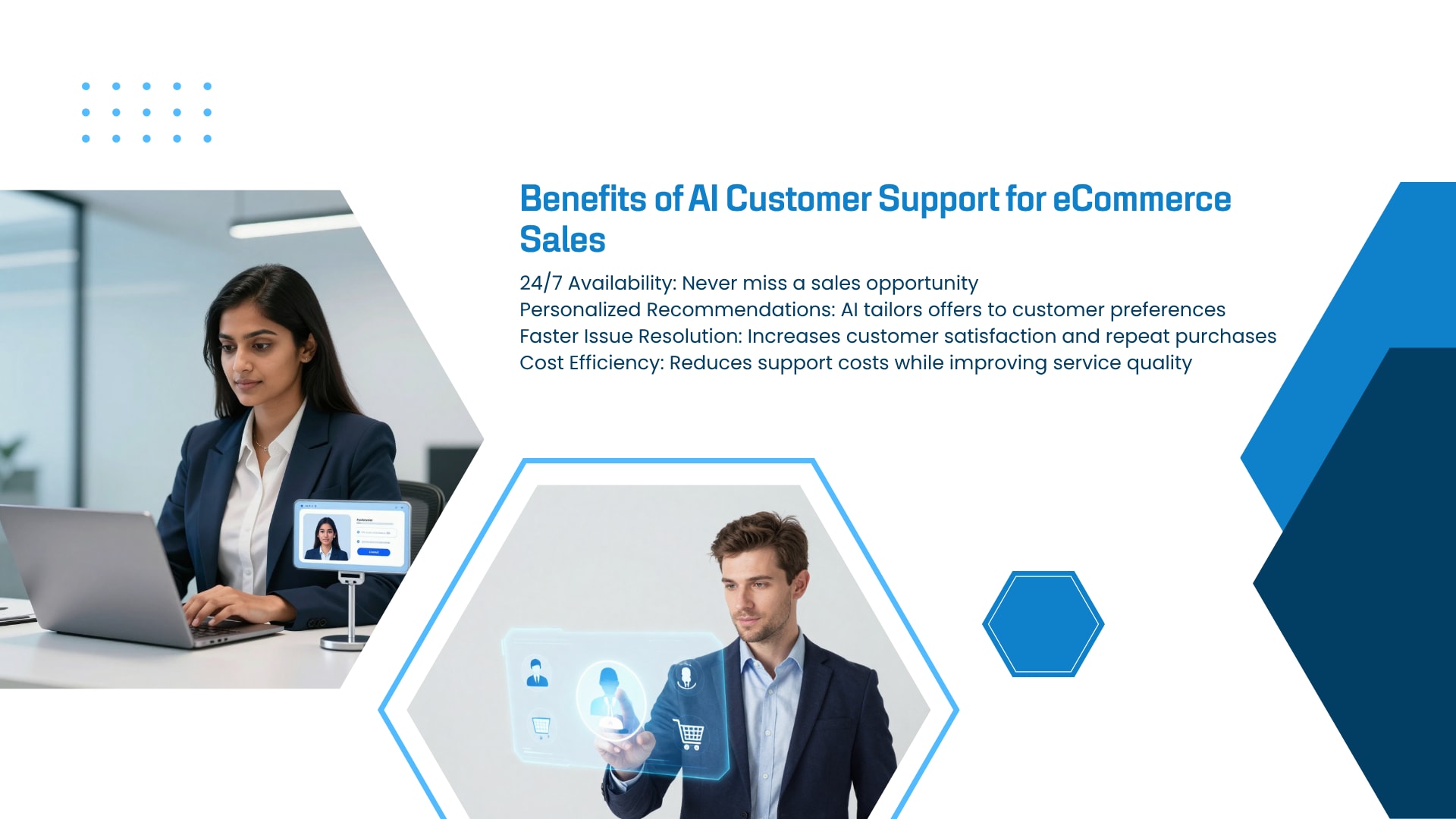
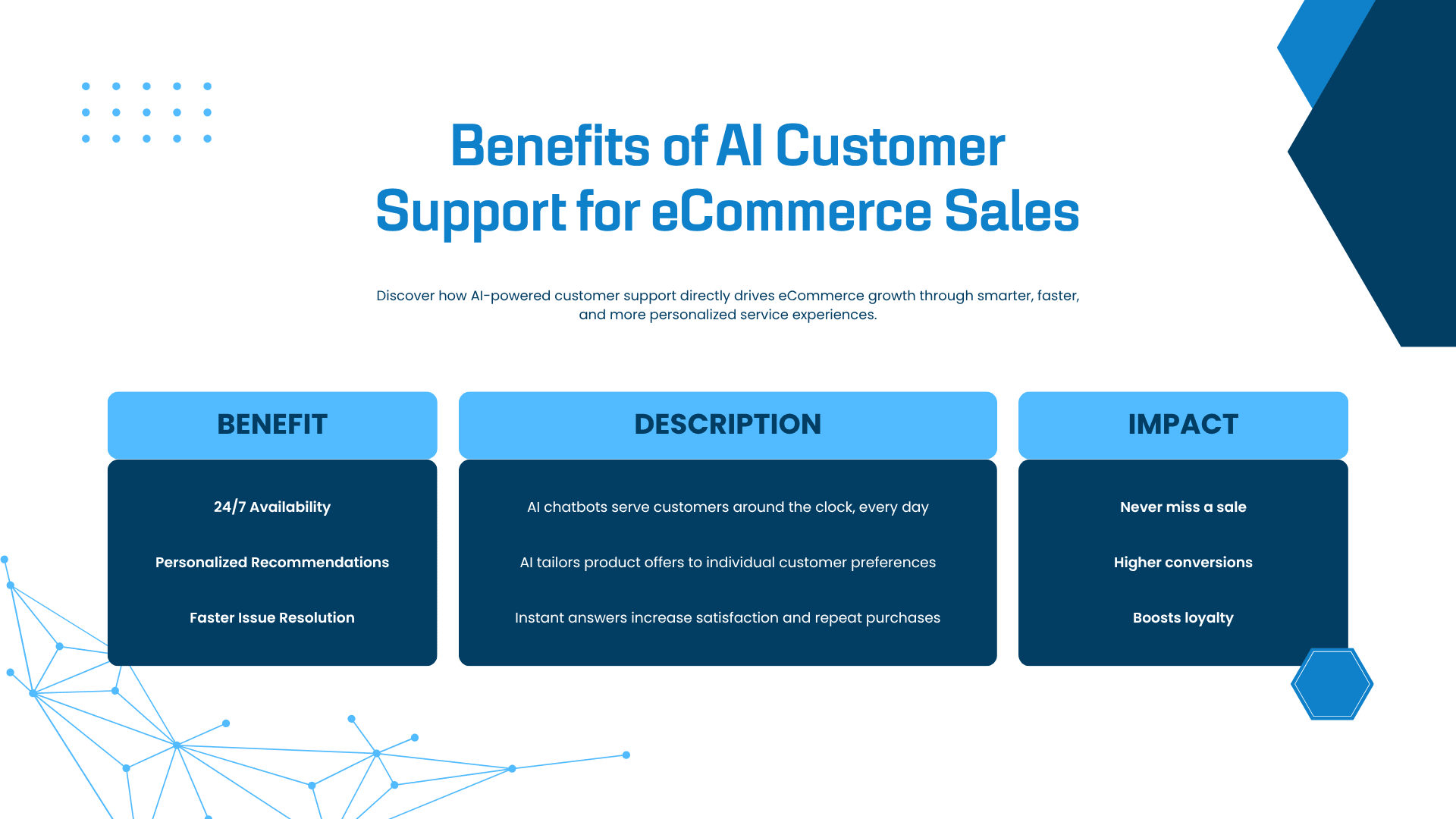
AI-powered customer support can help eCommerce businesses increase sales by answering questions quickly, reducing purchase friction, assisting shoppers with product decisions, supporting customers throughout the buying journey, and keeping help available 24/7. It does not guarantee higher revenue, but faster and more relevant assistance can create better conditions for conversions and customer retention.
A customer visiting an online store can have many reasons for hesitating before purchasing.
They may wonder:
Is this product available in my size?
How long will delivery take?
Can I return it?
Is this compatible with another product?
What is the difference between these two options?
Do you offer cash on delivery?
What happens if the product arrives damaged?
Can I change my delivery address?
Is there a discount available?
Which product would be better for my needs?
Traditional customer support can answer these questions, but the timing matters.
Imagine a shopper is ready to purchase at 11:30 p.m. They open the chat box and ask about the return policy. If no one is available until the next morning, the shopper may close the website. They may also search for another seller that provides an immediate answer.
AI customer support gives businesses another option.
An AI assistant can respond immediately to common questions and guide the customer toward the information they need. If the question becomes complicated, the conversation can be transferred to a human agent.
This creates a simple relationship:
Faster answers → less uncertainty → less purchase friction → better opportunity for conversion.
However, businesses should avoid treating AI as a magic sales machine. AI works best when it is connected to accurate business information, designed around real customer questions, and supported by clear human escalation.
What is AI-powered customer support?
AI-powered customer support uses artificial intelligence to understand customer questions and provide automated responses through channels such as websites, messaging platforms, or chat applications. Depending on the system, it can answer FAQs, recommend information, guide shoppers, capture leads, support order-related questions, and transfer complex conversations to human agents.
Unlike a basic rule-based chatbot that only recognizes a limited number of predefined commands, modern conversational AI can interpret natural language and respond according to the information it has been trained or connected to.
For an eCommerce company, that information may include:
Product descriptions
Product specifications
FAQs
Shipping policies
Return policies
Payment information
Warranty details
Size guides
Business information
Customer support documentation
The more accurate and well-organized the underlying information is, the more useful the AI assistant can become.
Why does customer support matter during the buying journey?
Customer support is often treated as a post-purchase function.
But customers need information before, during, and after purchasing.
A typical eCommerce journey can look like this:
Discover → Explore → Compare → Ask → Decide → Purchase → Track → Receive → Return or Repurchase
Questions can appear at every stage.
A customer may ask for recommendations during exploration, product comparisons during consideration, payment questions during checkout, and delivery information after purchasing.
This means customer support can influence the entire customer journey.
When support is available at the right moment, customers do not necessarily need to leave the website to find answers somewhere else.
How does faster support reduce purchase friction?
Purchase friction refers to anything that makes it harder for a customer to complete a purchase.
Common examples include:
Unclear product information
Complicated returns
Unanswered questions
Confusing checkout processes
Delivery uncertainty
Lack of payment information
Difficulty comparing products
Slow customer service
Concerns about product suitability
AI-powered customer support cannot fix every problem, but it can address many information-related obstacles quickly.
For example, if a customer asks, “Does this laptop support two external monitors?” an AI assistant can provide the relevant information if that specification exists in the business knowledge base.
The customer gets an answer without searching through multiple pages.
That small interaction can remove one reason to delay the purchase.
How does AI customer support improve the online shopping experience?
AI customer support improves the online shopping experience by making assistance faster, easier to access, and available throughout the customer journey. Instead of forcing shoppers to search through long FAQ pages or wait for an agent, an AI assistant can provide conversational guidance and direct customers toward relevant products, policies, and next steps.
A good shopping experience is not only about attractive website design.
It is also about how easily customers can find answers.
Consider two online stores selling similar products.
Store A has detailed information, but customers must search through multiple pages to find answers.
Store B allows customers to ask questions directly through a conversational interface.
The products may be similar, but the second experience can feel easier and more responsive.
This is one reason conversational AI has become increasingly relevant to eCommerce.
Can AI help customers find products?
Yes. AI can help customers discover products when it has access to reliable product information and clear instructions about how the business wants recommendations handled.
Instead of browsing dozens of products, a customer can describe what they need.
For example:
“I need a lightweight backpack for a two-day trip with a laptop compartment.”
An AI assistant could ask follow-up questions about laptop size, budget, preferred capacity, or features and then direct the shopper toward suitable products.
This is different from simply showing a search bar.
The conversation can help customers express their needs naturally.
How can AI-powered product recommendations support conversions?
Product recommendations can reduce the amount of effort customers need to spend evaluating options.
For example, an online skincare store may have dozens of products.
A shopper might say:
“I have dry skin and want a simple nighttime routine.”
An AI assistant could explain which categories may be relevant and direct the shopper to appropriate products based on the store's available information.
The recommendation should not invent product benefits or make unsupported claims.
It should rely on verified information from the business.
The objective is to make product discovery easier, not to pressure customers into purchasing something unsuitable.
Can AI answer product questions before checkout?
This is one of the most practical applications of AI customer support.
Customers often hesitate because they cannot find a specific piece of information.
Questions may involve:
Material
Dimensions
Compatibility
Availability
Delivery
Warranty
Returns
Payment
Product variations
Usage instructions
An AI assistant can address these questions while the customer is still on the product page.
That timing matters because the customer is already considering the purchase.
Can AI customer support reduce cart abandonment?
AI customer support can potentially reduce cart abandonment by identifying and resolving common questions that prevent shoppers from completing purchases. By helping with product details, shipping, returns, payment questions, and other concerns during the buying process, AI can remove some sources of hesitation, although it cannot eliminate every cause of abandoned carts.
Cart abandonment happens for many reasons.
Customers may abandon a purchase because of unexpected costs, complicated checkout, lack of preferred payment methods, slow delivery, comparison shopping, or simply because they are not ready to buy.
Not every abandoned cart can or should be recovered.
However, some abandoned carts are connected to unanswered questions.
What questions commonly stop customers from purchasing?
Consider a customer who adds a product to the cart but is unsure about delivery.
They ask:
“Will this arrive before Friday?”
If the website provides no clear information, the customer may leave.
Another customer may ask:
“Can I return this if the size is wrong?”
If they cannot quickly find the answer, they may hesitate.
A third customer may ask:
“Is this compatible with my existing device?”
Again, uncertainty can delay the purchase.
AI support can help answer these questions when the necessary information is available.
How can AI support customers during checkout?
AI can provide assistance without forcing shoppers to leave the checkout process.
Depending on the eCommerce setup, an AI assistant might help explain:
Shipping options
Delivery timelines
Payment methods
Return policies
Coupon requirements
Order information
Product compatibility
General checkout questions
The purpose is to remove confusion rather than interrupt the shopper.
A chatbot that constantly opens promotional messages or pushes irrelevant offers may create more friction instead of less.
The best approach is contextual assistance.
Can AI identify when a human agent is needed?
Yes. Human-agent support remains important for situations involving exceptions, complaints, sensitive account issues, complicated orders, or conversations requiring judgment.
A strong AI customer support system should have an escalation path.
For example:
Simple question → AI answer
Product guidance → AI assistance
Order information → Automated support
Complex complaint → Human agent
Sensitive issue → Human agent
This creates a hybrid customer service model rather than an “AI versus humans” model.
How can AI customer support work alongside human agents?
AI customer support works alongside human agents by handling repetitive, high-volume questions while routing complex or sensitive conversations to people. This allows human teams to spend more time on cases requiring judgment, empathy, negotiation, or deeper problem-solving while AI handles routine assistance.
The strongest eCommerce support strategy is rarely about removing humans completely.
Human agents remain valuable because some customers want to speak with a person, especially when something has gone wrong.
AI can instead become the first layer of assistance.
For example:
Customer opens the website.
AI asks how it can help.
Customer asks a common product question.
AI provides the answer.
Customer asks about a complicated order problem.
AI identifies that the issue requires human support.
The conversation is transferred to an agent.
This can create a smoother support workflow.
Why is human handoff important?
AI systems have limitations.
There are situations where a confident but incorrect answer can damage customer trust.
Human handoff provides a safety layer for situations where the AI should not make the final decision.
YourSiteChat, for example, positions human handoff as part of its AI customer support approach, allowing complex questions to be routed to live agents. (yoursitechat.com)
The goal should be simple:
Automate what can be automated. Escalate what should remain human.
Which customer conversations should go to humans?
Human escalation can be appropriate for:
Serious complaints
Refund disputes
Sensitive account issues
Complex order problems
Legal or regulatory questions
High-value customers requiring personal attention
Situations where the AI does not have enough information
Customers who explicitly request a human agent
Businesses should define these boundaries before deploying AI.
How can eCommerce businesses use AI to answer customer questions faster?
eCommerce businesses can use AI to answer customer questions faster by training an AI assistant with accurate product, policy, and support information and placing it where customers need help. The system can handle repetitive questions automatically, provide answers at any hour, and escalate conversations that require human expertise.
Implementation should start with customer questions rather than technology.
Look at your support inbox, chat history, emails, social media messages, and sales conversations.
Find the questions customers ask repeatedly.
These questions can become the foundation of an AI support system.
Which customer questions should be automated first?
Start with questions that are:
Frequent
Simple
Well documented
Low risk
Repetitive
Easy to verify
Examples include:
What are your delivery times?
Do you offer returns?
How can I track my order?
What payment methods do you accept?
Where are you located?
What are your business hours?
Do you ship internationally?
What is your return window?
These questions often consume support team time even though they do not necessarily require complex reasoning.
How should an eCommerce knowledge base be prepared?
Before launching an AI chatbot, businesses should organize their information.
Create clear documentation for:
Products: names, features, specifications, variations, availability rules.
Shipping: locations, delivery estimates, charges, restrictions.
Returns: eligibility, process, time limits, exclusions.
Payments: accepted methods, installment information, payment issues.
Support: escalation rules, contact methods, working hours.
Orders: tracking process, cancellation rules, modification policies.
A well-structured knowledge base helps reduce ambiguity.
Why is accurate information more important than clever AI?
A sophisticated AI system cannot compensate for incorrect business information.
If the return policy says one thing and the chatbot says another, customers lose trust.
Therefore, businesses should regularly review their AI knowledge sources.
Whenever a policy changes, product is discontinued, or shipping rules are updated, the relevant information should also be updated.
How can AI-powered customer support improve customer engagement?
AI support can make engagement more conversational.
Instead of asking customers to navigate a large FAQ section, businesses can allow them to ask questions naturally.
For example:
“Which phone case should I buy for outdoor use?”
This is more conversational than:
“Click Accessories → Phone Cases → Filter → Material → Outdoor.”
AI can act as a navigation layer between the customer and the information on the website.
Can AI provide 24/7 customer support?
Yes, AI systems can remain available outside normal business hours.
This is particularly useful for eCommerce stores serving customers across multiple time zones.
A customer may visit a website late at night, during a weekend, or on a public holiday.
Human teams may not always be available.
An AI assistant can still answer supported questions.
YourSiteChat describes its platform as providing 24/7 AI-powered website support, including instant replies and human-agent handoff. (yoursitechat.com)
However, “24/7 support” should not be interpreted as meaning every problem can be solved automatically.
It means the customer has an always-available first point of assistance.
How does multilingual AI support help global eCommerce stores?
Customers may prefer to communicate in different languages.
Multilingual conversational AI can make support more accessible to international audiences.
YourSiteChat currently describes multilingual capabilities covering more than 50 languages. (yoursitechat.com)
For global eCommerce businesses, language support can reduce communication barriers.
However, businesses should still review important translations, particularly for legal policies, product specifications, warranties, and other information where wording needs to be precise.
What is the difference between AI customer support and traditional customer service?
AI customer support and traditional customer service serve the same broader goal—helping customers—but they approach the work differently.
AreaTraditional SupportAI-Powered SupportAvailabilityUsually limited by staff hoursCan operate 24/7Repetitive questionsHandled manuallyCan be automatedResponse speedDepends on queueOften near-instantComplex issuesStrongShould usually involve humansProduct guidanceDepends on agent knowledgeBased on connected business dataScalabilityRequires more staff as volume growsCan handle many routine conversationsHuman empathyStrongLimited compared with peopleEscalationAgent-basedAI-to-human handoff
This comparison shows why hybrid support is often practical.
AI is particularly useful for scale and speed.
Humans remain essential for empathy, judgment, exceptions, and complex customer relationships.
How can AI support improve customer retention?
AI customer support can support retention by making help easier to access after purchase, answering common questions quickly, assisting with order-related issues, and maintaining a consistent support experience. Better support does not automatically create loyalty, but reducing unnecessary frustration can contribute to a stronger overall customer experience.
Customer retention is not created by a chatbot alone.
Customers return when a business consistently delivers value, quality, reliability, and a positive experience.
Support is one part of that experience.
Imagine a customer has an issue with an order.
If they can immediately find out what is happening, understand the next step, and reach a human when necessary, the experience may feel less frustrating.
If they must send several emails and wait days for a response, frustration can grow.
Can AI help after the purchase?
Absolutely.
Post-purchase support is one of the most practical uses of automation.
AI can help customers with:
Order tracking
Delivery questions
Return instructions
Product usage
Warranty information
Exchange policies
Frequently asked post-purchase questions
This makes AI customer support useful beyond the sales funnel.
How can post-purchase support create future sales opportunities?
A satisfied customer may return later.
AI can support that relationship by helping customers understand products and services without making every interaction feel like a sales pitch.
For example, after a customer purchases a camera, they might later ask about compatible accessories.
If the AI can answer accurately, the conversation can naturally lead to relevant product discovery.
The important word is relevant.
Recommendation systems should help customers rather than overwhelm them with promotions.
What are the limitations of AI customer support?
AI customer support can struggle with ambiguous questions, incomplete information, unusual situations, sensitive conversations, and requests that require human judgment. Businesses should not assume AI can solve every support problem. Clear knowledge sources, testing, monitoring, and human escalation are essential for maintaining accuracy and customer trust.
AI can be powerful, but it is not perfect.
One of the biggest mistakes an eCommerce company can make is deploying a chatbot and assuming the work is finished.
It is only the beginning.
What happens when AI does not know the answer?
The system should have a defined response for uncertainty.
Instead of inventing an answer, it should communicate that it does not have enough information and provide an appropriate next step.
For example:
“I don't have enough information to confirm that. Let me connect you with our support team.”
This is better than confidently providing incorrect information.
Why can incorrect AI answers hurt an eCommerce business?
Customer support directly affects trust.
If an AI assistant gives incorrect information about a return policy, delivery date, product specification, or refund, the customer may become frustrated.
Therefore, businesses should monitor conversations.
Useful metrics can include:
Resolution rate
Escalation rate
Response time
Customer satisfaction
Frequently unanswered questions
Incorrect-response reports
Conversation abandonment
Conversion behavior after support interactions
These metrics can reveal where the AI needs improvement.
How can businesses implement AI customer support effectively?
Businesses can implement AI customer support effectively by identifying repetitive customer questions, preparing accurate business information, selecting the right support channels, defining human escalation rules, testing the chatbot before launch, and continuously reviewing conversations. The best implementation focuses on solving real customer problems rather than adding AI simply because it is popular.
A practical implementation process can be divided into several stages.
Step 1: Identify the biggest support bottlenecks
Start with your existing customer service data.
Ask:
What questions appear most often?
Which questions take the most time?
When do customers usually need help?
Which questions happen before purchase?
Which questions happen after purchase?
Where do customers abandon conversations?
This gives you a practical starting point.
Step 2: Build a reliable knowledge base
Collect the information the AI will need.
Do not simply upload everything without organizing it.
Separate information into logical categories.
For example:
Products
Orders
Shipping
Returns
Payments
FAQs
Company policies
Contact information
A structured knowledge base makes ongoing maintenance easier.
Step 3: Choose where customers need support
The website is often the most obvious starting point.
But eCommerce businesses may also receive customer questions through WhatsApp, Instagram, Facebook, and other channels.
YourSiteChat supports website chat along with channels such as WhatsApp, Instagram, and Facebook through its broader conversational platform. (yoursitechat.com)
Businesses should start with the channels where customers already communicate rather than forcing everyone into a completely new process.
Step 4: Define escalation rules
Decide which conversations should be handled by AI and which should be transferred to people.
For example:
AI: Product FAQs
AI: Shipping information
AI: General return policy
AI: Basic order questions
Human: Refund disputes
Human: Complex complaints
Human: Sensitive account issues
Human: Exceptions requiring judgment
This creates a clear boundary between automation and human support.
Step 5: Test real customer questions
Do not test only perfect questions.
Use realistic conversations.
Try:
“Where is my order?”
“Can I return this after 20 days?”
“Which one is better?”
“I ordered the wrong size, what should I do?”
“Can you guarantee delivery tomorrow?”
“I want a refund because the product arrived damaged.”
Testing should include confusing and incomplete questions too.
Step 6: Monitor and improve
An AI customer support system should become better through continuous review.
Look for:
Questions the AI could not answer
Repeated human escalations
Incorrect responses
Customer complaints
Missing product information
Confusing conversations
These insights can also help improve the website itself.
If customers repeatedly ask about shipping costs, perhaps the shipping information should be more visible.
If customers repeatedly ask about product compatibility, perhaps the product page needs clearer specifications.
AI conversations can therefore become a source of website optimization insights.
How can YourSiteChat help eCommerce businesses with AI customer support?
YourSiteChat provides AI-powered conversational support designed to help businesses answer customer questions, automate repetitive conversations, capture leads, and connect AI assistance with human support. Its platform supports website chat and additional messaging channels, while businesses can train the chatbot using website URLs, documents, and business information. (yoursitechat.com)
For an eCommerce business, the value of a platform like YourSiteChat is not simply having a chatbot bubble on a website.
The larger opportunity is connecting conversations with the customer journey.
YourSiteChat describes capabilities including AI website training, human handoff, analytics, multilingual conversations, lead capture, customization, and integrations with tools such as CRM systems and Shopify. (yoursitechat.com)
These capabilities can support several common eCommerce workflows.
How can YourSiteChat help customers before purchase?
A website visitor can ask questions while browsing.
For example:
“Which product should I choose?”
“Do you deliver to my city?”
“What is your return policy?”
“Is this suitable for beginners?”
If the business has provided the relevant information, the AI can respond without requiring a human agent to answer every repetitive question.
This can make the shopping journey more conversational.
How can YourSiteChat support lead capture?
Some visitors may not be ready to purchase immediately.
They may want additional information or assistance from a sales representative.
YourSiteChat includes lead capture capabilities that can collect customer details during conversations. (yoursitechat.com)
For an eCommerce business, this can be useful when a visitor needs human follow-up.
Instead of ending the conversation with no record of the visitor, the business can potentially capture relevant information and continue the relationship through its normal sales process.
Can YourSiteChat connect AI support with human agents?
Yes. Human handoff is one of the capabilities highlighted by YourSiteChat. The platform describes routing complex questions to live agents so that AI can handle routine interactions while people handle conversations requiring additional attention. (yoursitechat.com)
This hybrid model is particularly useful for eCommerce businesses because support volumes can change dramatically during:
Product launches
Holiday shopping
Sales campaigns
Seasonal events
Promotional periods
New market launches
AI can provide an additional layer of capacity during these periods without making every interaction dependent on a human agent.
How can YourSiteChat support multiple channels?
Modern customers do not always communicate through one channel.
A shopper may discover a brand on Instagram, ask a question through WhatsApp, visit the website, and later contact the business through another platform.
YourSiteChat describes an omnichannel inbox for managing WhatsApp, Instagram, Facebook, and web chats from one place. (yoursitechat.com)
For businesses managing multiple customer touchpoints, having conversations organized within a broader support workflow can simplify customer communication.
How should eCommerce businesses measure the impact of AI support?
AI implementation should be measured using business and customer experience metrics rather than chatbot activity alone.
Useful metrics include:
Response time
How quickly does the customer receive an answer?
A reduction in response time can indicate that the system is successfully handling routine questions.
Resolution rate
How many conversations are resolved without human intervention?
A high resolution rate can be useful, but it should not be the only goal.
An AI that refuses to escalate when it should is not providing better support.
Escalation rate
How often does the AI transfer customers to human agents?
A high escalation rate may indicate missing information, poor configuration, or questions that genuinely require people.
Customer satisfaction
Ask customers whether the interaction was helpful.
This provides context that pure automation metrics cannot provide.
Conversion behavior
Businesses can compare customer behavior before and after AI support implementation.
For example:
Did supported visitors continue browsing?
Did they add products to carts?
Did they complete purchases?
Did support interactions lead to more qualified conversations?
These measurements should be interpreted carefully because many factors influence eCommerce conversions.
Cart abandonment
Businesses can examine whether customers who interacted with support behave differently from those who did not.
Again, correlation does not automatically mean that the chatbot caused the result.
What mistakes should businesses avoid when using AI customer support?
AI support can fail when businesses focus more on the technology than the customer experience.
Mistake 1: Automating everything
Not every conversation should be automated.
Some situations need empathy and judgment.
Mistake 2: Using outdated information
A chatbot trained on old product or policy information can create confusion.
Keep information updated.
Mistake 3: Hiding the human option
Customers should not feel trapped inside a chatbot.
Make human escalation easy when appropriate.
Mistake 4: Making the chatbot too promotional
Customers often open support because they need help.
If every question triggers a sales pitch, the interaction can become frustrating.
Help first.
Sell when relevant.
Mistake 5: Ignoring failed conversations
Every unanswered question is useful information.
Review failed conversations regularly and improve the knowledge base.
Mistake 6: Expecting instant ROI
AI support can create operational efficiencies and improve accessibility, but business results depend on implementation, product quality, traffic, pricing, customer demand, and many other factors.
Measure real outcomes rather than assuming automation automatically produces revenue.
How can AI customer support become part of an eCommerce sales funnel?
AI can support customers at different stages of the funnel.
Awareness
A visitor arrives through search, social media, advertising, or another channel.
The AI can answer basic questions about the brand and products.
Consideration
The shopper compares products.
AI can explain differences, specifications, and relevant features using verified information.
Decision
The customer has a final question before purchasing.
AI can provide information about delivery, returns, payment, or product suitability.
Purchase
The customer completes the transaction.
AI may continue supporting basic checkout or order-related questions depending on available integrations.
Post-purchase
The customer wants tracking information, return guidance, or product assistance.
AI can provide first-line support.
Retention
The customer returns with questions about products, accessories, services, or future purchases.
AI can continue the relationship.
This makes customer support less of a separate department and more of a connected part of the customer journey.
What does the future of AI-powered customer support look like for eCommerce?
The future is likely to move beyond simple question-and-answer chatbots.
AI support is increasingly becoming conversational assistance that can understand context, connect with business systems, and support multiple stages of the customer journey.
The important development is not simply that AI can generate text.
It is that AI can become connected to business processes.
For example, instead of only answering:
“What is your return policy?”
an advanced support system could potentially guide the customer through the relevant return process when the necessary systems and permissions are connected.
Instead of only answering:
“Where is my order?”
the system may eventually provide relevant order information through an authorized integration.
Instead of simply saying:
“Here are our products.”
AI can help customers describe what they need and navigate suitable options.
This is where conversational commerce becomes increasingly interesting.
Is AI customer support worth considering for an eCommerce business?
AI customer support is worth considering when an eCommerce business receives repetitive customer questions, needs faster responses, operates outside traditional support hours, or wants to improve the shopping experience without making every interaction dependent on a human agent. Its value depends on accurate information, thoughtful implementation, human escalation, and ongoing optimization.
The best reason to adopt AI is not because competitors are using it.
The best reason is because customers have a problem that AI can solve effectively.
If your support team spends hours answering the same questions every day, automation may be useful.
If customers frequently abandon the buying journey because they cannot find basic information, conversational assistance may help.
If your business serves multiple time zones, 24/7 support may improve accessibility.
If your support team is overwhelmed by repetitive requests, AI can become a useful first layer.
But implementation should be intentional.
A practical AI customer support checklist
Before launching an AI chatbot for eCommerce, ask:
Do we know our most common customer questions?
Is our product information accurate?
Are our return and shipping policies clearly documented?
Which questions can safely be automated?
Which conversations require human agents?
Do we have clear escalation rules?
Where should the chatbot appear?
Which channels do our customers already use?
How will we monitor incorrect answers?
How will we measure customer satisfaction?
How will we measure business impact?
Who will maintain the AI knowledge base?
If these questions have clear answers, the business is in a stronger position to implement AI successfully.
How can businesses start using AI-powered customer support today?
Businesses can start by identifying their top repetitive customer questions, organizing reliable answers, selecting an AI customer support platform, deploying it on the most important customer channel, and testing real conversations before expanding. Starting with a focused use case is usually more practical than trying to automate the entire customer service operation at once.
A simple starting plan could look like this:
Week 1: Understand
Review customer questions and identify the top 20–50 repetitive queries.
Week 2: Organize
Create accurate answers for products, shipping, returns, payments, and FAQs.
Week 3: Configure
Train the AI assistant using approved business information and define escalation rules.
Week 4: Test
Run realistic customer conversations and identify gaps.
After launch: Improve
Review conversations, update information, measure performance, and expand automation gradually.
YourSiteChat's stated setup process includes adding the chatbot, training it with business information such as FAQs and knowledge-base material, and using it to answer customer questions and escalate complex issues. (yoursitechat.com)
This type of focused rollout allows a business to learn what customers actually need before attempting more advanced automation.
Final Takeaway: Can AI-powered customer support really help eCommerce sales?
AI-powered customer support can become a valuable part of an eCommerce sales strategy when it helps customers get accurate answers at the right moment. By reducing information gaps, supporting product discovery, assisting with common purchase questions, providing 24/7 availability, and connecting shoppers with human agents when needed, AI can make the buying journey easier and more responsive.
The most important point is that AI customer support should not be viewed only as a cost-cutting tool.
It can also be a customer experience tool.
A shopper who receives a useful answer in seconds may be able to make a decision that would otherwise have been delayed.
A customer who can quickly understand a return policy may feel more confident about purchasing.
A visitor who receives product guidance may find a suitable product faster.
A customer with a post-purchase question may get help without waiting in a support queue.
These individual interactions may seem small, but together they shape the overall online shopping experience.
The role of AI is therefore not to replace every human conversation.
It is to make useful assistance more available.
Platforms such as YourSiteChat illustrate this approach by combining AI-powered conversations with features such as website chat, knowledge-based training, lead capture, analytics, multilingual support, integrations, and human handoff. (yoursitechat.com)