AI WhatsApp Chatbot: Automate Business Messaging
WhatsApp has become an important customer communication channel, particularly for businesses that need fast, conversational interactions. An AI WhatsApp Chatbot adds automation to that channel, allowing companies to answer routine questions, capture leads, qualify prospects, support customers, and route complex conversations to human teams.
The idea is straightforward: instead of requiring an employee to manually respond to every message, an AI-powered system can understand common requests and provide an appropriate response based on the business's information, rules, and workflows. Meta has also expanded business-focused AI capabilities on WhatsApp, including tools designed to answer questions, recommend products, capture leads, book appointments, and support sales.
For a small company handling dozens of conversations a day or a larger organization managing several customer-service teams, this can turn WhatsApp from a simple messaging inbox into a structured customer communication channel.
The important point is that automation does not have to mean removing people from the process. A well-designed AI WhatsApp chatbot handles predictable conversations while human agents remain available for situations requiring judgment, empathy, negotiation, or access to information the chatbot should not handle.
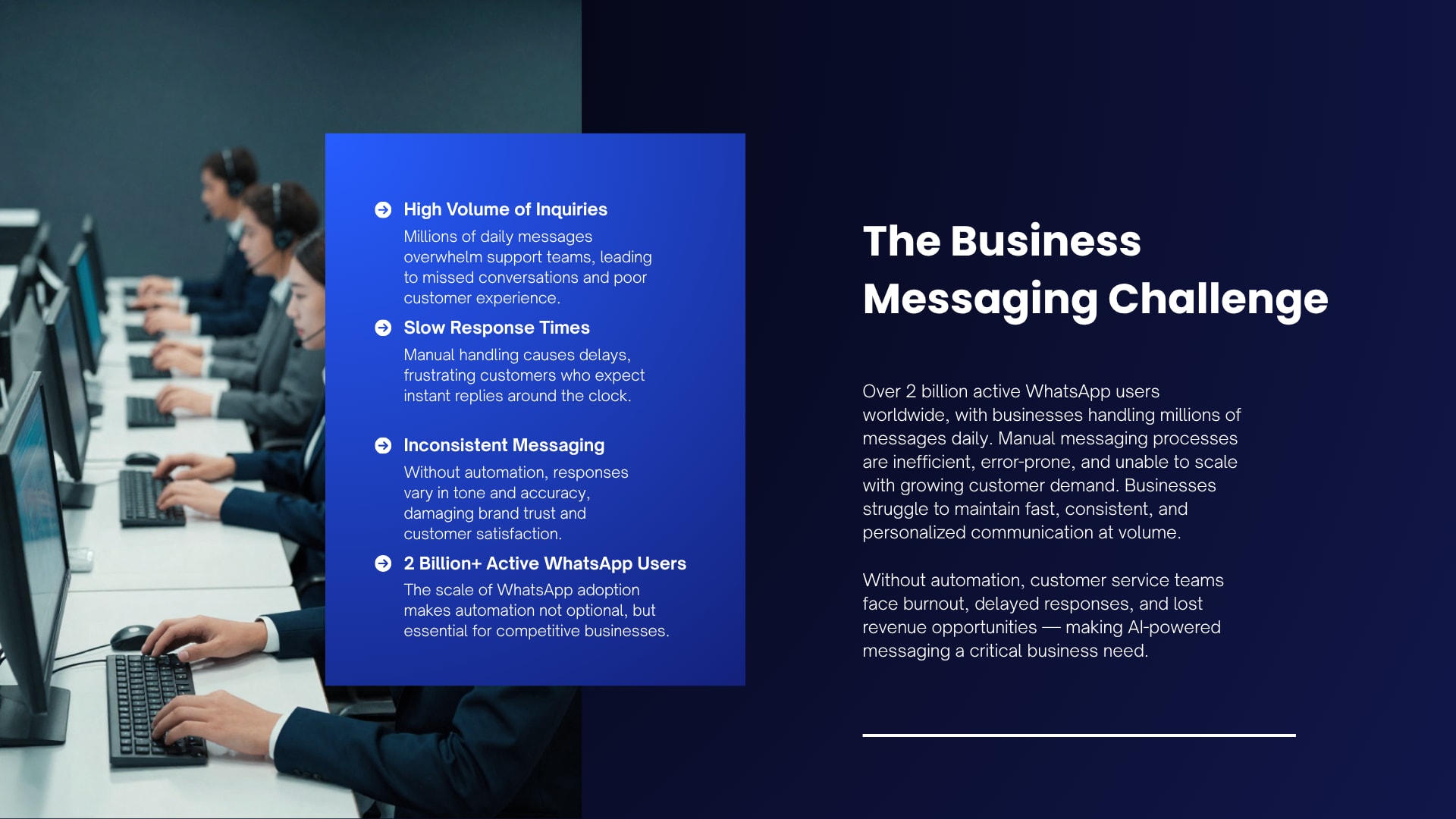
What is an AI WhatsApp chatbot and how does it work?
An AI WhatsApp chatbot is software that uses artificial intelligence to communicate with customers through WhatsApp. It interprets incoming messages, uses business-specific information to determine an appropriate response, and can trigger actions such as lead capture, appointment requests, support workflows, or human escalation.
Unlike a simple menu-based bot, an AI WhatsApp chatbot can interpret natural-language questions. A customer does not necessarily need to choose from a rigid sequence of buttons. The customer might type, “Do these shoes come in size 9, and how long does delivery take?” and the system can understand that the message contains both a product-availability question and a shipping question.
The chatbot then searches its configured business knowledge or connected systems and responds according to the information available to it.
This distinction matters because business messaging is rarely perfectly structured. Customers use abbreviations, incomplete sentences, regional expressions, spelling mistakes, and different ways of asking the same question.
What is an AI WhatsApp chatbot for business?
An AI WhatsApp chatbot for business is a customer-facing automation system built specifically around business conversations rather than general-purpose chatting.
A business chatbot might be configured with:
Product or service information
Prices and packages
Frequently asked questions
Opening hours
Delivery information
Return policies
Appointment rules
Booking procedures
Sales qualification questions
Support escalation rules
Brand tone and communication guidelines
For example, a dental clinic could configure its WhatsApp business chatbot to answer questions about services, opening hours, appointment availability, preparation instructions, and basic pricing information.
A real-estate company could use it to ask prospective buyers about location preferences, budget range, property type, and desired move-in timeline before passing qualified inquiries to an agent.
An online retailer could use it for product questions, order-status requests, return information, and basic shopping assistance.
The quality of the result depends heavily on the quality of the information and workflows behind the chatbot. AI does not eliminate the need for accurate business information.
How does an AI chatbot for WhatsApp understand customer questions?
An AI chatbot for WhatsApp typically combines natural-language processing or generative AI with a business knowledge source and predefined rules.
A simplified conversation might work like this:
A customer sends a WhatsApp message.
The chatbot identifies what the customer is asking.
It determines whether the request can be answered from the available business information.
It retrieves or generates an appropriate response.
If an action is required, it follows the configured workflow.
If the question is outside its scope, it escalates the conversation to a human agent.
Consider a customer asking:
“Can the installation happen Saturday morning?”
The chatbot may recognize this as a scheduling question rather than a general FAQ. If scheduling data is connected, it can potentially guide the customer toward available options. If scheduling is not connected, it should explain the next step instead of inventing an appointment.
That last point is critical.
A trustworthy AI WhatsApp chatbot should be designed to distinguish between information it knows and information it does not know.
What information should businesses give an AI WhatsApp chatbot?
The chatbot should receive a carefully maintained source of truth.
That can include:
Frequently asked questions
Product descriptions
Service descriptions
Pricing rules
Shipping policies
Refund and cancellation policies
Business hours
Location information
Contact details
Booking procedures
Sales qualification criteria
Support procedures
Escalation instructions
Businesses should also define what the chatbot must not do.
For example, a company might instruct its chatbot not to make refunds, change customer account details, provide legal interpretations, or promise delivery dates unless the relevant system confirms them.
A good knowledge base is therefore more than a collection of marketing copy. It is an operational reference for customer conversations.
How does human handoff work when AI cannot answer?
Human handoff is one of the most important parts of responsible chatbot design.
A customer may begin with a routine question such as, “What are your opening hours?” The chatbot can answer immediately. The same customer might then say, “My order arrived damaged and I need help.” That second issue may require a human agent.
The chatbot should recognize the change in complexity and make escalation easy.
WhatsApp's Business Messaging Policy also emphasizes the importance of clear escalation routes for automated responses, including human-agent transfer and other support channels.
WhatsApp for Business
A practical escalation workflow can look like this:
The AI identifies a request outside its permitted scope.
It explains that a human specialist is needed.
It collects any useful information.
It transfers or flags the conversation.
The agent receives the relevant conversation context.
The human continues from where the chatbot stopped.
This creates a hybrid model rather than treating AI and human support as competing systems.
How is a WhatsApp AI chatbot different from a basic chatbot?
A traditional rule-based chatbot generally follows predetermined paths.
For example:
Customer: “What are your opening hours?”
Bot: “Choose an option: 1. Store hours 2. Location 3. Contact.”
An AI system can potentially interpret more natural language:
Customer: “Are you open tomorrow morning?”
The chatbot can recognize that the customer is asking about business hours and provide the relevant information.
The difference is not simply that one system is “smarter.” It is that an AI-powered chatbot can work with more flexible language while still operating within business rules and knowledge.
For businesses, that can make conversations feel less like navigating a menu and more like asking a knowledgeable support representative a straightforward question.
How can an AI WhatsApp chatbot automate business messaging?
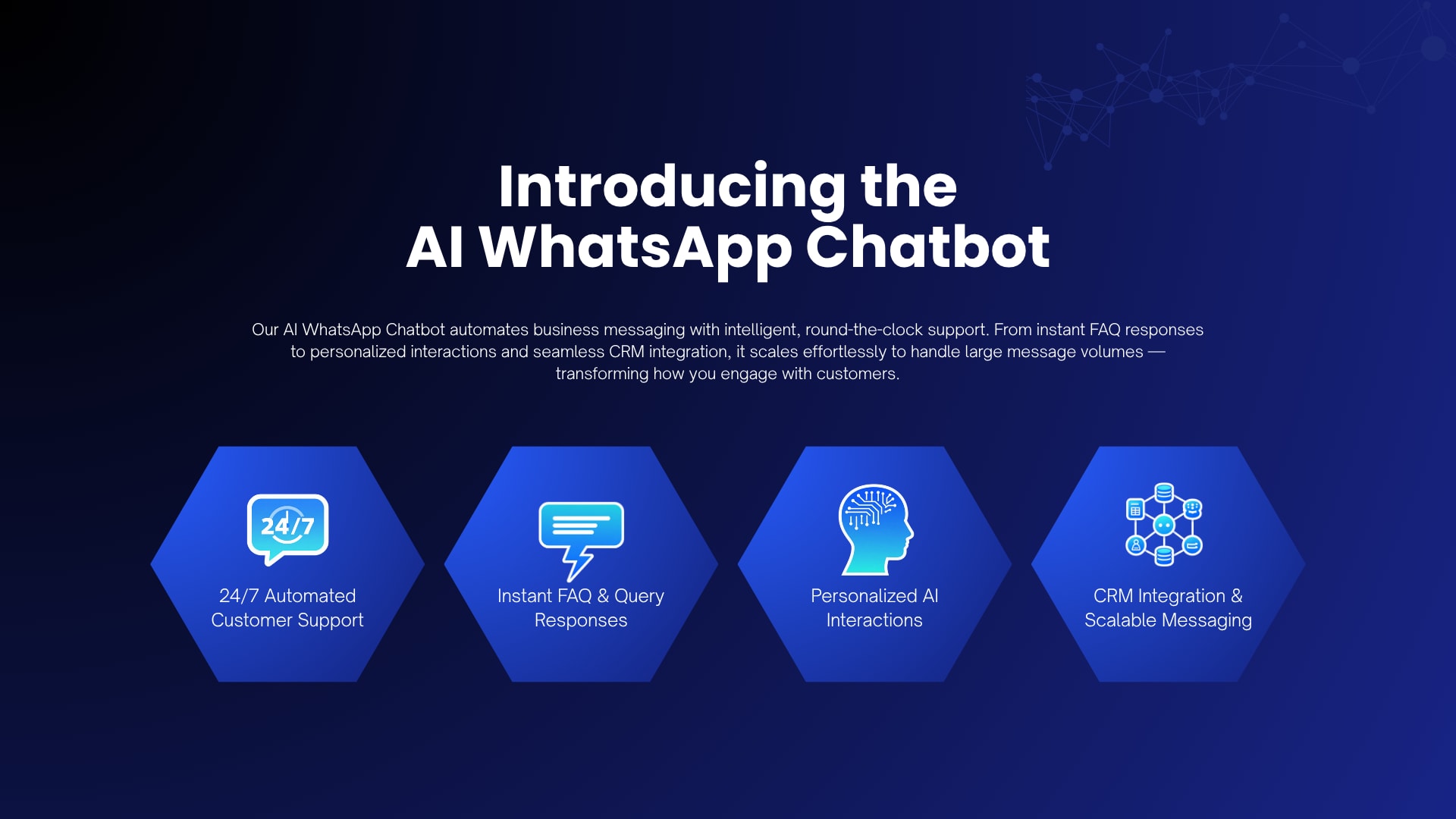
An AI WhatsApp chatbot automates business messaging by handling repetitive conversations, answering frequently asked questions, collecting customer information, qualifying prospects, supporting sales workflows, and routing complex requests to human agents. The goal is not to automate every conversation; it is to automate the predictable parts while preserving human involvement where it adds value.
This is increasingly relevant as businesses receive messages across different times, campaigns, and customer journeys. Meta has described WhatsApp business tools that support customer questions, product discovery, marketing, and AI-assisted customer interactions.
What can an AI WhatsApp chatbot automate for customer support?
A WhatsApp customer support chatbot can be particularly useful when support teams receive the same questions repeatedly.
Common examples include:
“What are your working hours?”
“Where is my order?”
“How much does this service cost?”
“What is the return policy?”
“Do you deliver to my city?”
“How can I book an appointment?”
“What documents are required?”
“Is this product available?”
“How long does delivery take?”
Instead of making an employee answer every message individually, the chatbot can handle routine questions immediately.
For example, imagine an online furniture company receiving 150 WhatsApp conversations after a weekend promotion. A significant portion might involve delivery times, dimensions, color options, and return policies.
The support team still has important work to do, but the chatbot can absorb the repetitive questions first.
That allows employees to spend more time on unusual orders, complaints, complex product advice, and customer relationships.
Can an AI WhatsApp chatbot generate and qualify leads?
Yes. A WhatsApp lead generation chatbot can turn an initial inquiry into a structured sales opportunity.
Suppose a customer messages a software company:
“I want to know about your business plan.”
Instead of simply sending a generic product page, the chatbot could ask:
What type of business is it?
How many employees will use the product?
Which features are most important?
When is implementation expected?
Is a product demonstration required?
The answers can help the sales team understand the prospect before the conversation reaches a salesperson.
A lead qualification workflow might look like this:
Customer starts a conversation.
AI identifies buying intent.
Chatbot asks a small number of relevant questions.
Customer provides contact and business details.
The system categorizes the inquiry according to configured criteria.
A qualified lead is routed to sales.
A human salesperson continues the conversation.
The objective is not to interrogate every visitor with a long questionnaire. The best workflows collect only information that will actually help the next person or system in the process.
How can businesses use WhatsApp chatbot automation for sales?
Sales teams often spend substantial time answering early-stage questions before a prospect is ready to speak with a salesperson.
An AI chatbot for WhatsApp can help with this first stage.
For example, a prospect might ask:
“Which package would work for a 20-person company?”
The chatbot can explain the relevant packages using approved business information. If the customer then asks for a personalized proposal, the chatbot can collect the information needed by the sales team.
A sales workflow might include:
Product discovery
Feature explanations
Basic pricing information
Qualification questions
Lead capture
Demo requests
Appointment requests
Follow-up prompts
Human sales handoff
Meta's current Business Agent capabilities similarly describe use cases including answering business-specific questions, product recommendations, lead qualification, appointment booking, and sales support.
How does automated WhatsApp messaging support marketing?
WhatsApp marketing automation can help businesses manage relevant customer communications, but automation should not be confused with sending unlimited promotional messages.
Businesses need to pay attention to consent, message quality, applicable policies, and the rules governing business-initiated conversations.
WhatsApp's policies require businesses to obtain appropriate permission before sending subsequent messages, and business-initiated messaging on the platform can require approved message templates.
WhatsApp for Business
Useful marketing-related workflows can include:
Appointment reminders
Product availability notifications
Order updates
Relevant promotional communications
Event reminders
Customer re-engagement
Follow-ups after an inquiry
The strongest automation usually provides a clear reason for the customer to receive the message.
For example, “The product requested is back in stock” is more useful than an unrelated promotional message sent simply because the customer's phone number exists in a database.
How can a WhatsApp business chatbot handle repetitive questions?
Repetitive questions are one of the clearest opportunities for automation.
Imagine a coaching company receiving the following messages every day:
“When does the next batch start?”
“How much is the course?”
“Is there an online option?”
“How long is the program?”
“Is a certificate included?”
A chatbot can answer those questions consistently.
The support team can then focus on questions such as:
“Which course is appropriate for this specific career transition?”
“Can the company customize the program for our employees?”
“I have a problem with my existing enrollment.”
The dividing line is not simply “easy question versus difficult question.” It is whether the business can safely and accurately automate the response.
How can businesses automate pricing and product questions?
Pricing questions are often high-volume and commercially important.
An AI WhatsApp chatbot can explain published prices, packages, inclusions, exclusions, and basic differences between plans when those details are clearly configured.
For example:
Customer: “What is included in the standard package?”
Chatbot: “The standard package includes X, Y, and Z. The premium package adds A and B.”
The business can then invite the customer to continue if they need a personalized quotation.
The key is keeping pricing information synchronized. If the website says one price and the chatbot provides another, automation can create more support problems rather than fewer.
How can businesses automate bookings, orders, and status updates?
Messaging becomes particularly useful when it connects to operational workflows.
A service business could use a chatbot to guide appointment requests.
An e-commerce company could use it to answer order-status questions.
A restaurant could use it to handle booking inquiries.
A repair company could use it to collect information about a service request.
A simple workflow could be:
Identify the customer's request.
Collect the required information.
Check the relevant system if an integration exists.
Provide the confirmed information.
Escalate when a system check or human decision is required.
This is where chatbot automation becomes more valuable than a static FAQ page. The conversation can become part of a larger business process.
Can an AI WhatsApp chatbot support customers outside business hours?
Yes, provided the chatbot has the right information and boundaries.
Consider a company that operates from 9 a.m. to 6 p.m. A customer sends a question at 10:30 p.m.
Without automation, the customer may have to wait until the following day.
With an AI WhatsApp chatbot, the customer may receive an immediate answer to routine questions.
For example:
“The support team is currently offline, but the return policy allows returns within 14 days. If the issue requires an agent, the conversation can be passed to the team when support resumes.”
That is more useful than pretending a human is available when one is not.
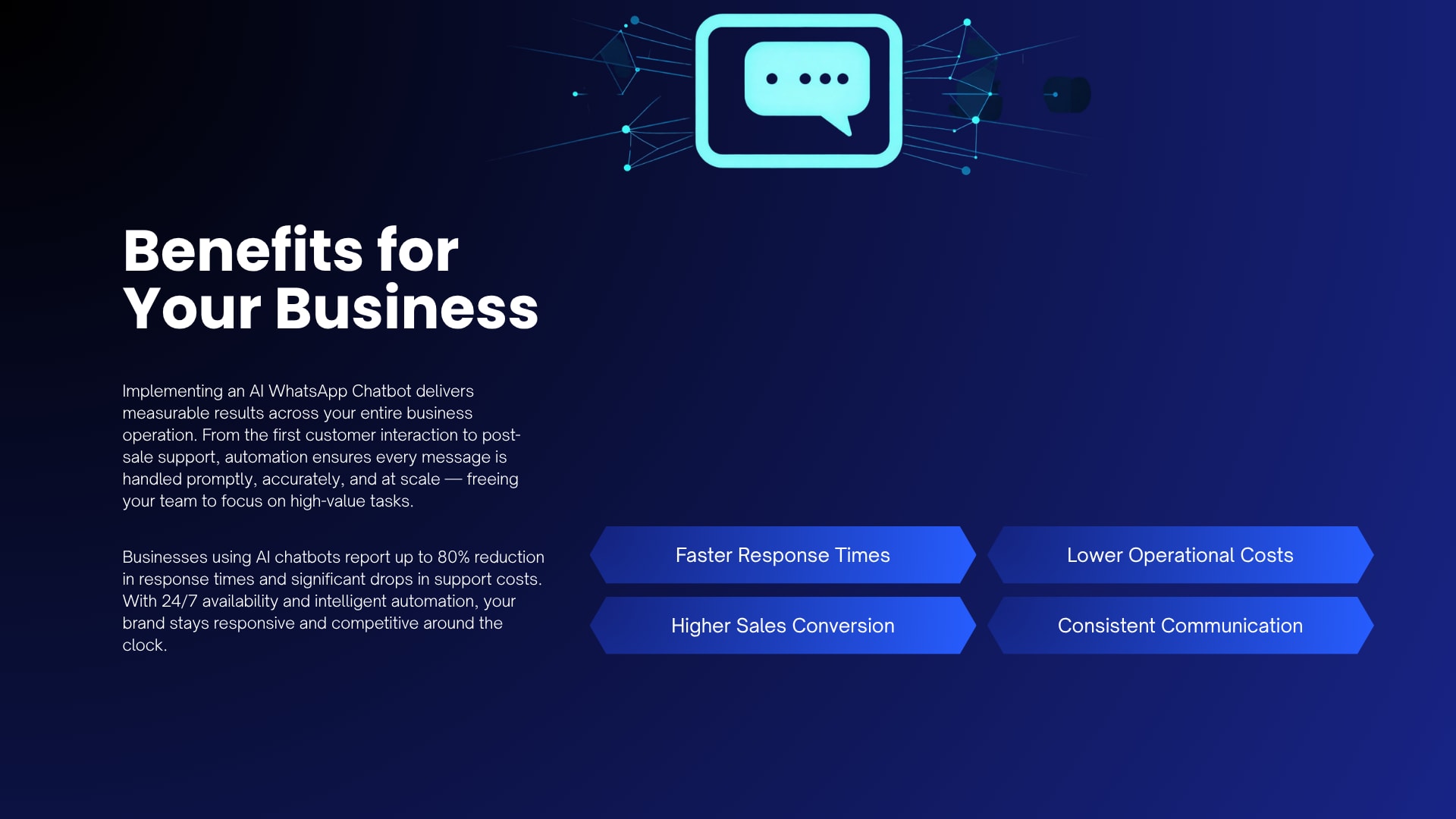
What are the benefits of business messaging automation?
The practical benefits depend on implementation, but common advantages include:
Faster responses to routine questions
More consistent answers
Reduced repetitive workload
Lead capture outside office hours
More structured sales qualification
Easier routing of complex requests
Better use of human support time
Greater visibility into recurring customer questions
More scalable customer communication
Meta reported in May 2026 that its Business AI for eligible small businesses in India can answer customer questions, recommend products, capture leads, book appointments, and support sales directly within WhatsApp Business.
About Facebook
That development illustrates an important shift: AI-based business messaging is moving from simple autoresponders toward systems that can participate in more complete customer journeys.
Traditional WhatsApp support vs AI WhatsApp chatbot
FeatureTraditional SupportAI WhatsApp ChatbotRoutine FAQ responsesUsually handled manuallyCan be automatedAfter-hours responsesUsually delayedCan respond automaticallyLead captureOften manualCan be structured and automatedLead qualificationUsually handled by salesCan ask predefined qualification questionsComplex complaintsHuman agentEscalated to human agentResponse consistencyDepends on agentCan follow configured knowledge and rulesScalabilityRequires more staff capacityAutomation can handle repetitive volumeHuman interactionCentral to every conversationReserved for cases requiring human judgment
This does not mean that an AI WhatsApp chatbot is automatically better for every conversation. Human support remains important when a customer is frustrated, the issue is sensitive, the request requires judgment, or the chatbot lacks sufficient information.
How can a business get started with an AI WhatsApp chatbot?
A business can get started with an AI WhatsApp chatbot by defining its goals, organizing accurate business information, selecting appropriate WhatsApp integration, designing customer workflows, establishing human handoff rules, testing conversations, and measuring performance after launch. A focused first use case is generally easier to manage than trying to automate the entire customer journey immediately.
The most useful implementation is rarely the one with the largest number of features. It is the one that solves a clear communication problem without creating new confusion.
Is an AI WhatsApp chatbot suitable for small businesses?
An AI WhatsApp chatbot for business can be useful for small companies when WhatsApp already generates meaningful customer conversations.
A small business does not need thousands of conversations before automation becomes relevant.
A local service provider might receive 20 inquiries per day, but if 12 of those inquiries ask about the same services, prices, availability, and location, repetitive messaging can still consume valuable time.
Examples include:
Salons
Clinics
Restaurants
Educational providers
Real-estate businesses
Home-service companies
Retail stores
Travel businesses
Professional services
Small e-commerce brands
The right question is not simply “How many messages does the business receive?”
It is:
How much of the existing messaging workload is repetitive, predictable, and safe to automate?
A business with 30 highly complex conversations may benefit less from automation than one with 100 routine inquiries.
What should businesses prepare before implementation?
Before deployment, businesses should document the conversations they want to automate.
A useful preparation process is:
Review recent WhatsApp conversations.
Identify the most common customer questions.
Group questions by intent.
Separate routine requests from complex issues.
Gather accurate answers and business policies.
Define which actions the chatbot can take.
Define when a human must take over.
Test the workflows with realistic questions.
Launch with a limited scope.
Review conversations and improve the system.
This process often reveals that the biggest challenge is not technology.
It is information management.
If employees give customers different answers about pricing, delivery, cancellation rules, or product availability, the chatbot cannot solve the underlying inconsistency by itself.
How should a business build its chatbot knowledge base?
A chatbot knowledge base should contain information that customers actually need.
Useful categories include:
Business information
Company name
Locations
Working hours
Contact channels
Products and services
Features
Pricing
Packages
Availability
Eligibility
Customer support
FAQs
Troubleshooting
Returns
Refunds
Cancellations
Sales
Qualification questions
Product recommendations
Demo information
Appointment process
Escalation
What requires a human
Who receives the escalation
What information should be collected first
The information should be reviewed whenever policies or offerings change.
A chatbot that continues using an outdated return policy can create a customer-service problem at scale.
What customer conversations should remain with human agents?
Not every conversation should be automated.
Human involvement may be appropriate when:
A customer makes a complex complaint.
A refund requires manual approval.
A customer requests an exception.
The issue involves sensitive personal circumstances.
The chatbot lacks reliable information.
A negotiation is required.
A high-value sales opportunity needs personal attention.
The customer explicitly requests a human.
A policy interpretation requires professional judgment.
A good WhatsApp customer support chatbot should therefore have a clear boundary.
Automation should remove unnecessary repetition, not remove accountability.
What should businesses look for in a WhatsApp AI chatbot?
A business evaluating a WhatsApp AI chatbot should look beyond whether the product can generate fluent answers.
Important considerations include:
WhatsApp integration
Business knowledge configuration
Human handoff
Conversation history
Lead capture
Workflow automation
Analytics
Access controls
Data handling
Integration with existing business systems
Ability to update information easily
Support for the business's customer languages
Clear configuration of chatbot boundaries
A fluent answer is not necessarily a correct answer.
Businesses should therefore test the system using real customer questions, including incomplete questions, spelling mistakes, unusual requests, and questions the chatbot should refuse to answer.
What does an AI WhatsApp chatbot cost?
There is no single universal price for an AI WhatsApp chatbot.
The total cost can depend on factors such as:
Chatbot platform fees
AI usage
WhatsApp-related charges
Message volume
Integration requirements
Number of agents
CRM or commerce integrations
Advanced automation
Support requirements
WhatsApp's Business Platform also has rules around business-initiated messaging, approved templates, and applicable pricing, so businesses should check the current official policies and commercial terms rather than relying on an old pricing article.
For a small company, the right calculation is often based on operational value rather than message volume alone.
If employees spend several hours each week answering repetitive questions, automation can be evaluated against that workload.
The calculation should also include implementation and maintenance rather than treating chatbot software as the only cost.
What are the limitations and common mistakes to avoid?
An AI WhatsApp chatbot can create problems when it is implemented without clear boundaries.
Common mistakes include:
Giving the chatbot outdated information
Automating too many conversations at once
Making it difficult to reach a human
Allowing the system to invent answers
Sending excessive promotional messages
Ignoring WhatsApp policies
Collecting unnecessary customer information
Failing to monitor conversations
Measuring only message volume
Treating AI as a complete replacement for customer-service staff
Another mistake is making the chatbot sound overly enthusiastic.
Customers usually want answers, not marketing slogans.
A useful response is:
“The standard installation is available Monday to Friday. Saturday appointments can be requested, subject to availability.”
A less useful response might bury the answer under several promotional sentences.
The best chatbot writing is often straightforward.
How can businesses measure WhatsApp chatbot performance?
Performance should be measured according to the chatbot's purpose.
For customer support, useful metrics may include:
Percentage of routine questions resolved
Human escalation rate
Average response time
Resolution time
Customer satisfaction
Repeated-contact rate
For sales, businesses can monitor:
Leads captured
Qualified leads
Appointment requests
Sales conversations handed to agents
Conversion from inquiry to qualified opportunity
For marketing, businesses can consider:
Opt-in rates
Message engagement
Response rates
Opt-out rates
Conversion from campaign conversations
A high automation rate is not automatically a positive result.
If a chatbot “resolves” 90% of conversations by giving poor answers and customers repeatedly return to ask the same question, the automation rate is misleading.
The better goal is useful resolution.
How can businesses implement an AI WhatsApp chatbot with YourSiteChat?
Businesses exploring an AI WhatsApp chatbot for business can evaluate a platform such as YourSiteChat as one possible implementation route.
YourSiteChat's published product information describes WhatsApp integration, AI-based customer replies, lead capture, appointment workflows, FAQ automation, human escalation, analytics, and connections with other business channels. Its published setup process involves adding business information, connecting channels, and deploying the assistant.
A business interested in exploring the option can review the AI WhatsApp chatbot for business integration page:
AI WhatsApp chatbot for business
A sensible evaluation process would be to start with one or two high-volume use cases rather than attempting to automate every customer interaction immediately.
For example, a business could begin with:
FAQ automation
Lead capture
Appointment requests
Product questions
Basic support
After reviewing real conversations, additional workflows can be introduced.
What should a business do after launching?
Launching an AI WhatsApp chatbot is the beginning of optimization, not the end.
Businesses should periodically review:
Questions the chatbot could not answer
Questions customers asked repeatedly
Conversations that required escalation
Incorrect or incomplete answers
New products or services
Policy changes
Customer feedback
Lead quality
Support-team feedback
These reviews create a feedback loop.
How can businesses implement an AI WhatsApp chatbot with YourSiteChat?
Suppose 15 customers ask a question the chatbot cannot answer during one week. That may indicate a missing knowledge-base entry.
Suppose customers frequently request a human after receiving a particular automated answer. That may indicate that the workflow needs redesigning.
Suppose many leads abandon the conversation at the same question. The business may need to simplify its qualification process.
This is where practical experience becomes important. Chatbot optimization is less about endlessly changing the AI model and more about understanding where the customer journey is breaking down.
What role does WhatsApp play in modern business messaging?
WhatsApp's importance as a business communication channel is reflected in Meta's continuing investment in business messaging, AI support, marketing tools, and customer-service capabilities.
In September 2025, Meta said that 91% of online adults in India chatted with businesses weekly, citing a Kantar 2025 report, and described expanded Business AI and WhatsApp Business Platform capabilities for Indian businesses.
In May 2026, Meta announced Business AI for eligible small businesses in India, with capabilities including customer support, product recommendations, lead capture, appointment booking, and sales assistance.
Those developments are useful context for businesses evaluating automation. WhatsApp chatbot technology is no longer limited to simple keyword autoresponders; the platform ecosystem is increasingly supporting AI-assisted business conversations.
At the same time, businesses still need to respect customer expectations and platform policies.
WhatsApp states that businesses should obtain appropriate consent, provide clear opt-out mechanisms, and avoid unauthorized bulk messaging.
Frequently Asked Questions About AI WhatsApp Chatbots
What is an AI WhatsApp chatbot?
An
is an AI-powered system that communicates with customers through WhatsApp. It can interpret natural-language questions, provide answers using business information, capture leads, support sales workflows, automate FAQs, and escalate conversations to human agents when necessary.
Can an AI WhatsApp chatbot answer customer questions?
Yes. An AI WhatsApp chatbot can answer routine customer questions when the required information has been properly configured. Common examples include questions about products, services, pricing, hours, availability, delivery, bookings, and policies. Businesses should ensure that the chatbot uses current and approved information.
Can a WhatsApp chatbot generate leads?
Yes. A WhatsApp lead generation chatbot can ask qualification questions, collect contact information, identify buying intent, and route relevant prospects to a sales team. The exact workflow depends on the business's qualification criteria and available integrations.
Can businesses automate WhatsApp customer support?
Yes. Businesses can automate repetitive support conversations such as FAQs, basic product questions, order inquiries, appointment requests, and other predictable interactions. Complex or sensitive issues should have a clear route to a human support agent.
How much does an AI WhatsApp chatbot cost?
Costs vary according to the chatbot platform, AI usage, WhatsApp messaging charges, conversation volume, integrations, and required functionality. Businesses should evaluate the complete cost structure, including WhatsApp's current commercial and messaging requirements, WhatsApp, the next step can be to identify the 10–20 questions or workflows that consume the most repetitive staff time. Those conversations provide a practical starting rather than assuming a single flat price.
Is an AI WhatsApp chatbot suitable for small businesses?
Yes, particularly when a small business receives a meaningful number of repetitive WhatsApp questions. A local service provider, retailer, clinic, restaurant, educational company, or professional-services firm can use automation for FAQs, lead capture, appointment requests, and basic customer support.
Does a WhatsApp AI chatbot replace human agents?
Usually, the more practical model is collaboration rather than replacement. An AI WhatsApp chatbot can handle repetitive, predictable conversations while human agents deal with complex complaints, exceptions, negotiations, sensitive issues, and high-value customer relationships.
What should businesses consider before choosing a WhatsApp AI chatbot?
Businesses should evaluate WhatsApp integration, knowledge-base management, AI accuracy, human handoff, workflow automation, lead capture, analytics, data handling, integrations, scalability, and ease of updating business information. Testing the chatbot with realistic customer questions is also important before a full rollout.
Conclusion
An AI WhatsApp Chatbot can turn business messaging from a largely manual activity into a more structured customer-service, sales, and support workflow.
The strongest use cases are usually straightforward: answering repetitive questions, capturing leads, qualifying prospects, supporting customers outside normal working hours, guiding product discovery, and handing complex conversations to human agents.
The technology should not be treated as a magic replacement for a customer-service team. Its value comes from giving businesses a practical way to automate predictable conversations while allowing people to concentrate on situations where human judgment matters.
Businesses considering WhatsApp automation should begin with a clear problem, accurate information, sensible escalation rules, and measurable goals. They should also account for WhatsApp's current messaging policies, consent requirements, approved templates, and other platform rules.
For companies that already receive substantial customer communication through WhatsApp, the next step can be to identify the 10–20 questions or workflows that consume the most repetitive staff time. Those conversations provide a practical starting point for AI WhatsApp chatbot automation.
Businesses interested in exploring a platform-based approach can learn more through the WhatsApp AI chatbot solution from YourSiteChat and assess whether its published capabilities fit their support, sales, and lead-generation requirements.
Ultimately, effective business messaging automation is not about making every conversation automated. It is about making the right conversations easier, faster, and more consistent—while keeping the human side of customer relationships where it matters most.