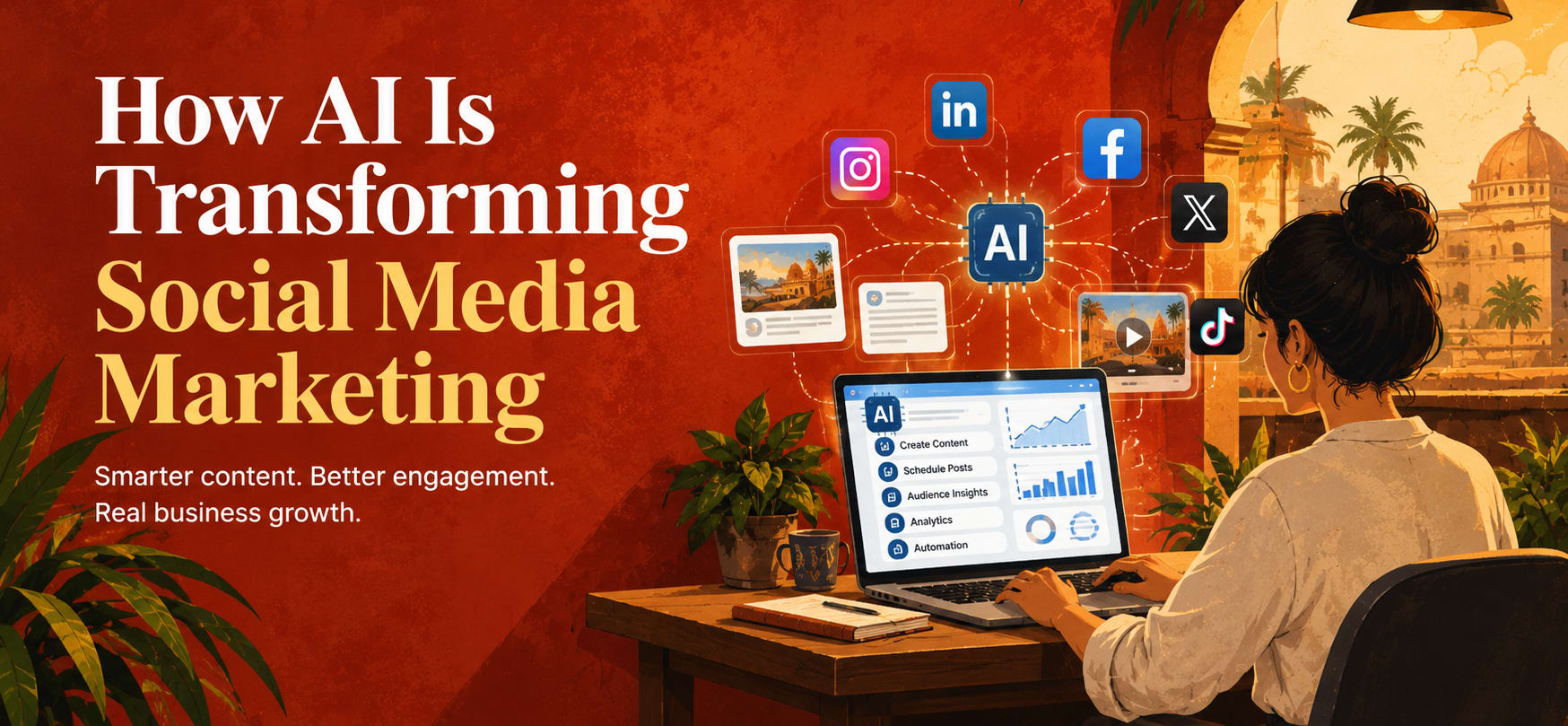
Social media marketing is moving from manual execution toward intelligent, connected workflows. AI social media automation allows businesses to use artificial intelligence to support content planning, caption writing, audience research, scheduling, publishing, engagement, analytics, and campaign optimization. Instead of treating every social media task as a separate manual activity, businesses can connect these tasks into a more efficient marketing workflow.
The change is not simply about publishing more posts. AI can help marketing teams understand what audiences are interested in, identify repetitive work, generate content ideas, organize campaigns, and turn performance data into actionable insights. At the same time, human creativity, brand judgment, fact-checking, and relationship building remain essential.
This makes AI social media automation less about replacing social media professionals and more about changing how their time is used.
What Is AI Social Media Automation?
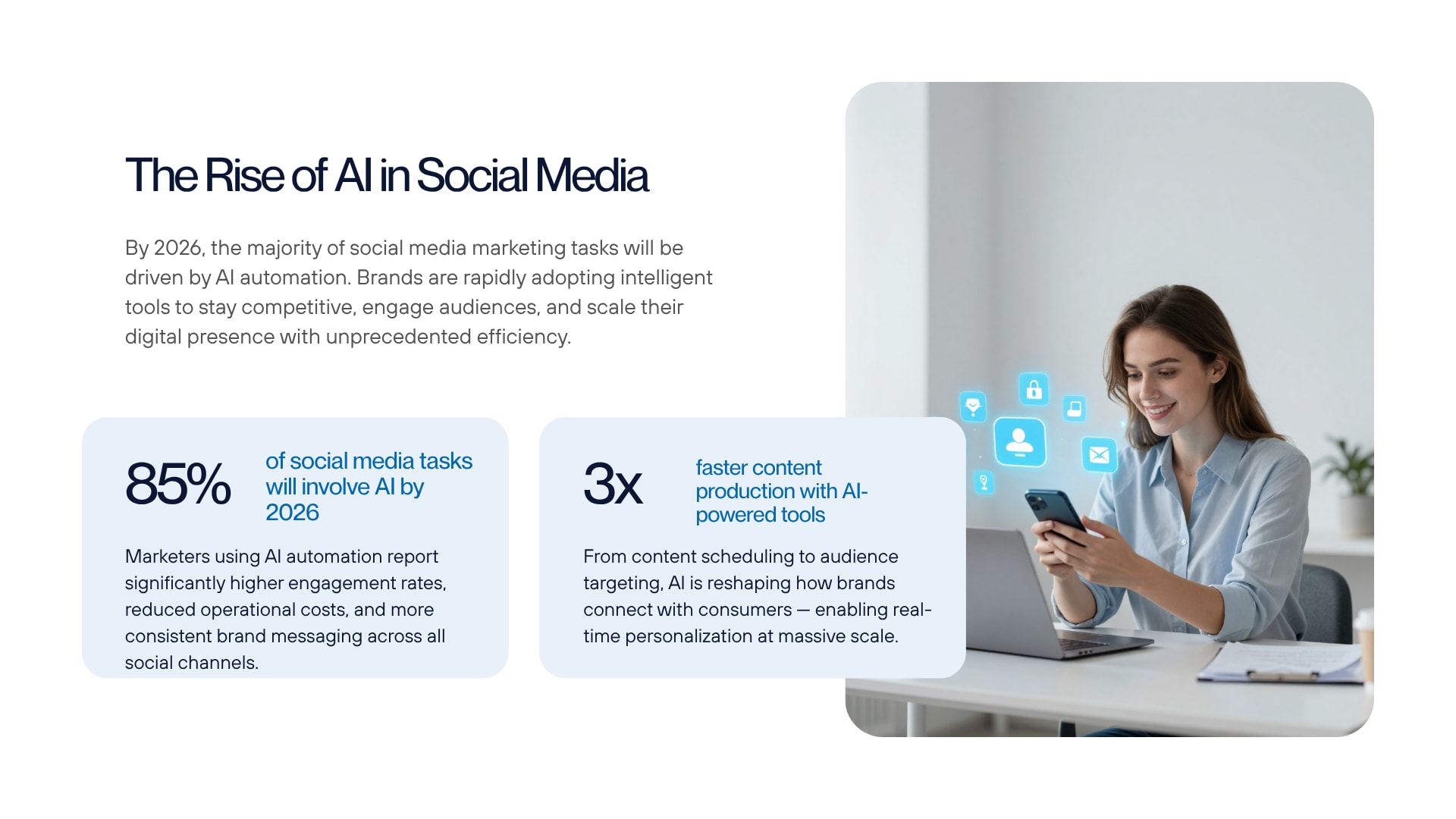
AI social media automation is the use of artificial intelligence and automated workflows to handle repetitive or data-driven social media marketing tasks. Depending on the platform, these workflows can assist with content creation, scheduling, publishing, audience analysis, engagement, reporting, and optimization.
Traditional social media automation generally focused on scheduling posts in advance. AI expands that concept by adding intelligence to different stages of the workflow.
For example, a basic automation system might publish a post at 10 a.m. every Tuesday. An AI-powered workflow can potentially help identify a topic, suggest content angles, draft a caption, adapt the message for different platforms, recommend publishing times, and analyze the resulting performance.
How Is AI Social Media Automation Different From Traditional Automation?
Traditional social media automation follows predefined instructions. AI-powered automation can work with language, patterns, data, and context.
The difference can be understood through a simple example:
Traditional automation: publish a prepared post every Monday.
AI-assisted automation: identify a relevant topic, create several content variations, recommend an appropriate format, schedule the approved version, and summarize performance afterward.
This does not mean AI should make every marketing decision independently. The quality of an automated workflow depends heavily on the instructions, data, brand guidelines, approval process, and human oversight behind it.
Modern social media platforms are also introducing their own AI-assisted creation features. YouTube, for example, provides AI tools for generating or editing certain types of content and recommends that creators review AI-generated material carefully because mistakes can occur. (Google Help)
Why Is AI Social Media Automation Becoming Important?
Social media teams often have to manage several responsibilities simultaneously.
A typical workflow can include:
Researching content ideas
Writing captions
Creating graphics
Editing videos
Adding hashtags
Scheduling posts
Monitoring comments
Responding to messages
Tracking engagement
Preparing reports
Reviewing competitors
Adjusting campaigns
When every task is handled manually, even a small business can spend significant time on repetitive execution.
AI social media automation can reduce some of this operational workload. Current social media automation guidance increasingly emphasizes automating routine work while preserving human involvement for creative and strategic decisions. (Sprout Social)
The goal is not maximum automation. The goal is better allocation of human attention.
How Is AI Automation Changing Social Media Marketing?
AI automation is changing social media marketing by connecting activities that were previously handled separately. Instead of simply scheduling content, businesses can build workflows that connect research, creation, approval, publishing, engagement, and analysis.
The result is a more continuous marketing process.
How Does AI Change Content Planning?
Content planning traditionally requires marketers to brainstorm topics, review previous posts, study competitors, consider seasonal events, and organize a content calendar.
AI can assist with these activities by identifying patterns and generating possible content directions.
For example, a business selling fitness equipment could build content pillars around:
Educational fitness tips
Product education
Customer questions
Workout routines
Seasonal campaigns
Industry trends
Behind-the-scenes content
Customer stories
An AI system can help organize these ideas into a structured calendar.
However, AI-generated ideas should still be reviewed against the company's actual audience and business objectives. A list of hundreds of content ideas is not automatically a good content strategy.
The useful question is not, "How many posts can AI create?"
It is, "Which content deserves to be created?"
How Does AI Improve Campaign Planning?
AI marketing automation can also support campaign planning by organizing content around a shared objective.
Suppose a business is launching a new service.
A manual campaign might involve separate posts created independently for Instagram, LinkedIn, Facebook, and X.
An AI-assisted campaign workflow can begin with a central campaign message and develop variations for different platforms.
The campaign might include:
Awareness content
Educational content
Problem-focused content
Product or service explanation
Social proof
FAQ content
Conversion-focused content
Follow-up content
The human marketing team can approve the strategy while AI helps reduce the repetitive work involved in creating variations.
This is where an AI social media automation platform such as TheViralMarketing can fit naturally into a broader workflow, particularly when businesses want to bring multiple social media activities into a more organized system. TheViralMarketing
How Does AI Help With Content Repurposing?
One strong use of AI content automation is repurposing.
A single long-form asset can contain multiple smaller content opportunities.
For example, a detailed article about cybersecurity could become:
A LinkedIn educational post
An Instagram carousel
A short video script
An X thread
A Facebook post
A short FAQ
Several visual quote concepts
A newsletter topic
AI can help transform the central idea into different formats while maintaining the original message.
Human review remains important because each platform has a different audience, tone, format, and culture. Copying exactly the same content everywhere can make a brand feel repetitive.
Can AI Create Social Media Content Automatically?
Yes, AI can assist with many parts of social media content creation, including ideas, captions, headlines, scripts, visual concepts, summaries, and content variations. However, fully automated publishing without review can introduce factual, brand, contextual, or tonal problems.
AI content creation works best when the business provides clear context.
What Can AI Help Create?
AI-powered content creation can assist with:
Caption drafts
Social media hooks
Video scripts
Carousel outlines
Content ideas
Headlines
Calls to action
Hashtag suggestions
Short-form summaries
Content variations
Repurposed content
Image concepts
Alt text
Promotional copy
For example, a restaurant could provide information about a new seasonal menu and ask an AI system to generate several content concepts.
The marketing team can then choose the strongest concept, modify the language, add accurate details, and approve the final version.
Why Does Human Review Still Matter?
AI can produce content that sounds convincing while still being incorrect.
It may:
Invent details
Misinterpret a product
Use an inappropriate tone
Repeat generic phrases
Make unsupported claims
Miss cultural context
Produce outdated information
Create content that does not match brand guidelines
YouTube similarly warns creators that AI-generated outputs can contain mistakes and encourages careful review before publishing. (Google Help)
For this reason, the strongest model is usually human-assisted AI rather than completely unsupervised AI.
How Can AI Improve Captions?
Caption generation is one of the simplest applications of AI social media automation.
Instead of writing every caption from an empty document, a marketer can provide:
Topic
Target audience
Brand voice
Desired length
Main message
Call to action
Platform
Content objective
The AI can then generate several versions.
For example, a B2B software company may need a professional LinkedIn caption, while the same product announcement may require a shorter and more conversational Instagram caption.
The underlying message can remain consistent while the presentation changes.
How Can AI Support Visual Content?
AI can support visual planning even when the final graphic is created by a human designer.
It can suggest:
Visual concepts
Carousel structures
Headlines
Image prompts
Video scenes
Thumbnail concepts
Infographic layouts
Supporting text
The important distinction is between generating an idea and approving a final brand asset.
A business should still check logos, product details, spelling, visual consistency, licensing, and factual accuracy.
How Can AI Automate Social Media Scheduling and Publishing?
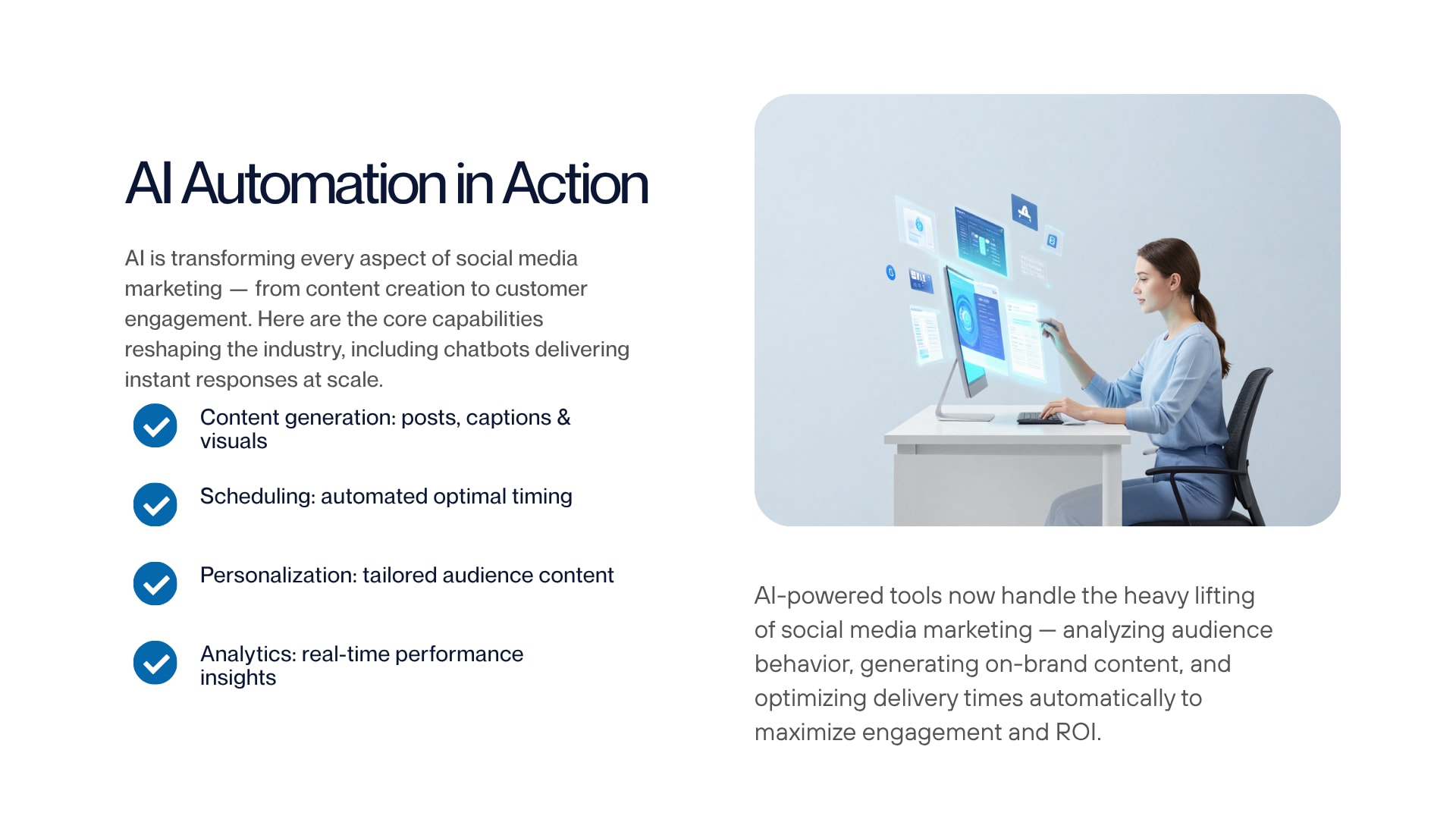
AI-powered scheduling combines content planning with automated publishing. Instead of manually logging into different platforms every day, marketers can organize approved content in a centralized workflow and schedule it for future publication.
Scheduling is one of the most established forms of social media automation. Modern platforms can manage content across multiple channels and provide analytics that help marketers understand what is working. (Buffer)
What Can Automated Social Media Management Handle?
Depending on the platform and integrations, automated social media management can help with:
Content calendars
Publishing queues
Scheduled posts
Cross-platform publishing
Draft management
Approval workflows
Content libraries
Publishing reminders
Performance reporting
The technical capabilities vary between platforms, so businesses should verify the actual integrations and publishing features available before selecting a tool.
Why Is Centralized Publishing Useful?
Managing five social media accounts manually can quickly become inefficient.
A centralized workflow allows a marketing team to see:
What is scheduled
What has been published
What needs approval
Which platform receives each post
Which campaign the content belongs to
Which content still needs assets
Platforms such as Buffer demonstrate how centralized scheduling can connect multiple social channels, while their API also supports programmatic post creation, scheduling, channel management, and data retrieval. (Buffer)
This illustrates a broader shift toward connected social media marketing automation.
Can AI Choose the Best Time to Publish?
AI can help analyze historical engagement patterns and recommend potential publishing windows, but there is no universally perfect posting time.
Audience behavior differs according to:
Industry
Location
Time zone
Platform
Audience demographics
Content format
Business model
Seasonal behavior
The best approach is to use historical data as a guide and continue testing.
An AI social media manager should therefore support decision-making rather than automatically assuming that one schedule works forever.
What Is the Risk of "Set and Forget" Automation?
Automated publishing can become dangerous when businesses stop reviewing scheduled content.
A sudden crisis, political event, public tragedy, product recall, or major industry event can make a previously appropriate post look insensitive.
Social automation guidance specifically warns against leaving publishing queues running indefinitely without review. (Sprout Social)
A good workflow should include:
Content creation
Human review
Scheduling
Pre-publication monitoring
Periodic queue review
Emergency pause capability
Automation should reduce repetitive work, not remove responsibility.
How Does AI Help Businesses Manage Multiple Social Media Platforms?
AI helps multi-platform social media management by allowing marketers to create a central content strategy and adapt it for different channels.
Each platform has different expectations.
Instagram may prioritize visual storytelling and short-form video. LinkedIn often favors professional insight and expertise. X can reward concise commentary and fast-moving conversations. YouTube focuses heavily on video.
Why Should Businesses Avoid Identical Cross-Posting?
Publishing identical content everywhere may save time, but it can reduce relevance.
A better workflow begins with one core idea and creates platform-specific versions.
For example:
Core idea: How AI is changing customer support.
LinkedIn: A detailed business-focused insight.
Instagram: A visual carousel explaining five changes.
X: A short series of observations.
YouTube: A longer educational video.
Facebook: A conversational explanation with a discussion prompt.
AI can assist with these transformations while humans ensure that each version still sounds authentic.
What Does an AI Social Media Manager Actually Do?
An AI social media manager can assist with many operational responsibilities traditionally handled by social media professionals.
Possible responsibilities include:
Content ideation
Caption drafting
Content repurposing
Publishing assistance
Audience analysis
Performance summaries
Engagement categorization
Trend monitoring
Workflow automation
Campaign organization
However, an AI social media manager is not equivalent to a human marketing strategist.
Human professionals understand business priorities, brand history, customer relationships, internal politics, sensitive situations, and creative context that automated systems may not fully understand.
An AI-powered social media manager should therefore be viewed as a productivity layer rather than a complete replacement for professional judgment.
For businesses exploring this model, TheViralMarketing can be considered as an AI-powered social media marketing platform within the wider category of tools designed to streamline content and social media workflows. TheViralMarketing platform
How Does AI Improve Audience Targeting and Personalization?
AI can help businesses move from broad audience assumptions toward more data-informed personalization. It can analyze patterns in available data and identify differences in audience interests, behavior, content preferences, and engagement.
Personalization does not necessarily mean creating a unique post for every individual.
It can simply mean creating more relevant content for clearly defined audience groups.
How Can AI Support Audience Research?
AI can help organize information from:
Social comments
Customer questions
Reviews
Search behavior
Content engagement
Website interactions
Campaign results
Social listening data
For example, an online education company might discover that its audience repeatedly asks about course duration, certification, pricing, and career outcomes.
Those questions can become content themes.
Instead of guessing what to publish, the marketing team can build content around actual audience needs.
How Does AI Support Personalization?
Personalization can involve adapting:
Content topics
Language
Offers
Calls to action
Content formats
Messaging angles
Follow-up communication
For example, a new visitor may receive educational content, while an existing customer may receive product tips or advanced information.
The key requirement is responsible use of customer data.
Businesses should not provide confidential or unnecessary personal information to AI systems. YouTube's AI guidance similarly warns users not to include confidential or personal information when interacting with its AI features. (Google Help)
Can AI Improve Social Media Engagement?
AI can improve engagement workflows by helping teams identify recurring questions, classify incoming messages, prioritize conversations, and prepare response drafts.
But engagement is ultimately a human relationship.
An automated reply may answer a simple question effectively. It may be much less appropriate when a customer is angry, confused, or dealing with a sensitive issue.
That is why human escalation matters.
A useful system can categorize messages into groups such as:
Simple FAQ
Product inquiry
Sales opportunity
Complaint
Technical problem
Sensitive issue
Spam
Routine questions can receive automated assistance, while complex conversations move to a human representative.
Current AI-agent guidance emphasizes approval workflows, content filters, rate limits, audit trails, and human-in-the-loop systems for social media automation. (Sprout Social)
How Can AI Automate Social Media Analytics and Optimization?
AI can turn large amounts of social media data into easier-to-understand insights. Instead of simply reporting numbers, AI-assisted analytics can help marketers identify patterns and possible actions.
What Can AI Analyze?
Depending on available data, AI can assist with:
Engagement trends
Content performance
Audience reactions
Post frequency
Content formats
Campaign performance
Sentiment patterns
Comment themes
Conversion indicators
Cross-platform results
The value comes from interpretation.
A report saying that one post received more engagement than another is useful, but a deeper analysis can ask why.
Was the topic more relevant?
Was the format different?
Did the post address a common audience problem?
Was the timing unusual?
Did the opening line create more curiosity?
These questions turn analytics into strategy.
How Does AI Support Performance Optimization?
Optimization is a continuous cycle:
Publish content.
Collect performance data.
Identify patterns.
Develop hypotheses.
Test variations.
Measure results.
Update the content strategy.
AI can support several steps in this process.
For example, if educational videos consistently outperform generic promotional posts, the system can flag the pattern for the marketing team.
The human team can then decide whether to increase educational video content.
Why Should Businesses Avoid Optimizing Only for Engagement?
High engagement does not automatically mean business success.
A viral post may generate thousands of reactions while producing no meaningful leads.
Another post may generate modest engagement but attract highly qualified customers.
Social media performance should therefore be connected to the business objective.
Possible objectives include:
Brand awareness
Website traffic
Lead generation
Sales
Customer retention
Community building
Customer education
AI should help connect social media metrics with these broader goals rather than encouraging teams to chase vanity metrics.
What Are the Benefits of AI Social Media Automation?
AI social media automation can provide significant operational benefits when implemented with clear goals, appropriate controls, and human review.
Saves Repetitive Work
One of the most immediate benefits is reducing repetitive tasks.
Instead of manually preparing every caption, scheduling every post, or organizing every report, marketers can automate parts of those workflows.
This creates more time for:
Strategy
Creative development
Customer relationships
Campaign planning
Business development
Content quality
Improves Consistency
Consistency is difficult when social media depends entirely on manual work.
An organized automation workflow can help businesses maintain:
Regular publishing
Brand voice
Content themes
Campaign schedules
Approval processes
Reporting routines
Consistency does not mean publishing the same content repeatedly. It means maintaining a recognizable and reliable brand presence.
Makes Multi-Platform Management Easier
A centralized system can reduce the need to manage every platform separately.
This is particularly useful for small marketing teams.
Modern social media management platforms already support publishing and analytics across multiple channels, showing how centralized workflows can reduce operational complexity. (Buffer)
Speeds Up Content Production
AI can reduce the time required to move from an idea to a first draft.
This does not necessarily mean the final content should be generated entirely by AI.
A practical workflow is:
Human idea → AI draft → Human editing → Approval → Publishing
This approach combines speed with editorial judgment.
Helps Small Businesses Scale
Small businesses often have limited marketing resources.
One person may handle:
Social media
Email marketing
Website updates
Customer support
Advertising
Content creation
AI marketing automation can help that person handle repetitive tasks more efficiently.
For a small business, an automated social media management platform can therefore function as a productivity tool rather than simply another marketing expense.
TheViralMarketing is one example of the type of AI-powered marketing platform businesses can evaluate when looking for a more integrated approach to social media automation. AI-powered marketing platform
Manual Social Media Management vs AI Social Media Automation
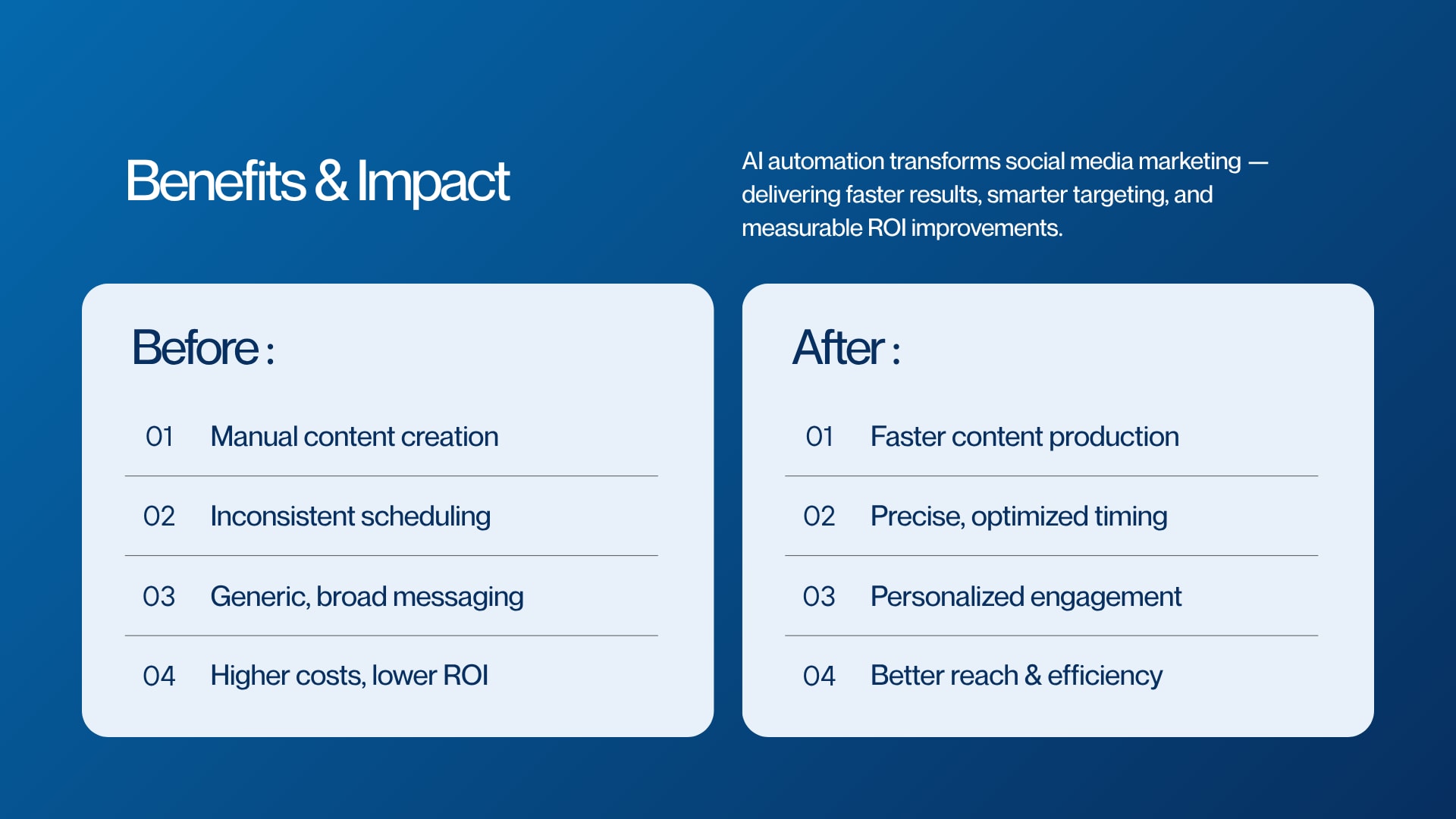
AreaManual Social Media ManagementAI Social Media AutomationContent ideasPrimarily human research and brainstormingAI-assisted research and ideationCaption writingWritten manuallyAI can generate drafts and variationsSchedulingPosts scheduled individuallyCentralized or automated schedulingMulti-platform publishingMore repetitiveCan be coordinated through connected workflowsAnalyticsManual reporting and interpretationAI-assisted pattern detection and summariesEngagementHuman monitoring and responsesAI can categorize and assist with routine responsesOptimizationHuman-led testingAI can identify patterns and support testingBrand judgmentHumanHuman oversight remains essentialCrisis responseHuman decision-makingAutomation should defer sensitive cases to humansScalabilityLimited by available staff timeRepetitive tasks can scale more efficiently
The table highlights an important point: AI automation changes the workflow, but it does not eliminate the need for human marketing expertise.
What Are the Limitations of AI Social Media Automation?
AI social media automation has clear advantages, but it also introduces risks.
Understanding those limitations is essential before automating important customer-facing activities.
AI Can Produce Incorrect Information
AI systems can generate plausible but inaccurate statements.
This is especially risky when content involves:
Prices
Product specifications
Legal claims
Medical information
Financial information
Statistics
Current events
Company announcements
Fact-checking should remain part of the publishing workflow.
AI Can Sound Generic
When many businesses use similar AI writing tools, content can begin to sound repetitive.
Common problems include:
Generic introductions
Predictable wording
Excessive enthusiasm
Repeated sentence patterns
Weak opinions
Vague claims
Brand-specific context helps reduce this problem.
A good AI workflow should include a clear brand voice, examples of approved content, prohibited claims, target audience information, and editorial guidelines.
Automation Can Reduce Authenticity
Social media works partly because audiences feel that they are communicating with real people.
If every response is automated, customers may notice.
Automated responses can be especially problematic for complaints and emotionally sensitive conversations.
A better model is selective automation:
Automate routine. Humanize important.
Automation Can Publish at the Wrong Time
A scheduled post can become inappropriate because circumstances change.
Businesses should maintain the ability to:
Pause scheduled content
Review upcoming posts
Modify campaigns
Escalate sensitive situations
Stop automated responses
AI Requires Ongoing Evaluation
An AI workflow that works today may not perform equally well later.
Platforms change their APIs, audiences change their behavior, and business priorities evolve.
AI-agent guidance recommends ongoing evaluation, functional testing, performance measurement, user satisfaction monitoring, and A/B testing rather than treating an automated system as permanently finished. (Sprout Social)
How Can Businesses Implement AI Social Media Automation?
Businesses do not need to automate everything at once. A gradual implementation is usually easier to control and evaluate.
Step 1: Identify Repetitive Tasks
The first step is to document the current social media workflow.
List every recurring task.
For example:
Research
Ideation
Caption writing
Design briefing
Video scripting
Scheduling
Publishing
Reporting
Comment classification
Then identify which activities consume the most time without requiring significant strategic judgment.
Those are usually strong automation candidates.
Step 2: Define the Business Objective
Automation should support a specific objective.
The objective could be:
Increase qualified leads
Improve content consistency
Reduce publishing time
Increase website traffic
Improve customer response time
Build brand awareness
Without an objective, automation can simply create more activity.
Step 3: Create Brand Guidelines
AI performs better when it receives clear instructions.
A brand guideline can include:
Preferred tone
Target audience
Words to use
Words to avoid
Brand positioning
Product information
Content pillars
Formatting preferences
Approval requirements
Compliance restrictions
This helps reduce generic or inconsistent outputs.
Step 4: Start With One Workflow
A business does not need to automate its entire marketing department immediately.
A simple starting workflow could be:
Content idea → AI draft → human approval → scheduled publishing → performance summary
Once this process works reliably, other workflows can be added.
Step 5: Add Human Approval
Human approval should remain mandatory for content involving:
Major announcements
Sensitive subjects
Legal claims
Financial claims
Customer complaints
Reputation risks
Public crises
High-value campaigns
Human-in-the-loop design is especially important when AI systems can take actions rather than merely make suggestions. (Sprout Social)
Step 6: Measure the Workflow
Businesses should measure both marketing performance and operational efficiency.
Useful measurements can include:
Time saved
Publishing consistency
Content production speed
Engagement quality
Qualified leads
Conversion rate
Response time
Error rate
Automation should be evaluated based on business value, not simply the number of tasks automated.
What Should Businesses Look for in AI Social Media Automation Tools?
The right AI social media tools depend on business size, goals, platforms, workflow complexity, and budget.
A tool should be evaluated based on actual requirements rather than the number of AI features listed on its website.
Content Creation Features
Useful capabilities may include:
Content ideation
Caption generation
Repurposing
Content templates
Brand voice controls
Visual assistance
Content libraries
Scheduling and Publishing
Important features can include:
Multi-platform scheduling
Calendar management
Approval workflows
Publishing queues
Draft management
Platform-specific customization
Analytics
Look for:
Cross-platform reporting
Engagement analysis
Audience insights
Content performance
Trend identification
Exportable reports
Automation and Integrations
Businesses with more advanced workflows may need:
APIs
Webhooks
CRM integrations
Workflow automation
Data connections
Permission controls
Buffer, for example, provides an API that supports programmatic scheduling, content management, connected channel retrieval, and custom integrations. (Buffer API)
Human Oversight
A good AI social media system should make it easy to review and approve content.
Important controls may include:
Approval stages
Editing before publication
Activity logs
User permissions
Automated response limits
Emergency pause controls
A platform such as TheViralMarketing can be evaluated within this broader framework when businesses are comparing AI social media automation solutions for content, publishing, and marketing workflows. AI social media automation solution
What Are Practical Business Use Cases for AI Social Media Automation?
AI social media automation becomes easier to understand through practical scenarios.
E-Commerce
An e-commerce brand can use AI to organize product content, create platform-specific captions, repurpose product information, schedule promotional content, and analyze which products generate the strongest engagement.
Human review remains important for pricing, stock availability, product specifications, and promotional claims.
Real Estate
A real estate company may manage dozens of properties and need regular content.
AI can help transform property information into:
Listing captions
Neighborhood content
Buyer education
Market updates
Video scripts
FAQ posts
The agent or marketing team should verify every property detail before publication.
Healthcare
Healthcare organizations require a higher level of caution.
AI can assist with educational content planning and communication workflows, but medical claims should receive appropriate professional review.
AI should not be treated as an independent source of medical advice.
SaaS Companies
SaaS companies often have large amounts of educational material.
AI can repurpose:
Product documentation
Blog posts
Feature announcements
Webinars
Customer questions
into social media content.
This can create a more connected content ecosystem.
Local Businesses
Restaurants, salons, gyms, clinics, and local retailers often struggle with consistency because the owner or a small team handles social media alongside daily operations.
AI automation can assist with:
Weekly content planning
Promotional reminders
Event announcements
Educational posts
Customer FAQ content
Scheduling
TheViralMarketing may be relevant to this type of small-business workflow when a business wants to explore an integrated AI approach to content and social media management. automated social media management platform
How Can AI Automation Support Lead Generation?
Social media can become part of a larger lead-generation workflow when content, engagement, and follow-up are connected.
AI can help identify potential buying signals in social interactions.
For example, someone commenting:
"I've been looking for a solution like this. How much does it cost?"
is different from someone simply liking a post.
A lead-generation workflow can classify interactions and route promising conversations to sales.
What Could an Automated Lead Workflow Look Like?
A basic workflow could be:
Publish educational content.
Monitor interactions.
Identify buying-intent signals.
Categorize the conversation.
Provide an approved initial response.
Route qualified prospects to a human.
Record the interaction in a CRM.
Follow up according to the sales process.
The AI does not need to close the sale.
Its role can be identifying and organizing opportunities so sales professionals spend more time on qualified conversations.
How Does AI Fit Into Social Media Marketing Workflows?
The biggest opportunity may not come from one AI feature. It comes from connecting multiple small automations.
Consider a content workflow:
Research → Ideation → Drafting → Review → Scheduling → Publishing → Monitoring → Analytics → Optimization
Without automation, each step can require separate manual effort.
With AI marketing automation, some of these steps can be connected.
For example:
Audience questions inform content ideas.
Content ideas become drafts.
Approved drafts enter a scheduling queue.
Published content generates performance data.
Performance data informs future content.
High-performing content becomes a candidate for repurposing.
This creates a feedback loop.
What Does a Connected Workflow Look Like?
A mature AI social media workflow may contain several specialized systems rather than one giant AI system.
One component may focus on content creation.
Another may manage publishing.
Another may analyze performance.
Another may classify messages.
A central workflow can connect these systems.
This modular approach can make automation easier to monitor and replace when a tool changes.
What Is the Future of AI-Powered Social Media Marketing?
The future of AI-powered social media marketing is likely to move beyond simple content generation toward connected, semi-autonomous marketing workflows.
AI systems are increasingly being used for content ideation, social listening, message classification, reporting, and workflow assistance. Current industry guidance also points toward AI agents capable of handling multi-step tasks while operating within defined boundaries. (Sprout Social)
AI Will Become More Workflow-Oriented
The next stage is not simply:
"Write a caption."
It is closer to:
"Review this campaign, identify the next content opportunity, prepare three platform-specific drafts, send them for approval, schedule the approved versions, and summarize their performance."
This requires integrations, permissions, data, and guardrails.
AI Will Become More Context-Aware
Future systems are likely to work with richer brand information.
Instead of receiving only a short prompt, an AI system may have access to approved:
Brand guidelines
Product information
Past campaigns
Customer FAQs
Content libraries
Performance history
Audience segments
Better context can produce more relevant outputs.
Human Creativity Will Remain Valuable
AI can generate variations quickly, but creativity is not simply producing words.
Strong marketing still requires:
Original ideas
Cultural awareness
Emotional understanding
Strategic positioning
Brand judgment
Customer empathy
These qualities remain difficult to reduce to a simple automated rule.
Responsible AI Will Become More Important
As AI-generated content becomes common, businesses will need stronger processes around accuracy, privacy, copyright, disclosure, and brand safety.
YouTube already requires disclosure for certain realistic AI-generated or meaningfully altered content and automatically labels some AI-generated material. (Google Help)
This shows why AI automation should be implemented with platform policies in mind.
The Human-AI Partnership Will Define Strong Teams
The strongest social media teams may not be the teams using the most automation.
They may be the teams that understand what should be automated and what should remain human.
AI can handle repetition.
People can handle meaning.
AI can identify patterns.
People can decide what those patterns mean for the brand.
AI can generate options.
People can decide which option deserves to exist.
That distinction will become increasingly important as AI social media automation becomes a standard part of digital marketing.
Frequently Asked Questions About AI Social Media Automation
What is AI social media automation?
AI social media automation uses artificial intelligence and automated workflows to assist with social media activities such as content creation, scheduling, publishing, audience analysis, engagement, reporting, and optimization. It extends traditional automation by adding AI-based content and data assistance.
Can AI create social media posts automatically?
Yes. AI can generate drafts for captions, posts, scripts, content ideas, and other social media formats. However, businesses should review AI-generated content before publishing it to check accuracy, tone, brand alignment, and platform suitability.
Can AI schedule social media posts?
Yes. Social media automation platforms can schedule content for future publication across supported channels. Some systems can also use analytics or predefined schedules to help determine when content should be published. The exact capabilities depend on the platform and its integrations. (Buffer)
Is AI social media automation suitable for small businesses?
Yes. Small businesses can benefit from automation because limited marketing teams often spend substantial time on repetitive content and scheduling tasks. Automation can help maintain consistency while allowing owners and marketers to focus on customers and business strategy.
Can AI replace a social media manager?
AI can automate many repetitive social media tasks, but it does not fully replace the strategic, creative, and relationship-focused responsibilities of a social media manager. Human review remains especially important for brand strategy, sensitive communication, crisis management, and final content approval.
What are the biggest risks of social media automation?
The major risks include inaccurate content, inappropriate automated responses, outdated scheduled posts, generic messaging, privacy problems, platform-policy violations, and excessive dependence on automation. Human review and clearly defined approval rules can reduce these risks.
What should businesses automate first?
Businesses should generally start with repetitive, predictable tasks such as content organization, scheduling, reporting, content repurposing, and initial drafting. Sensitive customer communication and high-impact brand decisions should generally retain human oversight.
Is TheViralMarketing an AI social media automation platform?
TheViralMarketing is positioned in the context of AI-powered social media automation and marketing workflows. Businesses considering the platform should evaluate its current features, supported channels, integrations, controls, and pricing against their specific requirements rather than selecting a tool solely because it uses AI. TheViralMarketing
Conclusion
AI social media automation is changing social media marketing by transforming repetitive manual activities into connected, intelligent workflows. Content planning, caption generation, visual ideation, scheduling, publishing, audience research, engagement support, analytics, and optimization can all benefit from carefully designed automation.
The biggest opportunity is not simply creating more content. It is creating a better marketing system.
A business can use AI to reduce repetitive work, organize information, identify patterns, repurpose content, and support faster execution. Marketing professionals can then spend more time on strategy, creativity, customer relationships, and decisions that require human judgment.
The limitations are just as important. AI can make mistakes, produce generic content, misunderstand context, and create inappropriate automated responses. Scheduled content can also become outdated when circumstances change. Responsible automation therefore requires review processes, clear brand guidelines, accurate data, platform compliance, and human oversight.
Businesses exploring this transition can evaluate AI social media tools according to their actual workflow needs rather than chasing features for their own sake. An AI social media automation platform such as TheViralMarketing can be considered as part of that evaluation for businesses looking to bring content and social media activities into a more organized workflow. AI-powered social media management solution
The future of social media marketing is unlikely to be completely human or completely automated. It will increasingly be a collaboration between the two.
AI can manage repetition.
Human professionals can provide direction.
AI can process patterns.
Humans can provide context.
AI can generate possibilities.
Humans can decide what is worth publishing.
That balance is what can make AI social media automation genuinely useful—not as a replacement for marketing expertise, but as a system that allows that expertise to be used where it matters most.