
AI in Marketing is no longer a futuristic concept—it’s now a core part of how businesses attract, engage, and convert customers. For beginners, the challenge isn’t access to tools anymore, but understanding how everything fits together.
This guide breaks it down step-by-step using real-world examples, simple explanations, and practical actions so anyone can start using AI effectively.
How does AI in marketing work and why is it important in 2026?
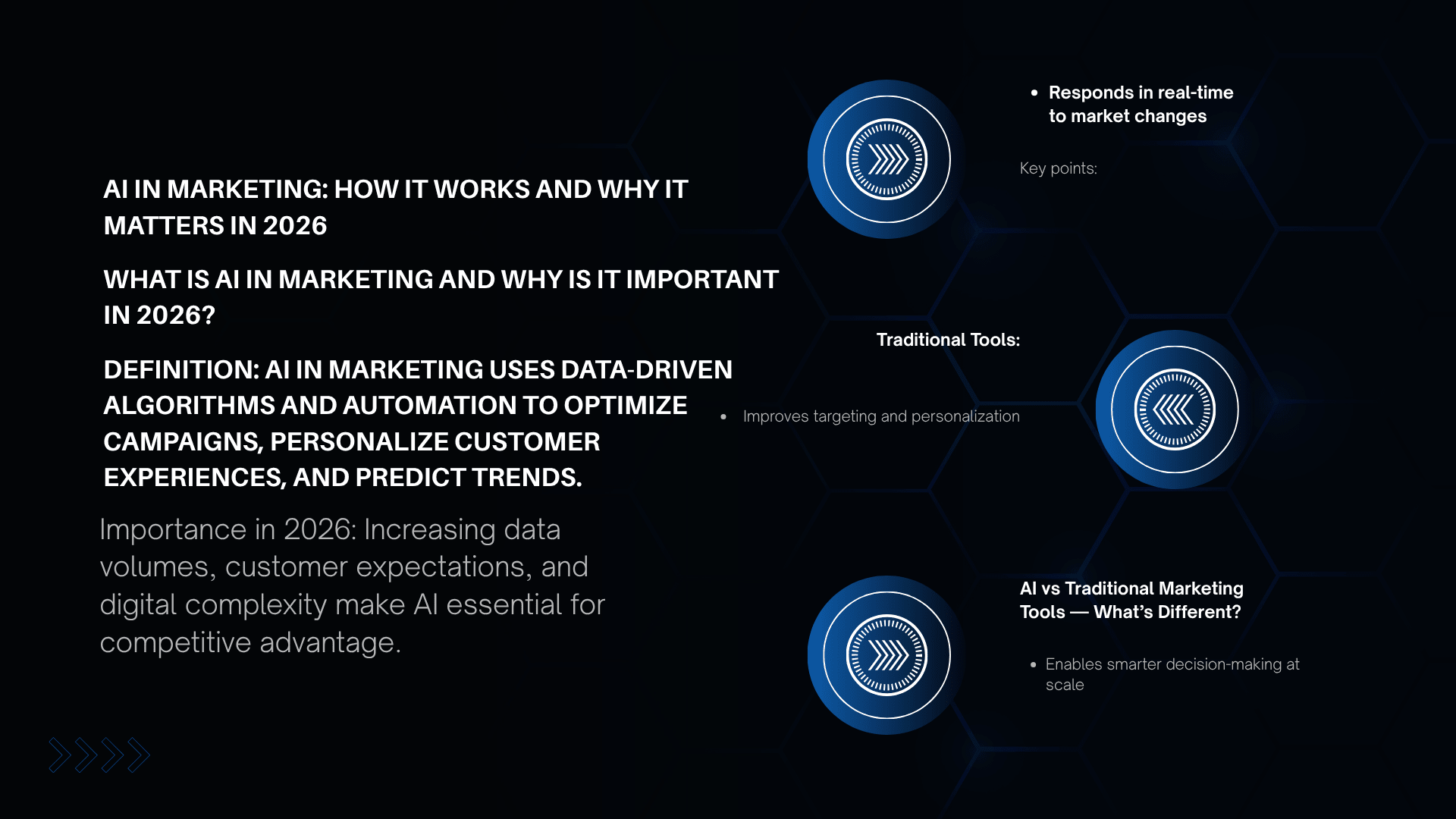
AI in Marketing works by analyzing large amounts of customer data, identifying patterns, and automating decisions like targeting, personalization, and content delivery. In 2026, it is important because it improves efficiency, reduces costs, and helps businesses deliver highly personalized experiences at scale.
AI systems process user behavior, preferences, and interactions across platforms. These systems then:
Predict what customers want
Automate repetitive marketing tasks
Personalize messaging in real time
Optimize campaigns without manual effort
In 2026, competition is driven by speed and personalization. Businesses using AI tools in marketing are able to respond instantly, while others fall behind.
What is AI in marketing in simple terms?
AI in Marketing means using smart software to make marketing decisions automatically.
Instead of manually:
Writing every message
Testing every ad
Segmenting every audience
AI tools do it faster by learning from data.
Think of it like this:
Traditional marketing = guesswork + manual effort
AI marketing = data-driven + automated decisions
How is AI different from traditional digital marketing tools?
Here’s the biggest difference:
FeatureTraditional Marketing ToolsAI in MarketingDecision MakingManualAutomatedTargetingBroad audienceHyper-personalizedSpeedSlow testingReal-time optimizationData UsageLimitedMassive data processingLearningStaticSelf-improving
Traditional tools follow rules.
AI tools learn and improve over time.
What are real-world examples of AI in marketing today?
Businesses already use AI in everyday marketing:
E-commerce → Product recommendations (Amazon-style suggestions)
Email marketing → Personalized subject lines
Chatbots → Instant customer support
Ads → Auto-optimized Facebook/Google campaigns
Content → AI-generated blogs and captions
Why is AI in marketing becoming essential for businesses?
AI in Marketing is becoming essential because it helps businesses scale faster, reduce manual work, and deliver better customer experiences. Companies using AI outperform competitors in targeting, personalization, and ROI.
The marketing landscape is overloaded with data. Humans alone cannot process it effectively.
AI solves this by:
Automating repetitive tasks
Analyzing millions of data points instantly
Predicting customer behavior
Businesses that ignore AI risk:
Losing leads due to slow response
Poor targeting
Higher ad costs
How does AI improve marketing efficiency and ROI?
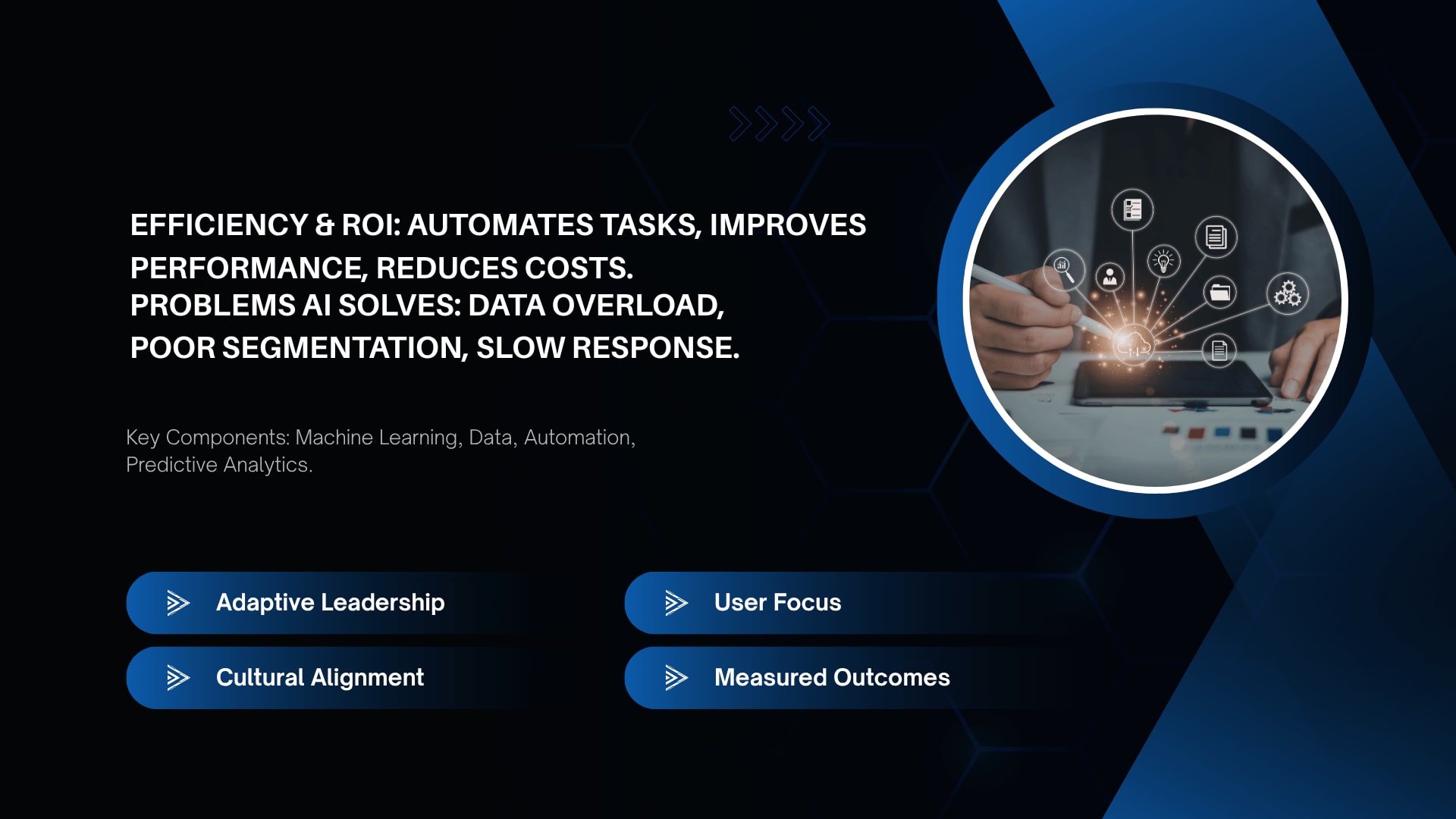
AI improves ROI in three main ways:
Better targeting
Ads reach the right audience
Less wasted budget
Automation
Saves time on repetitive tasks
Reduces operational costs
Optimization
Campaigns improve automatically
Higher conversion rates
What problems can AI solve for marketers?
AI addresses common marketing challenges:
Low-quality leads
Poor engagement rates
Time-consuming manual work
Inconsistent messaging
Lack of personalization
What are the key components of AI in marketing systems?
AI systems rely on a combination of technologies working together.
What role do machine learning and data play?
Machine learning marketing depends on data.
The more data → the better predictions
AI learns from:
Website visits
Click behavior
Purchase history
This allows AI to:
Predict customer intent
Recommend products
Personalize content
How do automation and predictive analytics work together?
Automation executes tasks.
Predictive analytics decides what to do.
Example:
AI predicts a user is likely to buy
Automation sends a targeted email
AI tracks response and improves next action
What are the main types and applications of AI in marketing?
AI in Marketing is used across content creation, customer targeting, email marketing, SEO, and advertising. These applications help automate processes, improve personalization, and optimize campaigns for better performance.
AI applications are now present in every stage of the marketing funnel:
Awareness → AI ads
Consideration → AI content
Conversion → AI personalization
Retention → AI email automation
How is AI used in content creation and copywriting?
AI in Marketing helps create blogs, ads, and social media content quickly by analyzing trends and generating text based on user input. It speeds up content production but still requires human editing for quality and originality.
Can AI generate blogs, ads, and social media posts?
Yes, AI tools can generate:
Blog posts
Ad copies
Instagram captions
Product descriptions
However, raw AI output often needs refinement.
What are the pros and limitations of AI-generated content?
Pros:
Fast content creation
Scalable output
Cost-effective
Limitations:
Lacks human emotion
Can feel generic
Needs editing
How does AI improve customer segmentation and targeting?
AI analyzes user behavior to create highly specific audience segments.
How does AI analyze customer behavior and preferences?
AI tracks:
Browsing patterns
Purchase behavior
Engagement levels
Then groups users into segments like:
High-value customers
Interested but inactive users
What tools use AI for audience targeting?
Popular AI tools in marketing include:
Google Ads (Smart campaigns)
Meta Ads (AI targeting)
CRM tools with AI segmentation
How is AI used in email marketing and personalization?
AI enhances email marketing through automation and personalization.
How does AI optimize subject lines and send times?
AI analyzes:
Past open rates
User activity timing
Then predicts:
Best subject line
Best time to send
Can AI automate email campaigns effectively?
Yes, AI can:
Trigger emails based on behavior
Personalize content
Optimize sequences
How does AI impact SEO and search marketing strategies?
AI in Marketing improves SEO by helping with keyword research, content optimization, and understanding user intent. It also plays a growing role in voice and visual search, making search strategies more intelligent and user-focused.
How can AI help with keyword research and content optimization?
AI tools:
Identify trending keywords
Analyze competitors
Suggest content improvements
Example:
Instead of guessing keywords, AI shows what users actually search.
What role does AI play in voice and visual search?
AI powers:
Voice assistants (search queries)
Image recognition (visual search)
This changes SEO strategy:
More conversational keywords
Image optimization
How is AI used in paid advertising and campaign optimization?
AI automates ad campaigns for better performance.
How does AI improve ad targeting and bidding strategies?
AI:
Identifies high-converting audiences
Adjusts bids automatically
Tests multiple variations
What platforms use AI for advertising automation?
Google Ads
Facebook Ads
Programmatic ad platforms
How can beginners start using AI in marketing effectively?
Beginners can start with AI in Marketing by using simple tools for content, automation, and analytics. The key is to begin small, focus on one use case, and gradually integrate AI into existing workflows.
Starting with AI doesn’t require advanced knowledge. It requires:
Clear goals
Basic tools
Consistent testing
What are the best AI marketing tools for beginners?
Which free AI tools can you start with today?
Chat-based AI tools for content
Canva AI for design
Google tools for analytics
What paid AI tools are worth investing in?
Advanced SEO tools
CRM with AI automation
Ad optimization platforms
How do you create an AI-driven marketing strategy step by step?
How do you set goals and KPIs for AI in marketing?
Start with:
Define objective (leads, traffic, sales)
Choose metrics:
CTR
Conversion rate
ROI
Track results consistently
How do you integrate AI tools into existing workflows?
Steps:
Identify repetitive tasks
Replace with AI tools
Monitor performance
Optimize continuously
How does AI chatbot improve marketing automation?
AI chatbots are one of the most practical applications of AI in Marketing.
helps businesses:
Respond instantly to visitors
Capture leads automatically
Provide 24/7 support
Real-world use case:
A real estate website uses an AI chatbot to:
Answer property queries
Collect user details
Send leads directly to CRM
This removes manual follow-ups and increases conversion rates.
Businesses exploring automation can experiment with AI chatbot tools to understand how real-time engagement impacts lead generation.
What skills do you need to succeed in AI in marketing?
Do you need coding or technical knowledge?
No.
Most AI tools are:
No-code
Beginner-friendly
What marketing skills still matter in an AI-driven world?
Copywriting
Strategy
Customer psychology
Creativity
AI supports skills—it doesn’t replace them.
What are the common mistakes beginners make with AI in marketing?
Why do some AI strategies fail?
Common reasons:
No clear goals
Overuse of automation
Ignoring data quality
How can you avoid over-reliance on AI tools?
Always review AI output
Add human touch
Focus on strategy
What are the future trends of AI in marketing you should prepare for?
AI in Marketing will continue evolving with hyper-personalization, real-time decision-making, and advanced automation. Businesses that adapt early will gain a competitive advantage.
AI is moving towards:
Predictive experiences
Voice-first marketing
Fully automated campaigns
How will AI change customer experiences in the next 5 years?
Personalized websites
Instant responses
Predictive recommendations
What emerging technologies will shape AI in marketing?
Generative AI
Voice AI
Visual search
Predictive analytics
Conclusion
AI in Marketing is not just a trend—it is a fundamental shift in how marketing works.
For beginners, the smartest approach is:
Start small
Focus on one use case
Use simple tools
Learn by doing
The businesses that win in 2026 are not the ones using the most tools—but the ones using AI strategically.
AI doesn’t replace marketers.
It amplifies those who know how to use it.