A customer visiting a business website usually has a specific reason for being there. The customer may want to know the price of a product, check whether a service is available, understand a feature, ask about delivery, or find out how to book an appointment. If the answer is not available quickly, attention can disappear just as quickly.
This is where an AI chatbot for customer support can become useful. Instead of requiring a customer to wait for business hours or search through several pages, an AI chatbot can provide an immediate first response based on the information provided by the business.
Fast responses do not mean that every customer interaction should become automated. Human support remains essential for complicated, sensitive, or unusual situations. The real opportunity is to let AI handle straightforward questions while support teams spend more time on conversations that require judgment, empathy, and expertise.
Customer service expectations are also changing. Salesforce's 2025 State of Service research found that 82% of service professionals surveyed believe customer expectations are higher than they used to be. The same research highlights growing expectations around always-available support and tailored interactions.
For businesses, the question is no longer simply whether customers want support. The bigger question is how quickly a business can provide useful support without overwhelming its team.
Why Do Customers Expect Instant Answers and What Does Slow Support Cost?
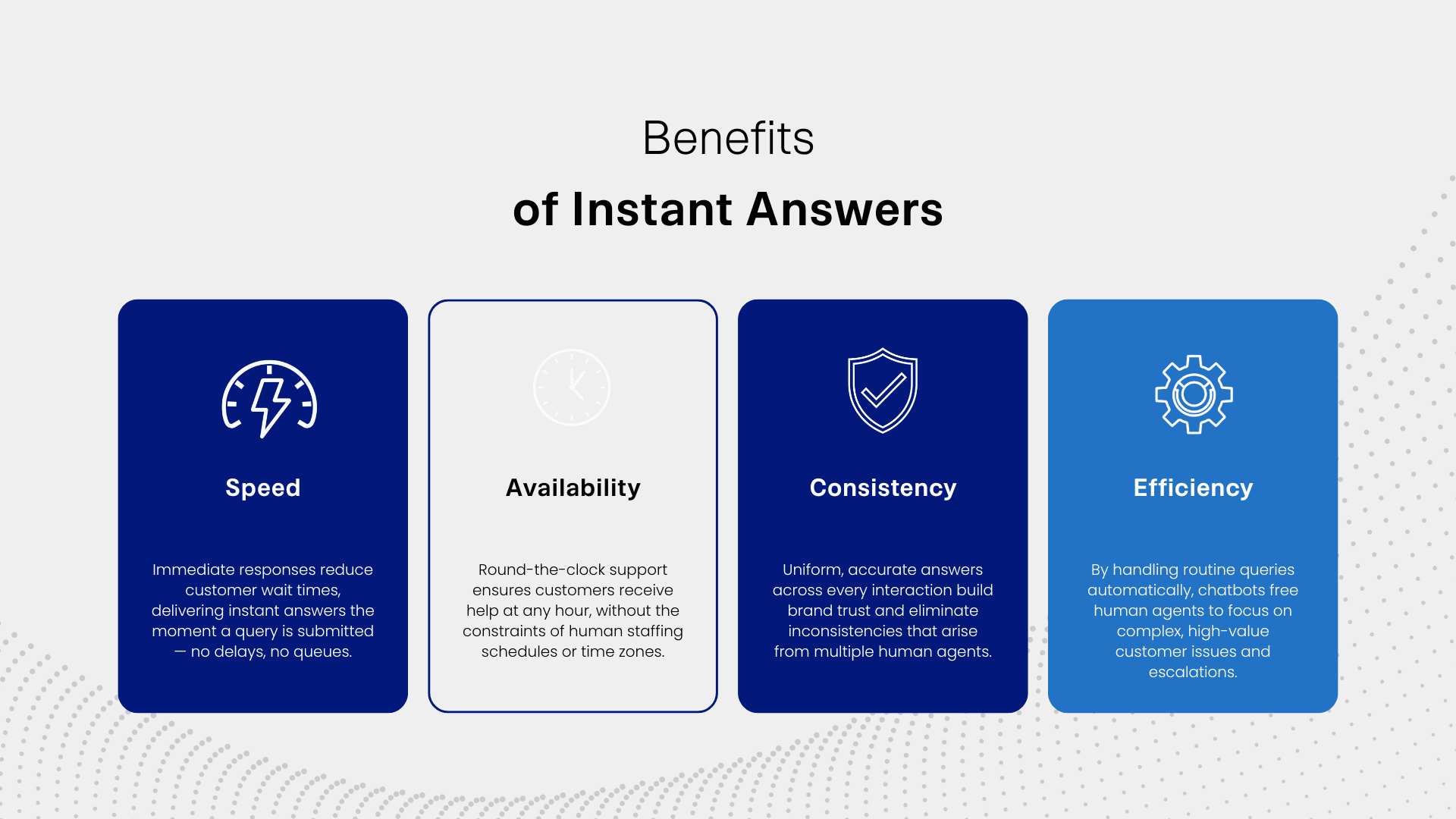
Customers expect quick answers because digital services have made immediate information normal. Search engines, online stores, messaging platforms, and self-service tools allow people to find information without waiting for traditional office hours. When a business cannot answer a simple question quickly, the customer may postpone the decision, abandon the conversation, or look elsewhere.
Why has customer response time become so important?
Customer response time matters because a question is often connected to a decision. A person asking whether a product is available may be preparing to buy. A prospect asking about pricing may be comparing providers. A student asking about course availability may be ready to enroll.
The question itself is only one part of the interaction. What happens immediately afterward can be just as important.
A slow response creates friction between interest and action.
Consider a visitor who arrives on a software company's website at 11:30 p.m. The visitor wants to know whether a particular feature is included in a plan. If the only option is to submit a form and wait until the next working day, the visitor has time to reconsider the purchase or investigate another provider.
An instant response does not guarantee a sale. It simply keeps the conversation moving while the customer's interest is active.
How have digital experiences changed customer expectations?
Digital experiences have conditioned customers to expect information whenever they need it. A customer can search for product specifications, compare prices, check an order status, watch a tutorial, or find an answer to a common question within moments.
That expectation extends to business websites.
Customers do not necessarily expect every company to have a large support department. They do, however, increasingly expect businesses to make basic information easy to access.
This is particularly relevant for online businesses that receive visitors from different time zones. A website may be available 24 hours a day, but traditional support may only operate for eight or ten hours.
That creates a gap between website availability and human availability.
A website chatbot can help close that gap by providing an immediate first layer of assistance.
Why do customers leave when simple questions take too long?
A simple question can become a major point of friction when the customer has no easy way to get an answer.
For example, a visitor may ask:
Is this service available in my location?
What does the basic plan include?
How long does delivery take?
Is there a refund policy?
Can an appointment be booked online?
Does the course include certification?
Is technical support available after purchase?
If the answer is buried inside a long FAQ page, unavailable after business hours, or accessible only after submitting a form, the customer may stop searching.
The problem is not always poor customer service. Sometimes the business simply has no scalable way to answer repetitive questions quickly.
What happens when customer support is too slow?
Slow support can create uncertainty, frustration, and lost momentum. A customer who has already decided to ask a question has shown some level of interest. If the business cannot respond within a useful timeframe, that interest may weaken. Delayed support can also increase the number of follow-up messages because customers repeat questions while waiting.
How can slow responses affect customer experience?
Customer experience is shaped by the entire interaction, not just the final answer.
A helpful answer that arrives after the customer has already solved the problem elsewhere may have little practical value.
This is why response speed should be considered alongside answer quality.
Fast but inaccurate information creates a poor experience. Slow but accurate information can also create frustration. Effective customer support needs both useful information and an appropriate response time.
An AI customer support chatbot can help with the first layer by answering common questions immediately, while human agents remain available when the conversation becomes more complex.
How can delayed answers affect leads and sales?
Lead generation often depends on timing.
Imagine a B2B visitor who is evaluating several software providers. The visitor has a question about integration and wants an answer before booking a demo. If the business responds two days later, the visitor may already have selected another option.
An e-commerce visitor faces a similar situation. The customer may want to know whether a product is suitable before purchasing. A quick answer can remove uncertainty while the product is still being considered.
This does not mean every delayed response results in a lost sale. Customer decisions are influenced by many factors, including price, product quality, trust, urgency, and competition.
The practical lesson is simpler: when a customer is actively looking for information, unnecessary waiting adds friction.
How quickly should businesses respond to customers?
Businesses should aim to provide an immediate response for simple, frequently asked questions whenever practical, while setting realistic expectations for issues that require human investigation. An AI chatbot can provide an instant first response, collect relevant information, answer routine questions, and direct complex cases to the appropriate support person.
Does every customer question require a human response?
No.
Many support questions are predictable and informational. They may involve business hours, product features, pricing structure, service availability, policies, delivery information, or basic troubleshooting.
A human employee does not necessarily need to type the same answer dozens of times each day.
Automation becomes useful when it removes repetitive work without removing the human support customers need when situations become complicated.
A useful support model can therefore look like this:
The customer asks a question.
The AI chatbot identifies whether the question is within its knowledge.
The chatbot provides a relevant answer when it can.
The chatbot asks clarifying questions when needed.
A human takes over when the issue requires judgment or specialized assistance.
This approach treats AI as a support layer rather than a complete replacement for customer service.
Why does after-hours availability matter?
Customers do not always research products and services during business hours.
An e-commerce customer may shop at night. A SaaS prospect may research software during a weekend. A student may explore courses after work. A traveler may need information from a hotel website outside normal office hours.
A business does not need employees working around the clock to offer a useful first response.
A 24/7 AI chatbot can answer supported questions whenever a visitor arrives, helping the business remain accessible even when the human team is offline.
How Does an AI Chatbot for Customer Support Provide Instant Help?
An AI chatbot for customer support uses business information and conversational AI to respond to customer questions through a digital interface, often directly on a website. Instead of waiting for a human agent to respond to every routine inquiry, customers can receive immediate answers, guidance, and next steps based on the information available to the chatbot.
What is an AI chatbot for customer support?
An AI chatbot for customer support is a software system designed to communicate with customers using natural-language conversations.
Unlike a basic website search box, an AI customer support chatbot can interpret questions written in conversational language.
For example, a visitor might type:
"Do you provide this service for small businesses?"
Instead of requiring the visitor to search for the exact wording used on the website, the chatbot can understand the intent and respond using relevant business information.
A well-configured chatbot can help with:
Frequently asked questions
Product and service information
Business hours
Pricing-related questions
Policies
Availability questions
Basic troubleshooting
Appointment or inquiry guidance
Lead qualification
Next-step recommendations
The quality of the response depends heavily on the information and instructions provided to the chatbot.
How does an AI chatbot understand business information?
A business-focused chatbot needs reliable information about the company it represents.
That information may include website content, product descriptions, service details, frequently asked questions, policies, contact information, and other approved business knowledge.
The purpose is to give the chatbot enough context to answer customer questions consistently.
For example, an education company might provide information about:
Courses
Eligibility
Course duration
Fees
Learning format
Enrollment process
Support options
A visitor can then ask a natural question instead of navigating through multiple pages.
The chatbot should not be treated as a source of information that exists independently of the business. It works best when the underlying business information is accurate, complete, and regularly reviewed.
How can an AI chatbot answer questions automatically?
When a customer enters a question, the chatbot interprets the request and looks for relevant information within its available business knowledge.
It can then formulate a conversational response.
For example:
Customer: "Does the company offer weekend support?"
Chatbot: "Support availability depends on the service. The standard support team operates during business hours. For common questions, assistance is available through the website chatbot at any time."
The exact answer should depend on the business's actual policies.
This distinction is important because customer support automation should never encourage a chatbot to invent information simply to sound confident.
A useful AI chatbot should prioritize accurate, business-approved answers and acknowledge when human assistance is required.
Can AI chatbots provide customer support 24/7?
Yes. An AI chatbot can remain available on a business website outside normal working hours and respond to supported questions at any time. This makes it possible for customers to receive first-line assistance at night, during weekends, or on holidays without requiring a human support representative to be online continuously.
What types of questions can an AI chatbot handle?
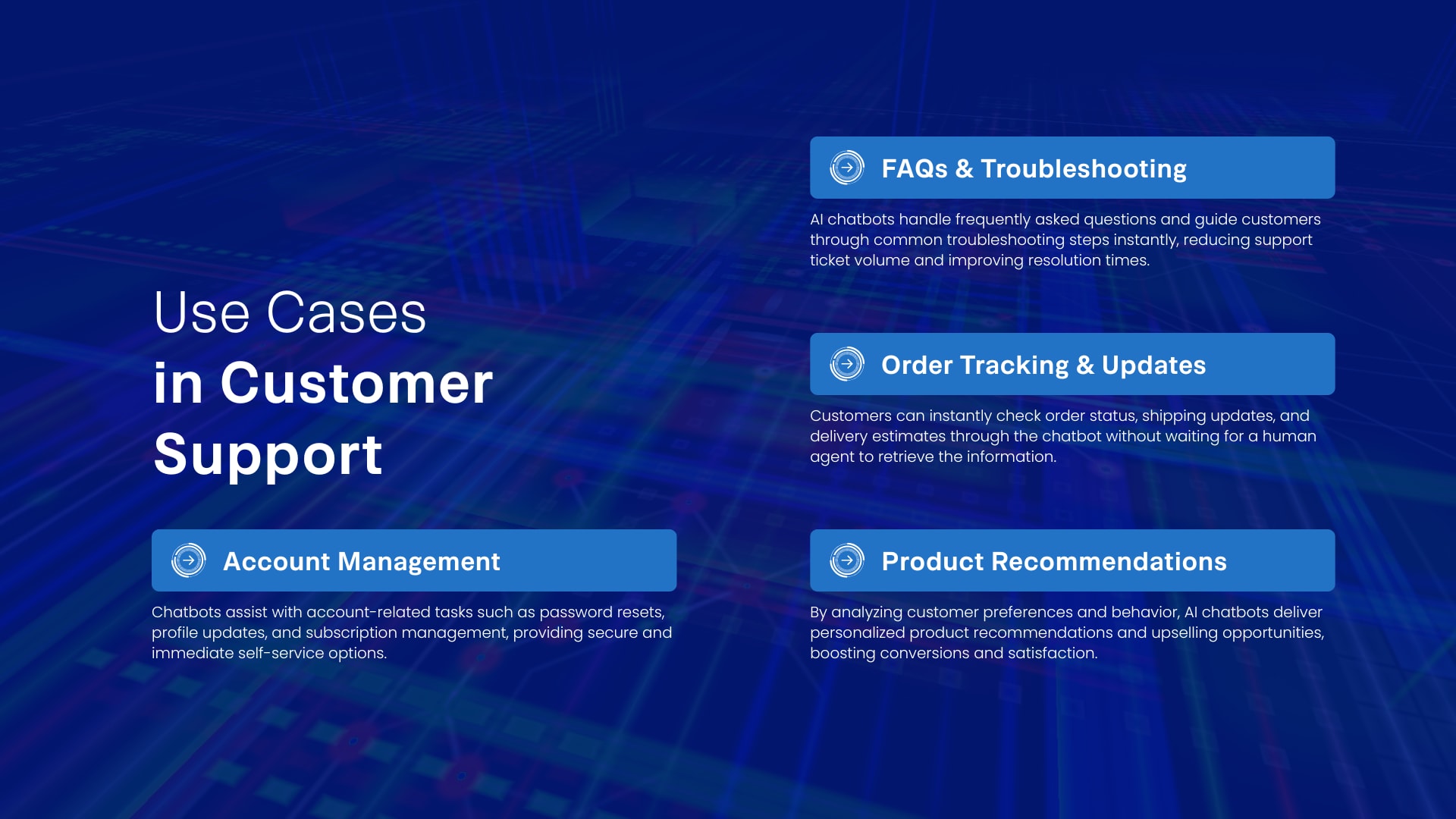
The best questions for automation are usually repetitive, predictable, and based on information the business can clearly define.
Examples include:
"What are your business hours?"
"Where is the company located?"
"What services do you offer?"
"How does the pricing work?"
"Do you offer this service for businesses?"
"How long does delivery take?"
"What payment methods are available?"
"How can an appointment be requested?"
"What does this product include?"
"How can a customer contact support?"
An AI chatbot can also ask qualifying questions before passing a lead to a sales team.
For example, a service business could ask about the customer's location, service requirement, preferred timeline, and approximate project type.
This creates a more organized conversation for the human team.
When should an AI chatbot hand a conversation to a human?
Human escalation is important when the customer has a complex, sensitive, unusual, or high-value issue.
Examples include:
Complaints requiring judgment
Billing disputes
Account-specific problems
Sensitive personal matters
Complex technical issues
Requests outside the chatbot's knowledge
Situations where the customer specifically asks for a person
A chatbot should not create a dead end.
A better experience is one where the AI provides useful first-line assistance and then helps the customer reach the right human when necessary.
How does an AI chatbot improve customer experience?
An AI chatbot can improve customer experience by reducing unnecessary waiting, making common information easier to access, and providing consistent first-line assistance. Customers can ask questions in natural language rather than searching through multiple pages, while support teams can spend more time on conversations that require human judgment and personal attention.
How can instant answers reduce friction?
Customer friction often comes from unnecessary steps.
Imagine a customer who needs one piece of information before making a decision. If obtaining that information requires opening a contact form, entering personal details, waiting for an email, and following up, the process feels heavier than the question deserves.
An AI chatbot can reduce those steps.
The customer can simply ask.
That small change can make a website feel more responsive.
The goal is not to automate every interaction. The goal is to remove unnecessary barriers between the customer's question and a useful answer.
How can conversational AI support different customer journeys?
Customers arrive at websites with different levels of intent.
Some are just researching. Others are comparing providers. Some already understand the product and are ready to buy. Existing customers may need support after a purchase.
An AI virtual assistant can support these different stages by adapting its responses to the customer's question.
For a new visitor, it might explain a service.
For a qualified prospect, it might help identify the right solution.
For an existing customer, it might answer a routine support question.
This makes the chatbot more than a pop-up box. It becomes part of the website's customer journey.
Can an AI chatbot help with sales and lead generation?
Yes. An AI chatbot can support sales by answering product questions, identifying visitor needs, collecting basic lead information, and guiding interested prospects toward a suitable next step. It does not guarantee conversions, but it can keep conversations moving when potential customers need information before contacting a sales representative.
How can chatbots qualify website visitors?
Lead qualification does not always require a long form.
A chatbot can ask conversational questions such as:
"Which service is the business interested in?"
"What type of company is making the inquiry?"
"When is the service needed?"
"What is the main challenge?"
The answers can help a sales team understand the context before beginning a human conversation.
For example, a B2B company could use an AI chatbot to identify whether a visitor is interested in enterprise software, a small-business plan, or a specific product feature.
This can make the next sales conversation more focused.
How can an AI chatbot guide customers toward the next step?
The next step depends on the business.
It could be:
Requesting a quote
Booking a consultation
Starting a free trial
Viewing a product
Contacting sales
Submitting an inquiry
Reading a relevant resource
A chatbot should not push every visitor toward the same action.
A customer who is still researching may need information first. A visitor who already knows what they want may be ready to contact sales.
Good conversational design respects that difference.
How can AI chatbots automate repetitive customer questions?
AI chatbots automate repetitive questions by providing consistent answers to common inquiries without requiring an employee to manually respond each time. This can reduce the volume of routine conversations reaching support staff and allow employees to focus on complex cases, relationship-building, problem-solving, and other higher-value responsibilities.
Which routine questions are suitable for automation?
Suitable questions are usually those that have clear answers and do not require personal judgment.
For example, a company may receive dozens of questions every week about its operating hours, pricing structure, services, delivery policies, or basic features.
If the same question is answered manually every time, employees spend valuable attention repeating information.
Automation can handle that first layer.
The support team can then concentrate on questions that require investigation or deeper expertise.
How does automation help customer support teams?
Automation can help reduce repetitive workload and create more space for meaningful customer conversations.
Salesforce's 2025 State of Service research reported that service representatives using AI spend less time on routine cases, while the broader research points toward increased use of AI for customer service tasks. The report also emphasizes that AI is intended to work alongside human representatives, allowing people to focus more on complex issues.
The practical benefit is not simply "fewer support employees."
A better goal is better allocation of employee time.
A skilled support representative is more valuable when solving a complicated customer problem than when repeatedly answering a question that an AI chatbot can handle accurately.
How Can Businesses Implement AI-Powered Customer Support and Choose the Right Chatbot?
Businesses can implement AI-powered customer support by first identifying repetitive customer questions, organizing reliable business information, selecting a chatbot that fits the website and support process, testing its answers, and establishing a clear path to human assistance. A successful implementation focuses on useful customer conversations rather than automation for its own sake.
How does an AI chatbot work on a business website?
A website chatbot is typically displayed as a conversational interface that visitors can open when they need assistance. The customer types a question, the AI interprets it, and the chatbot responds using the business information available to it. Depending on the platform, the chatbot can also guide visitors toward specific actions.
The customer experience can be simple.
A visitor opens the chat window and asks:
"Which service is suitable for a small e-commerce business?"
The chatbot can provide relevant information and, where appropriate, ask a follow-up question.
That is different from forcing the visitor to navigate through multiple pages before finding the answer.
What information should a business provide to its chatbot?
The chatbot should have access to accurate information that customers are allowed to receive.
Useful information may include:
Company overview
Products and services
Pricing information
FAQs
Policies
Service areas
Business hours
Contact details
Product specifications
Delivery information
Booking instructions
Support procedures
Businesses should also identify information that the chatbot should not disclose.
For example, confidential internal processes or customer-specific account information may require a secure system and human verification.
The quality of an AI chatbot is closely connected to the quality of its business knowledge.
If the source information is incomplete or outdated, the chatbot can provide incomplete or outdated answers.
How does website chatbot integration work?
Modern no-code chatbot platforms can simplify website integration by providing a ready-to-use chat interface that can be added to a website without building a chatbot system from scratch.
The exact process depends on the platform and website technology.
A typical implementation may involve:
Creating the chatbot.
Adding approved business information.
Reviewing its responses.
Customizing the website chat experience.
Adding the chatbot to the website.
Testing real customer questions.
Monitoring conversations after launch.
The important part is not simply placing a chat icon on the website.
The chatbot needs to be useful when customers actually use it.
How can businesses implement an AI chatbot without coding?
Businesses can use no-code AI chatbot platforms that handle the technical infrastructure and provide a simpler setup process. Instead of developing an AI system internally, the business can configure the chatbot using its own information, test responses, and add the chatbot to its website through the platform's integration process.
What should businesses prepare before launching a chatbot?
Preparation can make implementation much easier.
Before launching an AI chatbot, businesses should collect their most common customer questions.
A support manager can review emails, contact forms, live chats, sales questions, and social media messages to identify recurring themes.
For example, an online education company may discover that many visitors ask:
How long is the course?
Is the course online?
Is certification included?
What is the enrollment process?
Is there a payment plan?
Those questions provide a practical starting knowledge base.
The business should also decide which questions should always go to a human.
Clear boundaries reduce the risk of poor customer experiences.
How should businesses test chatbot answers?
Testing should happen before the chatbot becomes a major customer-facing channel.
Businesses can create a list of real questions and test how the chatbot responds.
Testing should include:
Simple questions
Misspelled questions
Short questions
Long questions
Follow-up questions
Questions with unclear wording
Questions outside the chatbot's knowledge
Questions that require human support
For example, if the business says its service is available in five cities, the chatbot should not incorrectly state that it is available everywhere.
Testing should also check whether the chatbot admits uncertainty appropriately.
A confident wrong answer can damage trust more than a clear request to speak with a human.
What should businesses look for when choosing an AI chatbot?
Businesses should look for an AI chatbot that can use accurate business information, provide natural conversations, support website integration, offer a practical no-code setup, handle routine customer questions, and provide a clear path to human assistance. Security, data handling, customization, analytics, maintenance, and scalability should also be considered before adoption.
Why does business-specific information matter?
A generic chatbot may know a great deal about the world but still know very little about a particular company.
Customers do not usually ask general questions.
They ask questions such as:
"Does this company offer weekend delivery?"
"Which package includes this service?"
"How does this company's cancellation policy work?"
"Can this service be provided in my city?"
Those answers come from business-specific information.
That is why a business-data-trained chatbot can be more useful than a general-purpose conversational tool for website support.
The chatbot needs context about the company it represents.
Why are no-code setup and website integration important?
Businesses often avoid new technology because implementation appears complicated.
A no-code setup can lower that barrier.
A small business may not have a dedicated software development team. A marketing team may manage the website without engineering support. A founder may want to test an AI chatbot without committing to a long development project.
In these situations, a straightforward platform can make experimentation easier.
Website integration also matters because the chatbot needs to appear where customers are already asking questions.
A separate support system may be useful, but a visitor should not have to leave the website simply to get an answer to a basic question.
What role do accuracy, escalation, and maintenance play?
Accuracy is one of the most important considerations when choosing an AI customer support chatbot.
The chatbot should provide information that reflects the current business.
If pricing changes, the chatbot's knowledge should be updated.
If a service area changes, the chatbot should not continue providing the old information.
If a policy changes, the new policy should replace the old one.
Businesses should also evaluate escalation.
A good support system does not attempt to answer everything. It recognizes when a customer needs a person.
Maintenance is therefore part of chatbot management.
AI customer support is not a "set it and forget it" process.
How can businesses avoid common AI chatbot mistakes?
Businesses can avoid common chatbot mistakes by starting with a focused knowledge base, testing real customer questions, setting clear limits, keeping information updated, and ensuring that customers can reach human support when necessary. The goal should be dependable assistance rather than maximizing the number of conversations handled by AI.
Why should businesses avoid uploading incomplete information?
Incomplete information creates gaps.
Suppose a business provides information about its products but not its return policy. A customer may ask about returns and receive an incomplete answer.
That can lead to frustration.
The solution is not necessarily to provide every internal document. Instead, the business should identify the information customers genuinely need and organize it clearly.
The chatbot should have enough approved context to answer common questions accurately.
A smaller, well-maintained knowledge base can be more useful than a large collection of outdated or irrelevant information.
Why should human support remain available for complex issues?
Human support remains important because not every customer problem can be reduced to a standard answer.
A customer may be upset about an order.
A technical issue may require account investigation.
A B2B buyer may need a customized proposal.
A customer may have a situation that the chatbot has never encountered.
These interactions require judgment.
The strongest customer support model combines automation with human expertise.
AI can handle the repetitive first layer. Human representatives can handle the situations where empathy, context, negotiation, or specialized knowledge matters most.
How can YourSiteChat help businesses provide faster customer responses?
YourSiteChat is an AI-powered chatbot platform designed to help businesses provide 24/7 customer responses using business-specific information. It supports AI-powered customer conversations, automated routine inquiries, customer engagement, and sales assistance, while offering a no-code setup and website integration designed to make deployment practical for businesses.
Businesses can explore YourSiteChat when looking for a website-based AI customer support solution.
How does YourSiteChat support 24/7 customer conversations?
YourSiteChat is designed to provide customers with access to AI-powered conversations around the clock.
That can be particularly useful for businesses whose websites receive visitors outside standard office hours.
Instead of showing a visitor only a contact form, a website can provide an immediate conversational starting point.
A customer may ask about a service, product, feature, or routine policy and receive an answer based on the business information available to the chatbot.
This does not remove the need for a human support team.
It creates an additional layer of accessibility.
How can businesses use YourSiteChat for sales and support?
Customer support and sales often overlap.
A visitor may begin with a support-style question but actually be evaluating whether to purchase.
For example:
"Does this plan include the feature needed by a small business?"
The answer can help the visitor decide what to do next.
An AI chatbot can therefore support both customer service and sales conversations by answering questions, understanding visitor intent, and directing customers toward an appropriate next step.
YourSiteChat is positioned for these types of business conversations, including routine inquiry automation, customer engagement, and sales support.
The value comes from reducing unnecessary waiting while keeping the conversation focused on the customer's needs.
What is the best way to measure AI chatbot performance?
Businesses can measure chatbot performance by monitoring the questions customers ask, how often the chatbot provides useful answers, how often conversations require human escalation, whether customers complete desired next steps, and where conversations break down. Performance should be evaluated using customer experience and business outcomes rather than conversation volume alone.
Which customer support metrics should businesses monitor?
Useful metrics may include:
Number of chatbot conversations
Common customer questions
Response completion rate
Human escalation rate
Unanswered questions
Lead qualification activity
Customer feedback
Conversion-related actions
Support workload changes
Time spent on routine inquiries
The right metrics depend on the business.
An e-commerce company may focus on product questions and purchase-related actions.
A SaaS company may track demo inquiries, feature questions, and trial-related conversations.
A service business may monitor quote requests and appointment inquiries.
The purpose of measurement is to identify whether the chatbot is helping customers move forward.
How can chatbot conversations be improved over time?
Improvement should come from actual conversations.
If customers repeatedly ask a question that the chatbot cannot answer, that is useful information.
If the chatbot gives unclear answers to a common question, the business can improve the underlying information.
If visitors repeatedly request a human, the business can examine why.
The process can be continuous:
Customer question → chatbot response → review → improvement → better response
This approach turns customer conversations into a source of practical insight.
A chatbot should evolve as the business evolves.
Traditional Customer Support vs. AI-Powered Customer Support
FactorTraditional SupportAI-Powered SupportResponse timeOften depends on staff availabilityCan provide immediate first responsesAvailabilityUsually tied to business hoursCan operate 24/7Repetitive questionsOften handled manuallyCan be automatedScalabilityOften requires additional staffCan handle many routine conversationsCustomer experienceDepends heavily on response speedProvides immediate first-line assistanceComplex issuesHuman agents can investigateCan escalate to human support
The comparison shows why AI-powered support is becoming a useful addition to traditional customer service rather than simply an alternative to it.
A human representative remains better suited to many situations.
An AI chatbot is often better suited to immediate, repetitive, information-based questions.
The strongest model combines both.
Conclusion: Why faster customer support is becoming essential
Customers increasingly expect businesses to provide information quickly because immediate digital experiences have become normal. A customer asking a question may already be considering a purchase, comparing services, solving a problem, or deciding whether to continue with a business.
Waiting can interrupt that decision-making process.
An AI chatbot for customer support gives businesses a practical way to provide instant first-line assistance without requiring an employee to answer every routine question manually. It can operate around the clock, respond to common inquiries, support customer engagement, and help sales teams maintain conversations with interested visitors.
The technology works best when it is built around accurate business information and clear boundaries.
AI should not be expected to replace human support for every situation. Complex complaints, sensitive matters, unusual problems, and high-value conversations may still require experienced people.
The goal is better division of work.
AI handles suitable routine interactions. Humans focus on conversations where human judgment, empathy, and expertise matter most.
Businesses considering this approach can explore YourSiteChat to learn how an AI-powered, no-code website chatbot can help provide faster customer responses, automate routine inquiries, support sales conversations, and remain available 24/7.
For businesses that want to reduce response times without losing the human element of customer service, that combination can provide a practical path toward faster and more accessible customer support.
Frequently Asked Questions About AI Chatbots and Instant Customer Support
What is an AI chatbot for customer support?
An AI chatbot for customer support is software that communicates with customers through natural-language conversations and provides answers based on approved business information. It can handle common questions, provide basic guidance, operate outside normal business hours, and direct customers to human representatives when an issue requires more specialized assistance.
Why do customers expect instant answers?
Customers increasingly expect instant answers because many digital services provide information immediately. Search engines, online stores, messaging platforms, and self-service tools have made fast access to information normal. When a business takes too long to answer a simple question, the customer may become frustrated, delay a decision, or look for information from another provider.
How can an AI chatbot reduce customer response time?
An AI chatbot can reduce response time by answering suitable customer questions automatically instead of requiring every inquiry to wait for a human representative. It can provide an immediate first response, explain common products or services, answer routine questions, and collect relevant information before a human agent becomes involved.
Can AI chatbots provide customer support 24/7?
Yes. AI chatbots can remain available on business websites outside normal working hours. They can answer supported questions during evenings, weekends, and holidays without requiring a human representative to be online continuously. Complex issues can be collected or routed for human follow-up when the appropriate support team becomes available.
Can small businesses use AI customer support chatbots?
Yes. Small businesses can use AI customer support chatbots to answer repetitive questions, provide after-hours assistance, explain products or services, and guide website visitors. No-code platforms can make adoption easier for businesses without dedicated development teams. The most useful starting point is usually a focused chatbot built around the company's most common customer questions.
Can an AI chatbot answer questions about a company's products or services?
Yes. An AI chatbot can answer product or service questions when it has reliable business information to work from. The business should provide accurate descriptions, policies, features, pricing information where appropriate, and other customer-facing details. Regular updates are important so that the chatbot does not continue providing outdated information after business changes.
Can AI chatbots help generate leads?
Yes. AI chatbots can support lead generation by answering prospect questions, identifying customer needs, collecting basic qualification information, and guiding interested visitors toward actions such as requesting a quote, booking a consultation, starting a trial, or contacting sales. Chatbots do not guarantee conversions, but they can help maintain conversations when potential customers are actively researching.
Does an AI chatbot replace human customer support?
No. An AI chatbot can automate suitable routine interactions, but human support remains important for complex, sensitive, unusual, or high-value situations. A strong customer support system uses AI for tasks that can be handled consistently and gives human representatives responsibility for issues that require judgment, empathy, investigation, or specialized expertise.
How quickly can a business add an AI chatbot to its website?
The implementation time depends on the platform, website, business information, testing requirements, and desired configuration. No-code chatbot platforms can simplify the process by reducing development work. YourSiteChat states that its chatbot can be integrated into a website in under five minutes, while businesses should still allow appropriate time for preparing information and testing responses.
What should a business consider when choosing an AI chatbot?
Businesses should consider the chatbot's ability to use company-specific information, answer questions accurately, integrate with the website, support no-code setup, handle routine inquiries, provide human escalation, and remain maintainable as information changes. Data handling, customization, analytics, scalability, ease of use, and the quality of the customer experience should also be evaluated before choosing a platform.