How does AI qualify leads automatically?
AI can qualify leads automatically by analyzing visitor behavior, asking relevant questions, scoring prospects based on predefined criteria, and identifying sales-ready customers in real time. Instead of relying on manual screening, businesses can use AI to engage every visitor instantly, collect valuable information, and route qualified leads to the sales team, resulting in faster response times and higher conversion rates.
What is AI lead qualification?
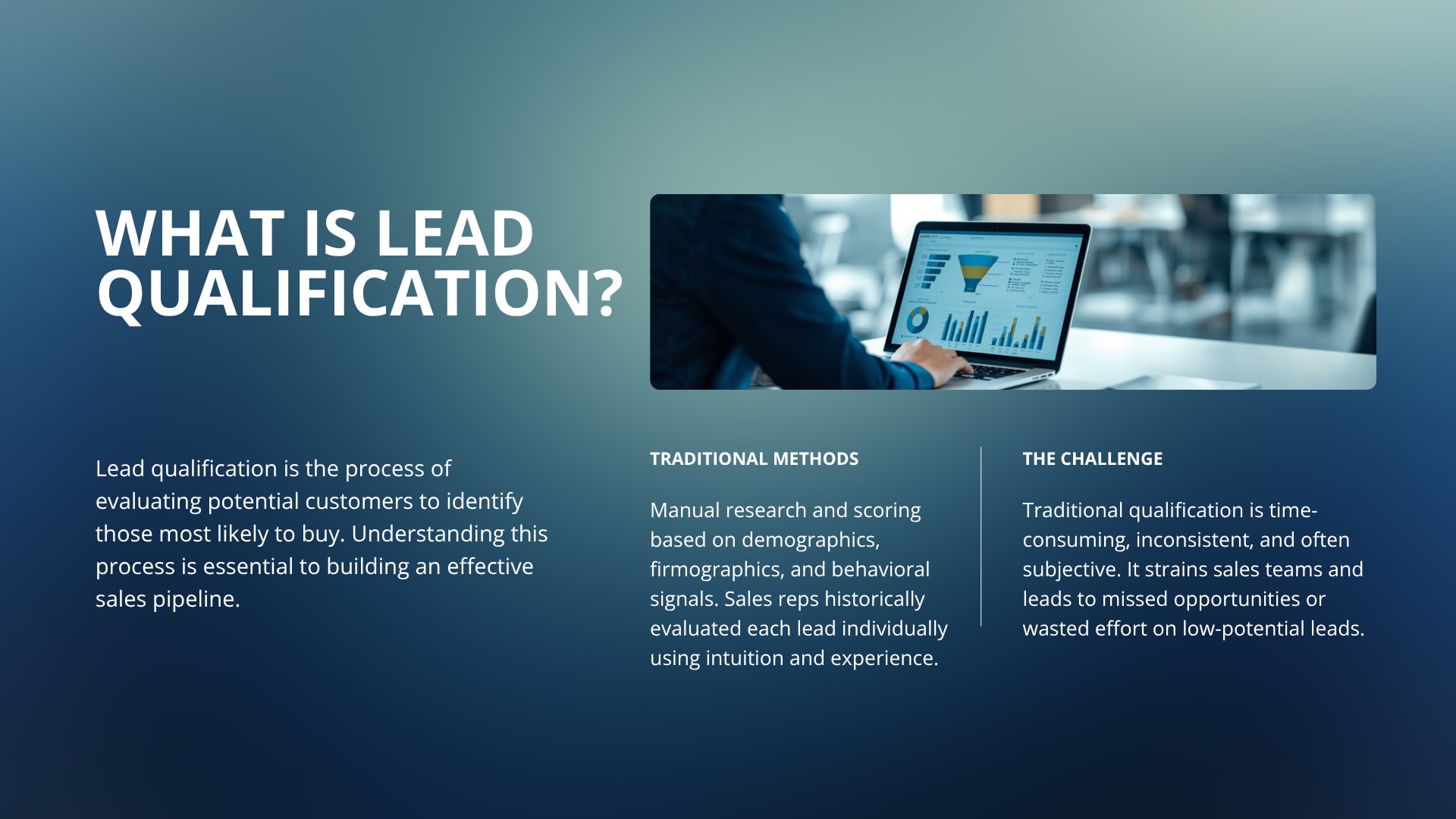
Lead qualification is the process of determining whether a potential customer is likely to become a paying customer.
Traditionally, this process involved sales representatives manually reviewing contact forms, making phone calls, sending emails, and evaluating each prospect one by one. While effective on a small scale, this approach becomes time-consuming and inconsistent as businesses grow.
Artificial intelligence changes this process by automating many of these tasks.
An AI-powered system can:
Start conversations instantly
Ask personalized qualifying questions
Understand customer intent
Score leads automatically
Capture contact details
Recommend the next step
Send qualified prospects directly to sales representatives
Instead of waiting hours or even days for a follow-up, website visitors receive immediate assistance, improving both customer satisfaction and business efficiency.
Why has automated lead qualification become essential?
Customer expectations have changed significantly.
Most website visitors expect answers within minutes. If they cannot find the information they need quickly, many leave and continue their search elsewhere.
Research consistently shows that responding to leads quickly increases the likelihood of conversion.
Businesses also face several common challenges:
Large numbers of unqualified inquiries
Limited sales resources
Slow response times
Missed business opportunities
Inconsistent lead evaluation
AI solves these problems by qualifying every visitor the moment they engage with a website.
Instead of asking sales teams to spend hours filtering inquiries, AI handles the initial conversation while sales professionals focus on closing deals.
How does traditional lead qualification work?
Before understanding AI automation, it helps to see how the conventional process operates.
A typical manual workflow looks like this:
A visitor fills out a contact form.
The marketing team receives the submission.
Someone reviews the inquiry.
A salesperson contacts the lead.
Qualification questions are asked.
The salesperson decides whether the lead is worth pursuing.
The lead is either accepted or rejected.
This process often introduces delays.
If the inquiry arrives outside business hours, it may not receive attention until the next working day. During that time, the prospect may already have contacted a competitor.
Manual qualification also depends heavily on individual judgment, leading to inconsistent decisions.
How does AI improve this process?
AI dramatically shortens the qualification timeline.
Instead of waiting for human intervention, AI immediately begins interacting with visitors.
For example, when someone lands on a pricing page, an AI chatbot can initiate a conversation.
Rather than displaying a generic greeting, it may ask questions such as:
What type of business do you run?
How many employees do you have?
Which service are you interested in?
When are you planning to purchase?
What challenges are you trying to solve?
Each response provides valuable qualification data.
The AI evaluates this information in real time and determines whether the visitor matches the company's ideal customer profile.
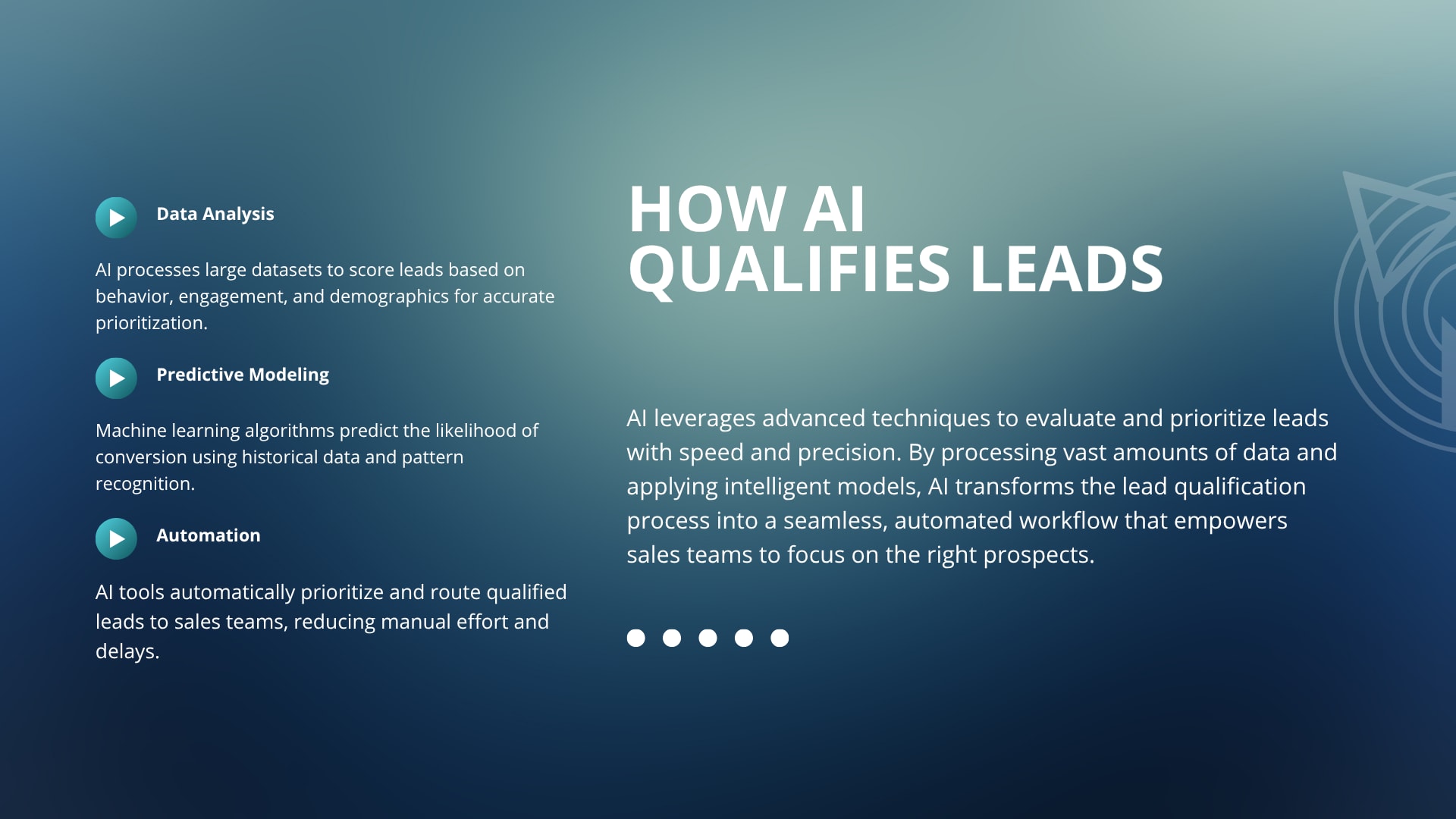
If the lead is highly qualified, the system can:
Schedule a meeting
Notify a sales representative
Recommend a product
Share pricing information
Collect additional details
Transfer the conversation to a live agent
All of this happens within minutes.
What information does AI use to qualify leads?
Modern AI systems analyze much more than simple contact forms.
They consider multiple behavioral and demographic signals simultaneously.
Some common qualification factors include:
Website behavior
AI monitors:
Pages visited
Time spent on each page
Number of return visits
Downloads
Pricing page activity
Product comparisons
A visitor spending fifteen minutes exploring pricing and product documentation usually demonstrates stronger buying intent than someone who leaves after viewing the homepage.
Conversation responses
AI asks qualifying questions naturally throughout the conversation.
Examples include:
Company size
Industry
Business goals
Budget
Decision-making authority
Timeline
Existing software
Primary challenges
These responses help create an accurate customer profile.
Engagement patterns
AI also evaluates engagement signals such as:
Chat duration
Number of questions asked
Product interest
Demo requests
Appointment requests
Repeat conversations
Together, these indicators paint a clearer picture of purchase intent.
Historical customer data
Many AI lead qualification platforms learn from previous successful sales.
By analyzing historical CRM data, AI can recognize patterns shared by customers who eventually converted.
This enables increasingly accurate lead scoring over time.
What is AI lead scoring?
Lead scoring assigns numerical values to prospects based on their likelihood of becoming customers.
Instead of relying on assumptions, AI continuously updates scores using real-time behavior.
A scoring model might consider:
Company size
Industry relevance
Budget availability
Product interest
Website engagement
Buying timeline
Previous interactions
For example:
A visitor requesting a demo after reviewing pricing may receive a high score.
Someone casually browsing blog posts might receive a lower score until they show stronger intent.
Because AI updates scores dynamically, businesses gain a clearer understanding of which leads deserve immediate attention.
Can AI identify purchase intent?
Yes.
One of AI's greatest strengths is recognizing buying signals that humans might overlook.
Examples include:
Multiple visits within a short period
Repeated visits to pricing pages
Requests for implementation details
Interest in integrations
Questions about contracts
Demo scheduling
Requests for case studies
Rather than treating every visitor equally, AI prioritizes those showing genuine interest.
Sales representatives can then focus their time where it is most likely to generate revenue.
How does conversational AI make qualification feel natural?
Traditional forms often ask many questions at once, creating friction.
Visitors may abandon lengthy forms before completing them.
Conversational AI changes the experience.
Instead of presenting a long questionnaire, it asks one question at a time, much like a helpful sales representative.
For example:
Visitor: "I'm looking for customer support software."
AI: "How many support agents does your team currently have?"
Visitor: "Around 25."
AI: "Are you looking for live chat, AI automation, or both?"
Visitor: "Both."
AI: "Would you like to schedule a personalized demo?"
The interaction feels helpful rather than intrusive.
Because the conversation flows naturally, visitors are more likely to share accurate information.
How quickly can AI qualify a lead?
In many cases, qualification happens within the first few minutes of a conversation.
Rather than waiting hours for a sales response, AI evaluates visitors almost immediately.
The exact timing depends on factors such as:
Number of qualifying questions
Visitor engagement
Business requirements
Product complexity
CRM integrations
For many organizations, AI reduces qualification time from several hours—or even days—to just a few minutes.
How does AI reduce workload for sales teams?
Sales teams often spend a significant portion of their day on activities that do not directly generate revenue.
These tasks include:
Reviewing inquiries
Filtering spam
Identifying decision-makers
Scheduling meetings
Collecting basic information
Sending follow-up emails
AI automates these repetitive processes.
Instead of spending valuable time on administrative work, sales professionals receive pre-qualified leads complete with conversation history, customer needs, and recommended next steps.
This allows them to focus on building relationships and closing deals.
Can small businesses benefit from AI lead qualification?
Absolutely.
AI is no longer limited to large enterprises with extensive budgets.
Cloud-based AI tools have made automated lead qualification accessible to businesses of all sizes.
For a small business, AI can:
Respond to inquiries around the clock
Capture leads outside office hours
Reduce manual follow-up
Improve customer experience
Increase sales opportunities without expanding the sales team
This helps smaller organizations compete more effectively while making better use of limited resources.
How can an AI chatbot qualify leads on a website?
An AI chatbot for lead generation acts as the first point of contact for website visitors.
Instead of simply answering questions, it can actively identify high-intent prospects.
A platform like YourSiteChat enables businesses to:
Welcome visitors instantly
Ask intelligent qualification questions
Capture names, email addresses, and phone numbers
Understand customer intent through natural conversations
Score leads automatically
Route qualified prospects to the appropriate sales representative
Book meetings directly into the sales calendar
Engage visitors 24/7, even outside business hours
This creates a seamless experience for customers while reducing manual work for sales teams. Businesses can learn more about its AI-powered lead qualification capabilities at https://www.yoursitechat.com/.
Common misconceptions about AI lead qualification
Many businesses hesitate to adopt AI because of common myths.
Myth 1: AI replaces salespeople.
In reality, AI supports sales teams by handling repetitive qualification tasks, allowing representatives to focus on meaningful conversations and closing deals.
Myth 2: AI only works for large companies.
Modern AI solutions are designed for businesses of all sizes, from startups to enterprises.
Myth 3: AI conversations feel robotic.
Today's conversational AI can understand context, ask follow-up questions, and provide natural, engaging interactions.
Myth 4: AI only captures contact details.
Advanced AI systems analyze behavior, intent, demographics, and engagement to determine lead quality—not just collect names and email addresses.
By automating the early stages of customer engagement, businesses can respond faster, qualify leads more accurately, and create a smoother buying experience. AI does not simply speed up the process—it helps ensure that sales teams spend their time with the prospects most likely to become customers, laying the foundation for stronger revenue growth and more efficient operations.
How does AI sales automation improve lead qualification and conversions?
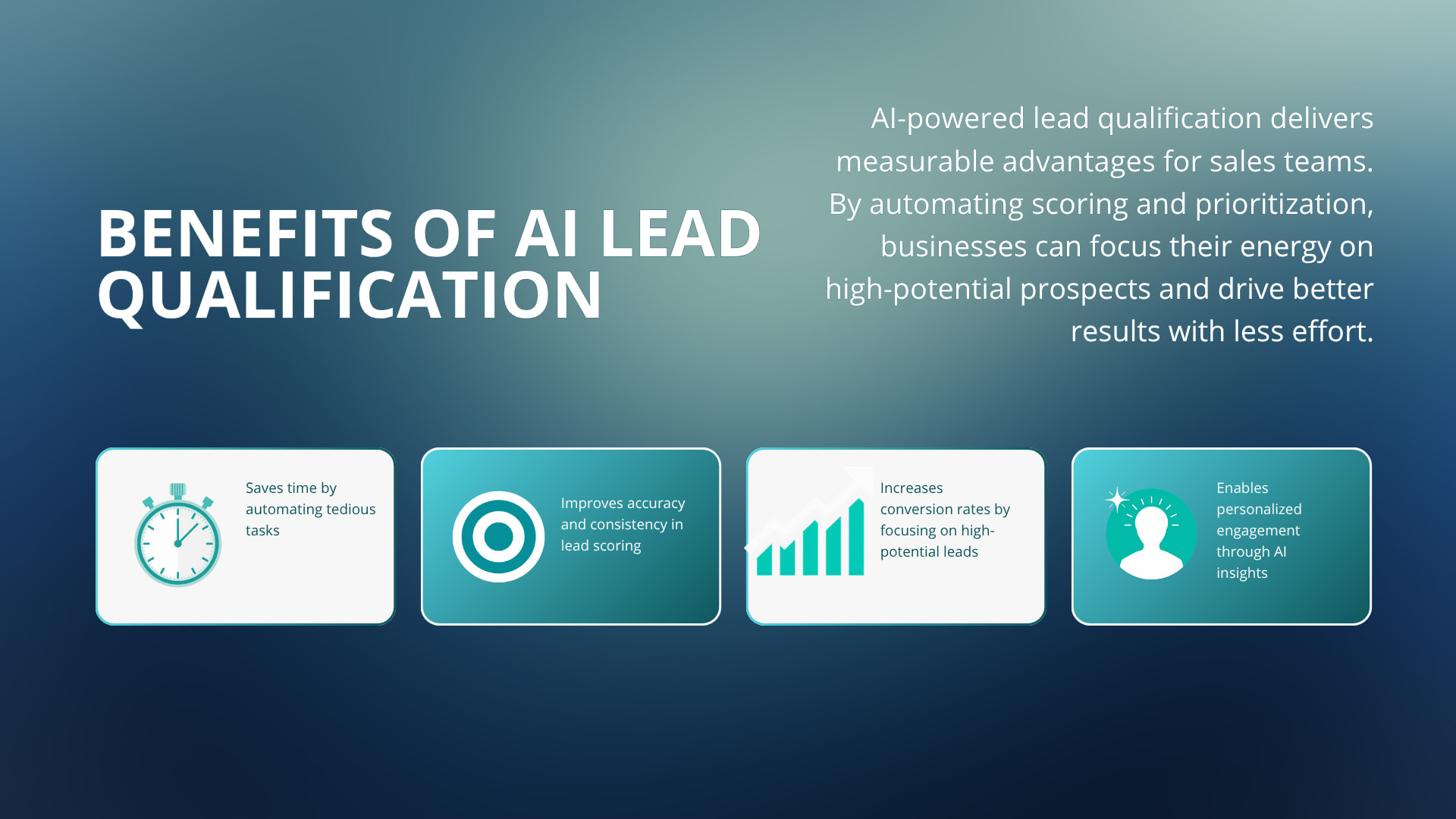
AI sales automation improves lead qualification and conversions by identifying high-intent prospects, responding instantly, personalizing conversations, and guiding qualified leads through the sales funnel. Instead of relying on manual follow-ups, businesses can use AI to automate repetitive tasks while enabling sales teams to focus on prospects who are most likely to convert into customers.
The sales process has changed dramatically over the past decade. Buyers now expect quick answers, personalized recommendations, and a seamless online experience. Waiting several hours for a response is often enough to lose a potential customer.
This is where AI sales automation makes a measurable difference.
Rather than replacing sales professionals, AI works alongside them by handling repetitive tasks that consume valuable time. From greeting website visitors to qualifying leads and scheduling meetings, AI becomes an always-available assistant that never misses an opportunity.
Why is speed one of the biggest advantages of AI sales automation?
Speed has become one of the most important factors in lead conversion.
When someone visits a business website, they are often researching solutions, comparing vendors, or looking for immediate answers. If they cannot find what they need quickly, they usually continue their search elsewhere.
AI eliminates delays by responding the moment a visitor arrives.
Instead of displaying a static contact form, an AI assistant can immediately begin a meaningful conversation.
For example:
A visitor lands on the pricing page of a software company at 11:45 PM.
Instead of seeing a message saying, "We'll get back to you tomorrow," the AI starts the conversation instantly.
It asks:
Which solution are you interested in?
How large is your company?
What problem are you trying to solve?
When do you plan to purchase?
Within minutes, the AI has collected enough information to determine whether the visitor is a qualified lead.
By the time the sales team starts work the next morning, the lead profile is already complete.
How does AI understand customer intent?
One of the most valuable features of modern AI is its ability to understand intent rather than simply reacting to keywords.
Traditional chatbots followed rigid scripts.
If a visitor asked an unexpected question, the conversation often ended with an unhelpful response.
Modern AI systems work differently.
They evaluate:
The visitor's questions
Conversation context
Browsing history
Previous interactions
Product interest
Overall engagement
This allows AI to recognize whether someone is:
Gathering general information
Comparing products
Looking for pricing
Ready to book a demo
Preparing to make a purchase
Understanding intent enables AI to tailor every interaction based on where the visitor is in the buying journey.
How does AI personalize every conversation?
Personalization is no longer a luxury—it is an expectation.
Customers appreciate businesses that understand their needs without requiring them to repeat the same information.
AI personalizes conversations by adapting questions based on previous responses.
For example:
A visitor says they run an eCommerce business.
Instead of asking generic questions, the AI continues with:
How many monthly website visitors do you receive?
Which eCommerce platform do you use?
Are you looking to increase sales or improve customer support?
Do you currently use live chat?
A visitor from a healthcare organization would receive an entirely different conversation.
This adaptive approach makes interactions feel more relevant and helpful.
Can AI qualify leads without sounding robotic?
Yes.
Advances in natural language processing have made AI conversations far more natural than earlier chatbot technology.
Instead of following fixed decision trees, AI can:
Understand complete sentences
Recognize different ways of asking the same question
Respond conversationally
Ask relevant follow-up questions
Clarify confusing answers
Maintain context throughout the discussion
For visitors, the experience feels similar to chatting with a knowledgeable customer service representative.
This improves engagement and increases the likelihood that visitors will complete the qualification process.
What repetitive sales tasks can AI automate?
Sales teams often spend hours every week completing repetitive administrative work.
AI can automate many of these tasks, including:
Responding to initial inquiries
Collecting contact information
Asking qualification questions
Lead scoring
Booking appointments
Sending confirmation emails
Updating CRM records
Assigning leads to sales representatives
Providing product recommendations
Answering frequently asked questions
Removing these repetitive tasks gives sales professionals more time to focus on relationship building, negotiations, and closing deals.
How does AI improve lead quality?
Many businesses generate a high volume of inquiries, but not every inquiry represents a genuine sales opportunity.
Without qualification, sales representatives often spend valuable time speaking with people who are unlikely to purchase.
AI improves lead quality by filtering prospects based on predefined business criteria.
Examples include:
Company size
Industry
Budget
Buying timeline
Product interest
Decision-making authority
Geographic location
Instead of forwarding every inquiry to sales, AI prioritizes prospects that closely match the ideal customer profile.
This results in:
Better sales efficiency
Higher close rates
Improved forecasting
More productive sales conversations
What role does AI lead scoring play in sales automation?
Lead scoring is one of the most valuable automation features available.
Rather than assigning scores manually, AI continuously evaluates visitor behavior throughout the customer journey.
Typical scoring factors include:
Number of website visits
Pages viewed
Chat engagement
Demo requests
Pricing page visits
Downloaded resources
Business size
Purchase timeline
Scores update automatically as new information becomes available.
For example:
A visitor who initially browses educational articles may receive a moderate score.
Later, after requesting a product demonstration and discussing implementation, the score increases automatically.
Sales representatives always see the most current level of buying intent.
How does AI reduce human error?
Manual lead qualification often produces inconsistent results.
Different sales representatives may evaluate the same prospect differently.
One representative might consider a lead highly qualified.
Another might reject it.
AI applies the same qualification standards to every visitor.
This consistency improves:
Lead evaluation
Sales forecasting
CRM accuracy
Team productivity
Customer experience
Businesses also reduce the risk of overlooking valuable opportunities due to human oversight.
Can AI work alongside existing CRM systems?
Yes.
Most modern AI lead qualification platforms integrate with popular CRM solutions.
Instead of requiring employees to enter information manually, AI automatically transfers collected data into the CRM.
Typical information includes:
Contact details
Conversation history
Qualification responses
Lead score
Product interests
Meeting schedules
Customer notes
This creates a complete customer profile before the sales representative makes the first call.
It also reduces duplicate work and improves data accuracy.
How does AI support businesses outside normal working hours?
Customers visit websites at all times of the day.
Many businesses, however, only operate during regular office hours.
Without AI, inquiries received overnight often remain unanswered until the next business day.
AI removes this limitation.
It can:
Welcome visitors instantly
Answer product questions
Recommend services
Capture lead information
Schedule meetings
Continue conversations across time zones
This 24/7 availability allows businesses to engage international customers and avoid losing opportunities simply because no one was available to respond.
Real business scenario: A growing SaaS company
Consider a software company receiving 250 website inquiries each week.
Before adopting AI:
Every inquiry was manually reviewed.
Sales representatives spent hours qualifying leads.
Many visitors left before receiving a response.
Low-quality leads consumed valuable sales time.
After implementing AI lead qualification:
Every visitor received an instant response.
Basic qualification happened automatically.
High-intent prospects were identified immediately.
Meetings were booked directly through the AI assistant.
Sales representatives focused only on qualified opportunities.
Within a few months, the business noticed:
Faster response times
Better-qualified leads
More productive sales meetings
Improved conversion rates
Increased customer satisfaction
While results vary between organizations, this illustrates how automation can improve efficiency without expanding the sales team.
How can an AI chatbot support business growth?
Business growth depends on consistently identifying and converting new customers.
An AI-powered chatbot contributes by:
Engaging every visitor
Reducing abandoned inquiries
Collecting valuable customer information
Qualifying prospects automatically
Routing leads to the right department
Supporting marketing campaigns
Improving customer satisfaction
Instead of acting as a simple support tool, AI becomes part of the overall revenue generation process.
Why do businesses choose YourSiteChat for AI-powered lead qualification?
Businesses looking to automate customer engagement often need more than a basic chatbot.
They require a solution that can understand visitor intent, qualify prospects, and help sales teams respond more efficiently.
YourSiteChat is designed to support this process by combining conversational AI with automated lead qualification.
With YourSiteChat, businesses can:
Engage website visitors instantly
Qualify leads through intelligent conversations
Capture customer information automatically
Answer common questions around the clock
Route qualified prospects to the right sales representative
Book meetings without manual coordination
Reduce repetitive sales tasks
Improve overall conversion opportunities
Because the platform operates continuously, businesses can continue generating qualified leads even outside standard business hours. More information is available at https://www.yoursitechat.com/.
What mistakes should businesses avoid when using AI for lead qualification?
AI is powerful, but success depends on thoughtful implementation.
Some common mistakes include:
Asking too many questions too early
Ignoring conversation analytics
Using overly generic qualification criteria
Failing to update AI based on customer feedback
Not integrating AI with CRM and sales workflows
Assuming AI eliminates the need for human sales representatives
The best results come from treating AI as a collaborative assistant rather than a replacement for human expertise.
Businesses should regularly review conversations, refine qualification rules, and ensure that AI aligns with changing customer needs.
Best practices for successful AI sales automation
Organizations that achieve the greatest success with AI often follow a few key practices:
Define an ideal customer profile before building qualification rules.
Keep conversations natural and focused on helping the visitor.
Ask only the questions needed to determine lead quality.
Integrate AI with CRM and marketing automation platforms.
Monitor conversation data and improve workflows continuously.
Allow seamless handoffs from AI to human representatives when needed.
Measure success using metrics such as response time, qualified leads, meeting bookings, and conversion rates.
When these practices are followed consistently, AI becomes a valuable contributor to long-term business growth rather than just another software tool.